
Browse by Category
Fiction
- Action & Adventure
- African American
- Anthologies
- Children's Fiction
- Classics
- Comics & Graphic Novels
- Coming of Age
- Contemporary
- Cultural & Regional
- Drama
- Erotica
- Fantasy
- General
- Historical Fiction
- Horror
- Humor & Satire
- Literary Fiction
- Mystery, Thriller & Suspense
- Poetry
- Religious & Inspirational
- Romance
- Science Fiction
- Short Stories
- War & Military
- Westerns
- Women's Fiction
- Young Adult
Non-Fiction
- Antiques & Collectibles
- Arts & Photography
- Biographies & Memoirs
- Business & Money
- Children's Non-Fiction
-
Computers & Technology
- Artificial Intelligence
- Computer Science
- Cybersecurity & Cryptography
- Data Science & Analytics
- Databases & Big Data
- Game Development & Design
- General
- Hardware & DIY
- Mobile App Development
- Networking & Cloud Computing
- Operating Systems
- Programming
- Robotics
- Software
- Software Engineering
- User Experience (UX) & Design
- Web Development & Design
- Cooking, Food & Wine
- Crafts, Hobbies & Home
- Education & Teaching
- Engineering
- General
- Health, Fitness & Dieting
-
History
- African History
- African History - North Africa
- African History - Sub-Saharan Africa
- American History
- American History - 20th Century
- American History - Civil War
- American History - Colonial Period
- Ancient History
- Asian History
- Asian History - China
- Asian History - India
- Asian History - Japan
- Asian History - Southeast Asia
- European History
- European History - Ancient Greece
- European History - Ancient Rome
- European History - Medieval
- European History - Modern
- European History - Renaissance
- General
- Middle Eastern History
- Military History
- Military History - Aviation
- Military History - Naval
- Social & Cultural History
- World History
- Humor & Entertainment
- Industrial Technology
- Language Learning
- Law
- LGBTQ+ Non-Fiction
- Literary Criticism
- Medical Books
- Parenting & Relationships
- Philosophy
- Politics & Social Sciences
- Reference
- Religion & Spirituality
-
Science & Math
- Agricultural Sciences
- Astronomy & Space Science
- Behavioral Sciences
- Biological Sciences
- Botany & Plant Science
- Chemistry
- Earth Sciences
- Engineering - Chemical
- Engineering - Civil
- Engineering - Electrical
- Engineering - Mechanical
- Environment
- General
- Geology
- Mathematics
- Nature & Ecology
- Oceanography
- Paleontology
- Physics
- Statistics
- Self-Help
- Sports & Outdoors
- Study Aids
- Sustainability & Green Living
- Textbooks
- Transportation
- Travel
- True Crime
- Urban Planning & Development
- Veterinary Medicine
- Writing & Publishing
Jump to Section
MixCache.com Total Access
Unlimited reading and audiobooks for every book published by MixCache.com.
Included titles carry the MTA badge.
Learn more →
A People's History of Soviet Education
MTA
Pedagogy, Youth Organizations, and the Making of Soviet Citizens
About this book:
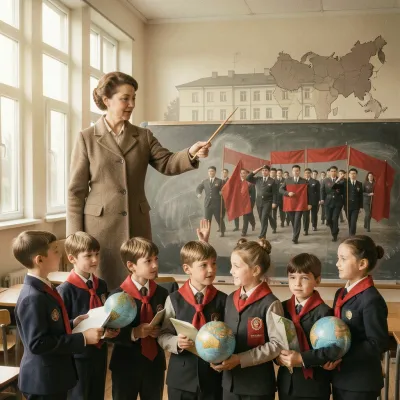
"A People's History of Soviet Education" offers a comprehensive exploration of Soviet schooling from the 1917 Revolution to the collapse of the USSR, focusing on the lived experiences of students, teachers, parents, and youth organizers. The book argues that Soviet education was fundamentally a project to refashion identities, shaping children's values, affiliations, and future aspirations beyond mere knowledge transmission. It delves into how ideological ambitions intersected with practical realities across seven decades, utilizing a rich mosaic of primary sources like memoirs, school newspapers, and teachers' journals to illuminate the "textures of everyday schooling."
The book anchors its analysis around four key themes: pedagogy, curriculum, youth organizations (Young Pioneers and Komsomol), and social mobility. It traces the evolution of teaching methods from early project-based learning and collective brigades to the rigid discipline of the Stalin era, and later the polytechnical reforms under Khrushchev and the eventual openness of Perestroika. Curriculum content, particularly in history, literature, and science, is shown to be constantly revised to align with state priorities, while also highlighting how students interpreted and sometimes resisted these narratives. The pervasive influence of youth organizations in orchestrating play, leadership, surveillance, and service is a central thread, illustrating how these groups blended voluntary enthusiasm with institutional pressure to foster political socialization.
Furthermore, the narrative consistently examines how education redistributed opportunity across class, gender, language, and regional lines. From the initial efforts to open higher education to workers and peasants through "rabfaks" to the creation of elite "internats" and Olympiads, the book reveals the inherent tension between egalitarian ideals and the selective cultivation of talent. It explores the unique challenges and adaptations of minority and borderland schools, the gendered expectations within classrooms, and the complex interplay between official ideology and the informal worlds of faith, doubt, and youth subcultures.
Ultimately, "A People's History of Soviet Education" concludes by reflecting on the "afterlives" of Soviet schooling, exploring how former pupils and educators remember their experiences and how these memories continue to shape their understanding of citizenship in the post-Soviet era. The book emphasizes that despite constant change and internal contradictions, the core conviction that schools should produce not just literate workers but specific kinds of "cooperative, loyal, cultured, and technically capable" people remained a defining aspiration, profoundly impacting millions of lives and leaving an indelible mark on Soviet society.
What You'll Find Inside:
- The book presents a people's history of Soviet education focusing on lived experiences through the perspectives of pupils, teachers, parents, and youth organizers, moving beyond official decrees to show daily classroom realities.
- It traces seven decades of educational evolution from revolutionary experiments and 1920s innovations through Stalinist standardization, wartime adaptations, postwar normalcy, Khrushchev's reforms, Brezhnev-era stagnation, and perestroika changes.
- Four core themes structure the analysis: pedagogy (teaching methods like project brigades), curriculum content and its ideological shaping, youth organizations (Pioneers and Komsomol) as vehicles of political socialization, and social mobility along class, gender, language, and regional lines.
- The work reveals how Soviet schooling aimed to produce specific kinds of citizens—cooperative, loyal, cultured, and technically capable—through both formal instruction and informal practices like rituals, wall newspapers, and collective labor.
- It highlights the persistent tension between ideological ideals and everyday realities, including gaps between central policies and local implementation, and between promises of equality and enduring hierarchies masked by meritocratic rhetoric.
Who's It For:
This book is written for teachers, students, and researchers seeking a vivid account of Soviet education as lived experience. Specialists will appreciate how familiar controversies about textbooks, local initiative versus central control, minority language policies, and the moral economy of grades are reconsidered through the testimonies of those who navigated the system. Non-specialists will find an accessible narrative demonstrating how everyday school elements—seating charts, lab benches, dormitory councils, children's games, and youth organization rituals—formed the fabric of Soviet citizenship formation.
Table of Contents:
- Introduction
- Chapter 1 From Empire to Revolution: Inheriting Schools, Imagining New Citizens
- Chapter 2 The Civil War Classroom: Literacy, Agitation, and Survival, 1917–1922
- Chapter 3 Building the School of the New Type: Narkompros, Experiments, and Early Pedagogies
- Chapter 4 Teaching the Collective: Project Methods, Brigades, and Everyday Practices
- Chapter 5 Language, Nation, and the Korenizatsiia Classroom
- Chapter 6 Teachers as State Servants and Local Neighbors
- Chapter 7 The Young Pioneers: Ritual, Play, and Political Socialization
- Chapter 8 Komsomol Paths to Adulthood: Loyalty, Mobility, and Dissent
- Chapter 9 Textbooks and Knowledge: Who Writes, Who Reads, Who Believes
- Chapter 10 Science for Socialism: Mathematics, Physics, and the Cult of the Engineer
- Chapter 11 History Lessons: Crafting the Past in Stalin’s Time
- Chapter 12 Work, Hand, and Head: Vocational and Factory-School Networks
- Chapter 13 Rabfaks and Red Professors: Opening the Gates of Higher Education
- Chapter 14 War Schools: Evacuation, Loss, and the Great Patriotic Classroom
- Chapter 15 Postwar Normalcy: Discipline, Merit, and the Return to Order
- Chapter 16 Khrushchev’s Reforms: Polytechnical Dreams and Rural Realities
- Chapter 17 The Hidden Curriculum: Gender, Family, and Everyday Morality
- Chapter 18 Minority and Borderland Schools: Peripheries at the Center
- Chapter 19 Special, Elite, and Gifted: Olympiads, Internats, and Selection
- Chapter 20 Arts, Sports, and the Body: Aesthetic and Physical Education
- Chapter 21 Surveillance and Self-Management: Pioneer Councils, Komsomol Bureaus, and Control
- Chapter 22 Faith, Doubt, and Informal Worlds: Religion, Subcultures, and Youth
- Chapter 23 Classrooms of Stagnation? Education under Brezhnev
- Chapter 24 Perestroika Pedagogies: Openness, Critique, and the End of a System
- Chapter 25 Afterlives: Remembering School and Rethinking Citizenship
Author:
Published By:
Date Published:
May 2, 2026
Type:
Nonfiction
Language:
English
Word Count:
70,010 words
Reading Time:
4 hours 54 minutes
Sample:
MixCache.com Total Access
Get unlimited access to this book + all books published by MixCache.com for $11.99/month
Subscribe to MTAOr purchase this book individually below
Order:
Buy the A People's History of Soviet Education ebook on MixCache.com:
Buy Now
Full ebook will be available immediately
- read online or download as a PDF file.
$5 account credit for all new MixCache.com accounts, usable toward any ebook purchase!*


Ratings & Reviews
Ask Questions About This Book
Have a question about the content? Ask our AI assistant!
Start by asking a question about "A People's History of Soviet Education"
Example: "Does this book mention William Shakespeare?"
Thinking...