
Browse by Category
Fiction
- Action & Adventure
- African American
- Anthologies
- Children's Fiction
- Classics
- Comics & Graphic Novels
- Coming of Age
- Contemporary
- Cultural & Regional
- Drama
- Erotica
- Fantasy
- General
- Historical Fiction
- Horror
- Humor & Satire
- Literary Fiction
- Mystery, Thriller & Suspense
- Poetry
- Religious & Inspirational
- Romance
- Science Fiction
- Short Stories
- War & Military
- Westerns
- Women's Fiction
- Young Adult
Non-Fiction
- Antiques & Collectibles
- Arts & Photography
- Biographies & Memoirs
- Business & Money
- Children's Non-Fiction
-
Computers & Technology
- Artificial Intelligence
- Computer Science
- Cybersecurity & Cryptography
- Data Science & Analytics
- Databases & Big Data
- Game Development & Design
- General
- Hardware & DIY
- Mobile App Development
- Networking & Cloud Computing
- Operating Systems
- Programming
- Robotics
- Software
- Software Engineering
- User Experience (UX) & Design
- Web Development & Design
- Cooking, Food & Wine
- Crafts, Hobbies & Home
- Education & Teaching
- Engineering
- General
- Health, Fitness & Dieting
-
History
- African History
- African History - North Africa
- African History - Sub-Saharan Africa
- American History
- American History - 20th Century
- American History - Civil War
- American History - Colonial Period
- Ancient History
- Asian History
- Asian History - China
- Asian History - India
- Asian History - Japan
- Asian History - Southeast Asia
- European History
- European History - Ancient Greece
- European History - Ancient Rome
- European History - Medieval
- European History - Modern
- European History - Renaissance
- General
- Middle Eastern History
- Military History
- Military History - Aviation
- Military History - Naval
- Social & Cultural History
- World History
- Humor & Entertainment
- Industrial Technology
- Language Learning
- Law
- LGBTQ+ Non-Fiction
- Literary Criticism
- Medical Books
- Parenting & Relationships
- Philosophy
- Politics & Social Sciences
- Reference
- Religion & Spirituality
-
Science & Math
- Agricultural Sciences
- Astronomy & Space Science
- Behavioral Sciences
- Biological Sciences
- Botany & Plant Science
- Chemistry
- Earth Sciences
- Engineering - Chemical
- Engineering - Civil
- Engineering - Electrical
- Engineering - Mechanical
- Environment
- General
- Geology
- Mathematics
- Nature & Ecology
- Oceanography
- Paleontology
- Physics
- Statistics
- Self-Help
- Sports & Outdoors
- Study Aids
- Sustainability & Green Living
- Textbooks
- Transportation
- Travel
- True Crime
- Urban Planning & Development
- Veterinary Medicine
- Writing & Publishing
Jump to Section
MixCache.com Total Access
Unlimited reading and audiobooks for every book published by MixCache.com.
Included titles carry the MTA badge.
Learn more →
Stalin's Shadow Cabinet
MTA
Inside Decision-Making, Purges, and Patronage in the 1930s USSR
About this book:
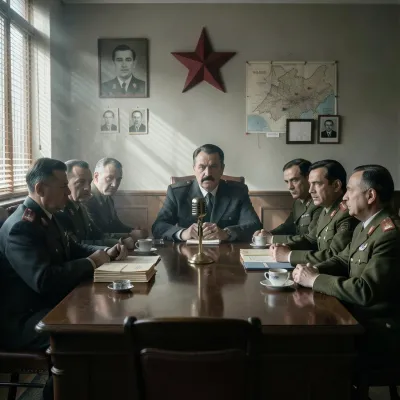
*Stalin’s Shadow Cabinet* explores the informal structures of power that governed the Soviet Union during the 1930s, arguing that the Great Purge was not merely a chaotic outburst of violence but a calculated administrative transformation. The book identifies a "shadow cabinet" composed of Stalin’s inner circle (Molotov, Kaganovich, Voroshilov), his personal secretariat, and the NKVD leadership. This core group bypassed formal institutions like the Politburo and Sovnarkom, utilizing private dacha councils, ciphered cables, and executive marginalia to convert broad political suspicions into concrete quotas for arrest and execution. By reconstructing these backstage circuits, the author demonstrates how personal patronage and state terror were fused into a singular "operating system" of rule.
The narrative details the bureaucratic machinery used to engineer the Great Purge, specifically the development of the *nomenklatura* and the Orgburo’s personnel lists. These tools transformed appointments and removals into weapons of political hygiene, allowing the center to decapitate regional elites in Ukraine, Leningrad, and the Urals. The book examines the strategic use of "categories" (such as former kulaks or ethnic minorities) and "quotas" to industrialize repression, making mass murder a matter of routine inventory control. This administrative approach was further legitimized by public theater—such as the 1936 Constitution and various show trials—which provided a legalistic and ideological smokescreen for the systemic dismantling of the Old Bolshevik guard and the Red Army command.
A significant portion of the study focuses on the role of information and technology in maintaining control. The author highlights how the personal secretariat functioned as a gatekeeper, filtering the flow of data to Stalin and translating his terse, often informal commands into actionable policy. Communication technologies like the telegraph enabled a "compressed" geography of power, allowing the Kremlin to monitor and purge distant provinces with unprecedented speed. Meanwhile, the systematic falsification of statistics and the curation of archives ensured that the regime could maintain a narrative of progress even as the purges caused massive economic and social disruption.
Ultimately, the book argues that by 1939, the Soviet state had been permanently "rewired." The frenzy of mass operations transitioned into a more stable, selective form of repression that prioritized absolute loyalty over professional competence. This period left a lasting legacy of centralized gatekeeping, politicized personnel control, and a culture of anticipatory obedience. The shadow cabinet succeeded in creating a durable, if brittle, state apparatus where institutional routines were inextricably linked to surveillance and fear—a template of authoritarian governance that would persist long after the 1930s concluded.
What You'll Find Inside:
- How Stalin's actual governance operated through informal networks—dachas, personal secretariats, and backchannel communications—rather than formal institutions alone
- The bureaucratic mechanics of terror: how directives, arrest quotas, and social categories transformed repression into a systematic administrative process
- The evolution of the NKVD from police force to central policy arm that helped define targets, manufacture conspiracies, and execute purges
- Center-periphery dynamics showing how purges were implemented differently across Soviet republics and regions like Ukraine, Leningrad, and the Urals
- The enduring legacy of the Great Purge: how terror became embedded in Soviet governance through nomenklatura systems, surveillance practices, and a culture of political vigilance
Who's It For:
This book is essential reading for historians and political scientists specializing in Soviet history, Stalinism, or comparative authoritarianism. It will particularly benefit graduate students and researchers interested in the informal mechanics of dictatorship, the interplay between terror and bureaucracy, and how personal networks shape state power. Readers seeking to understand how administrative systems can be repurposed for repression will find valuable insights applicable beyond the Soviet context.
Table of Contents:
- Introduction
- Chapter 1 The Machinery of Power: Formal Offices, Informal Rule
- Chapter 2 Stalin’s Inner Circle: From Politburo to Dacha Councils
- Chapter 3 The Personal Secretariat: Gatekeeping and Paper Flows
- Chapter 4 Orgburo and Nomenklatura: Engineering the Cadre State
- Chapter 5 Patrons, Clients, and Clans: Mapping Networks, 1928–1936
- Chapter 6 Kirov’s Murder and the Politics of Fear
- Chapter 7 Designing Terror: Directives, Quotas, and Categories
- Chapter 8 The NKVD as Policy Arm: From Yagoda to Yezhov
- Chapter 9 Troikas and Extraordinary Justice
- Chapter 10 Show Trials and Public Theater
- Chapter 11 Purging the Provinces: Center–Periphery Dynamics
- Chapter 12 Industrial Bosses under Watch: Factories, Plans, and Security
- Chapter 13 The Military Purge: Command, Doctrine, and Dissent
- Chapter 14 Ethnicity and the “National Operations”
- Chapter 15 Governing by Lists: Appointments, Removals, and Rewards
- Chapter 16 Communication Technologies: Ciphered Cables, Marginalia, and Silence
- Chapter 17 Institutions under Stress: Sovnarkom, Gosplan, and the Commissariats
- Chapter 18 Women in the Shadow Cabinet: Secretaries, Wives, and Intermediaries
- Chapter 19 Case Files in Patronage: Kaganovich, Molotov, and the Yezhovshchina
- Chapter 20 Republics and Regions: Ukraine, Leningrad, and the Urals
- Chapter 21 The 1936 Constitution: Law as Instrument
- Chapter 22 Knowledge and Secrecy: Archives, Statistics, and Falsification
- Chapter 23 International Dimensions: Comintern, Espionage, and Security
- Chapter 24 The Turn to 1939: From Mass Operations to Selective Repression
- Chapter 25 Legacies of the Great Purge: A Rewired Soviet State
Author:
Published By:
Date Published:
May 2, 2026
Type:
Nonfiction
Language:
English
Word Count:
68,045 words
Reading Time:
4 hours 46 minutes
Sample:
MixCache.com Total Access
Get unlimited access to this book + all books published by MixCache.com for $11.99/month
Subscribe to MTAOr purchase this book individually below
Order:
Buy the Stalin's Shadow Cabinet ebook on MixCache.com:
Buy Now
Full ebook will be available immediately
- read online or download as a PDF file.
$5 account credit for all new MixCache.com accounts, usable toward any ebook purchase!*




Ratings & Reviews
Ask Questions About This Book
Have a question about the content? Ask our AI assistant!
Start by asking a question about "Stalin's Shadow Cabinet"
Example: "Does this book mention William Shakespeare?"
Thinking...