
Browse by Category
Fiction
- Action & Adventure
- African American
- Anthologies
- Children's Fiction
- Classics
- Comics & Graphic Novels
- Coming of Age
- Contemporary
- Cultural & Regional
- Drama
- Erotica
- Fantasy
- General
- Historical Fiction
- Horror
- Humor & Satire
- Literary Fiction
- Mystery, Thriller & Suspense
- Poetry
- Religious & Inspirational
- Romance
- Science Fiction
- Short Stories
- War & Military
- Westerns
- Women's Fiction
- Young Adult
Non-Fiction
- Antiques & Collectibles
- Arts & Photography
- Biographies & Memoirs
- Business & Money
- Children's Non-Fiction
-
Computers & Technology
- Artificial Intelligence
- Computer Science
- Cybersecurity & Cryptography
- Data Science & Analytics
- Databases & Big Data
- Game Development & Design
- General
- Hardware & DIY
- Mobile App Development
- Networking & Cloud Computing
- Operating Systems
- Programming
- Robotics
- Software
- Software Engineering
- User Experience (UX) & Design
- Web Development & Design
- Cooking, Food & Wine
- Crafts, Hobbies & Home
- Education & Teaching
- Engineering
- General
- Health, Fitness & Dieting
-
History
- African History
- African History - North Africa
- African History - Sub-Saharan Africa
- American History
- American History - 20th Century
- American History - Civil War
- American History - Colonial Period
- Ancient History
- Asian History
- Asian History - China
- Asian History - India
- Asian History - Japan
- Asian History - Southeast Asia
- European History
- European History - Ancient Greece
- European History - Ancient Rome
- European History - Medieval
- European History - Modern
- European History - Renaissance
- General
- Middle Eastern History
- Military History
- Military History - Aviation
- Military History - Naval
- Social & Cultural History
- World History
- Humor & Entertainment
- Industrial Technology
- Language Learning
- Law
- LGBTQ+ Non-Fiction
- Literary Criticism
- Medical Books
- Parenting & Relationships
- Philosophy
- Politics & Social Sciences
- Reference
- Religion & Spirituality
-
Science & Math
- Agricultural Sciences
- Astronomy & Space Science
- Behavioral Sciences
- Biological Sciences
- Botany & Plant Science
- Chemistry
- Earth Sciences
- Engineering - Chemical
- Engineering - Civil
- Engineering - Electrical
- Engineering - Mechanical
- Environment
- General
- Geology
- Mathematics
- Nature & Ecology
- Oceanography
- Paleontology
- Physics
- Statistics
- Self-Help
- Sports & Outdoors
- Study Aids
- Sustainability & Green Living
- Textbooks
- Transportation
- Travel
- True Crime
- Urban Planning & Development
- Veterinary Medicine
- Writing & Publishing
Jump to Section
MixCache.com Total Access
Unlimited reading and audiobooks for every book published by MixCache.com.
Included titles carry the MTA badge.
Learn more →
Warlords and Reformers: China between Empire and Republic
MTA
Politics, social upheaval, and reform from the 1911 revolution to 1949
About this book:
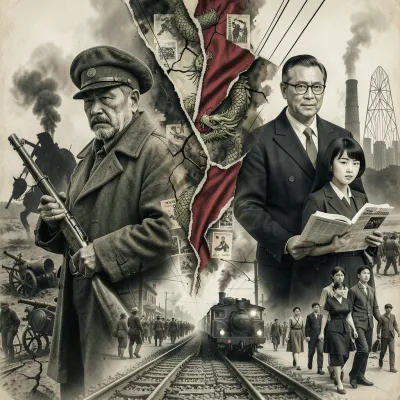
*Warlords and Reformers: China between Empire and Republic* provides a comprehensive historical analysis of China’s tumultuous transition from the collapse of the Qing Dynasty in 1911 to the establishment of the People's Republic in 1949. The book challenges the traditional view of the "warlord era" as mere anarchy, arguing instead that this period was a complex laboratory of state-building where military strongmen and social reformers often worked in parallel to define modern Chinese governance. By examining the interplay between fragmented military authority and creative grassroots reform, the text illustrates how competing visions of modernity were tested across cities, villages, and borderlands.
The narrative moves through the fragile institutional experiments of the early Republic, the centralized but monarchical ambitions of Yuan Shikai, and the subsequent descent into regional militarism. It highlights how financial necessity drove warlords to modernize tax systems, infrastructure, and policing, while intellectual movements like the New Culture and May Fourth movements redefined the cultural and political consciousness of the urban public. These decades were characterized by a "semi-colonial" economic reality, where treaty ports served as both symbols of national humiliation and engines of technological and administrative innovation.
Central to the book is the rise of the Nationalist and Communist parties, exploring their uneasy alliance during the First United Front and the subsequent violent fracturing of their relationship in 1927. The authors contrast the "Nanjing Decade" of Nationalist statecraft—marked by bureaucratic professionalization and top-down moral campaigns—with the Communist experiment in Yan’an, which focused on rural mobilization and land reform. These internal struggles were exacerbated by escalating Japanese aggression, leading to a total war that devastated the traditional social fabric but accelerated the development of mass mobilization techniques.
Ultimately, the book frames the 1949 Communist victory not as a sudden break, but as the culmination of four decades of cumulative institutional and social change. The costs of state failure—including hyperinflation, famine, and systemic corruption under the Nationalists—are positioned as the decisive factors that cleared the way for a new revolutionary order. By the end of the period, the "republic" had been transformed from a loose collection of idealistic parliamentary experiments into a disciplined, centralized state capable of mobilizing a vast, exhausted, and aspirational population.
What You'll Find Inside:
- The book reveals how China's transition from empire to republic involved competing visions of modernity, military strongmen, and grassroots reform efforts rather than a linear progression from 1911 to 1949.
- It examines the warlord era not as mere chaos but as a period of state-making experimentation where new taxes, schools, and infrastructure were tested alongside predatory practices like opium monopolies.
- It traces how intellectual movements like the New Culture Movement and May Fourth activism reshaped Chinese ideas about citizenship, science, and democracy through student protests, cultural critique, and urban mobilization.
- It analyzes the complex Nationalist-Communist relationship, from their initial United Front and Northern Expedition cooperation to the 1927 Shanghai purge and eventual civil war that determined China's fate.
- It demonstrates how the republic's legitimacy was constantly challenged by fiscal crises, foreign entanglements, and the tension between reform ideals and coercive governance practices across cities, villages, and borderlands.
Who's It For:
This book is ideal for university students and scholars of modern Chinese history seeking a nuanced understanding of the revolutionary period between 1911 and 1949. It will particularly benefit readers interested in the interplay between warlord politics, social reform movements, foreign influence, and the origins of the People's Republic. General readers with a strong interest in 20th-century revolutions, state-building processes, or Chinese modernization will also find valuable insights into how competing visions of modernity shaped China's turbulent path from empire to revolution.
Table of Contents:
- Introduction
- Chapter 1 The Fall of the Qing and the 1911 Revolution
- Chapter 2 Inventing a Republic: Ideals, Constitutions, and Fragile Institutions
- Chapter 3 Yuan Shikai and the Perils of Presidential Monarchy
- Chapter 4 A Country of Commanders: Mapping the Warlord Order
- Chapter 5 Guns, Grain, and Silver: Financing Armies and States
- Chapter 6 Treaty Ports and Foreign Leverage in a Semi-Colonial Economy
- Chapter 7 The New Culture Movement and Competing Visions of Modernity
- Chapter 8 May Fourth: Students, Science, and the Politics of Protest
- Chapter 9 Factories, Unions, and Urban Publics
- Chapter 10 Village Worlds: Land, Tenancy, and Local Power
- Chapter 11 Rural Reconstruction and Cooperative Experiments
- Chapter 12 Parties and Platforms: Nationalists, Communists, and Other Currents
- Chapter 13 The First United Front and Mass Mobilization
- Chapter 14 The Northern Expedition and the Uncertain End of Warlordism
- Chapter 15 Shanghai 1927: Purge, Terror, and the Fracturing of Alliances
- Chapter 16 Governing from Nanjing: Statecraft in the Nanjing Decade
- Chapter 17 Law, Policing, and the Everyday State
- Chapter 18 Culture Wars: The New Life Movement, Spiritual Currents, and Media
- Chapter 19 Borderlands and Minorities in a Fracturing Republic
- Chapter 20 Japan’s Shadow: From the Twenty-One Demands to Expanding Aggression
- Chapter 21 Total War and Society, 1937–1945
- Chapter 22 Bases and Blueprints: The Communist Experiment in Yan’an
- Chapter 23 Hyperinflation, Famine, and Dislocation: The Costs of State Failure
- Chapter 24 Civil War, 1946–1949: Military Campaigns and Political Choices
- Chapter 25 Revolutions Realized? Legacies of 1911–1949
Author:
Published By:
Date Published:
May 4, 2026
Type:
Nonfiction
Language:
English
Word Count:
67,008 words
Reading Time:
4 hours 42 minutes
Sample:
MixCache.com Total Access
Get unlimited access to this book + all books published by MixCache.com for $11.99/month
Subscribe to MTAOr purchase this book individually below
Order:
Buy the Warlords and Reformers: China between Empire and Republic ebook on MixCache.com:
Buy Now
Full ebook will be available immediately
- read online or download as a PDF file.
$5 account credit for all new MixCache.com accounts, usable toward any ebook purchase!*



Ratings & Reviews
Ask Questions About This Book
Have a question about the content? Ask our AI assistant!
Start by asking a question about "Warlords and Reformers: China between Empire and Republic"
Example: "Does this book mention William Shakespeare?"
Thinking...