Browse by Category
Fiction
- Action & Adventure
- African American
- Anthologies
- Children's Fiction
- Classics
- Comics & Graphic Novels
- Coming of Age
- Contemporary
- Cultural & Regional
- Drama
- Erotica
- Family Life
- Fantasy
- General
- Historical Fiction
- Horror
- Humor & Satire
- Literary Fiction
- Mystery, Thriller & Suspense
- Poetry
- Religious & Inspirational
- Romance
- Science Fiction
- Short Stories
- War & Military
- Westerns
- Women's Fiction
- Young Adult
Non-Fiction
- Antiques & Collectibles
- Arts & Photography
- Biographies & Memoirs
- Business & Money
- Children's Non-Fiction
-
Computers & Technology
- Artificial Intelligence
- Computer Science
- Cybersecurity & Cryptography
- Data Science & Analytics
- Databases & Big Data
- Game Development & Design
- General
- Hardware & DIY
- Mobile App Development
- Networking & Cloud Computing
- Operating Systems
- Programming
- Robotics
- Software
- Software Engineering
- User Experience (UX) & Design
- Web Development & Design
- Cooking, Food & Wine
- Crafts, Hobbies & Home
- Education & Teaching
- Engineering
- General
- Health, Fitness & Dieting
-
History
- African History
- African History - North Africa
- African History - Sub-Saharan Africa
- American History
- American History - 20th Century
- American History - Civil War
- American History - Colonial Period
- Ancient History
- Asian History
- Asian History - China
- Asian History - India
- Asian History - Japan
- Asian History - Southeast Asia
- European History
- European History - Ancient Greece
- European History - Ancient Rome
- European History - Medieval
- European History - Modern
- European History - Renaissance
- General
- Middle Eastern History
- Military History
- Military History - Aviation
- Military History - Naval
- Social & Cultural History
- World History
- Humor & Entertainment
- Industrial Technology
- Language Learning
- Law
- LGBTQ+ Non-Fiction
- Literary Criticism
- Medical Books
- Parenting & Relationships
- Philosophy
- Politics & Social Sciences
- Reference
- Religion & Spirituality
-
Science & Math
- Agricultural Sciences
- Astronomy & Space Science
- Behavioral Sciences
- Biological Sciences
- Botany & Plant Science
- Chemistry
- Earth Sciences
- Engineering - Chemical
- Engineering - Civil
- Engineering - Electrical
- Engineering - Mechanical
- Environment
- General
- Geology
- Mathematics
- Nature & Ecology
- Oceanography
- Paleontology
- Physics
- Statistics
- Self-Help
- Sports & Outdoors
- Study Aids
- Sustainability & Green Living
- Textbooks
- Transportation
- Travel
- True Crime
- Urban Planning & Development
- Veterinary Medicine
- Writing & Publishing
Jump to Section
MixCache.com Total Access
Unlimited reading and audiobooks for every book published by MixCache.com.
Included titles carry the MTA badge.
Learn more →
The Coming of the Saint
A Maltese Novel
About this book:
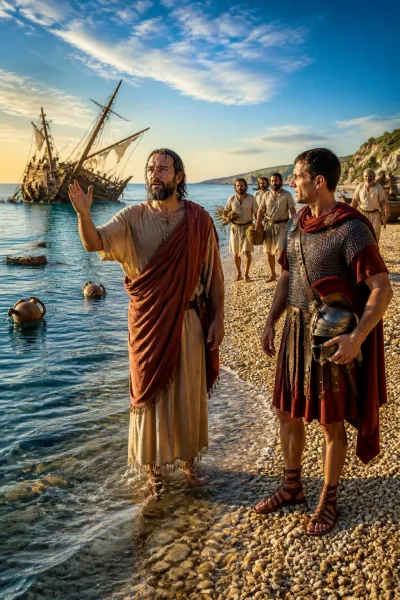
Step onto the storm-lashed decks of an Alexandrian grain ship fighting the Euroclydon, a northeast gale that tears across the Mediterranean for fourteen blind nights. You will feel the cedar hull shudder as three hundred tons of wheat shift in the hold, taste the salt spray that freezes on wool tunics, and hear the centurion's orders cut through the roar as two hundred seventy-six souls — soldiers, sailors, prisoners, and a Jewish tentmaker named Paul — fight to keep the ship intact. The novel places you in the grip of a historical tempest described in Acts 27, but rendered with the visceral immediacy of a sailor's log: the snap of rigging, the boil of the sea, the desperate calculus of anchors and frapping cables, and the quiet moment when a prisoner's voice steadies a panicked crew.
When the ship breaks on a hidden clay bar off the northern shore of Melite, you will climb ashore with the survivors onto limestone pebbles where Maltese fishermen have watched the sea for generations. The island lives in its details: the scent of wild thyme on terraced hills, the taste of boiled chickpeas and salted mackerel from cracked bowls, the sound of Punic bargaining in harbor lanes, the weight of olive-wood shutters against winter wind. You will walk the five-mile gorge to the walled town of Melita, sit in the magistrate's courtyard where a dying old man is restored, and witness how a community that calls itself *barbari* — because their Phoenician tongue sounds like gargling pebbles to Roman ears — opens its storehouses, its hearths, and its skepticism to strangers cast up by the storm.
Through the long winter rain, you will watch the island change. A viper shakes from a bundle of kindling into fire without harming the hand that held it. A potter walks without his crutch for the first time in ten years. A child's rattling cough clears in a single breath. Town elders who once argued alum tariffs now sit shoulder to shoulder beside the brazier, listening to a chained man speak of a God who pays debts instead of collecting them. The priest of the southern sanctuary rides up the ridge to negotiate, the weavers' guild sends cloaks without haggling, and a Dalmatian sergeant who once drew steel on prisoners finds himself sharing turnips with them. Nothing is simple, and no conversion is tidy — old habits die hard under limestone, and the painted snakes on boat prows remain even as the islanders question what they truly trust.
You will experience the Mediterranean world at street level: the Greek freedman who manages a magistrate's ledgers with fastidious Corinthian precision, the Alexandrian merchant who counts barley shrinkage to the ounce while his ship rots on a reef, the Roman centurion who carries Mars on his standard yet finds himself guarding a prisoner who lives freer than any senator. The novel does not flatten its characters into types — each carries wounds, prejudices, and quiet loyalties that collide and sometimes align in the close quarters of a winter quarters. Even the landscape becomes a character: the limestone that holds cistern water and breaks plowshares, the currents that meet at the bay mouth, the almond trees that bloom pink from rock crevices in February, promising fruit their roots may never reach.
When the west wind finally rises in March and the *Twin Brothers* spreads her sail for Syracuse and Rome, you will understand what it means to leave a place that has marked you. The Maltese fishermen push off in their patched skiff with fresh cedar ribs from the wreck, the centurion writes a dispatch that will reach the Praetorian Camp, and Paul adjusts his wool pack, the smooth iron cuff still on his wrist, stepping onto the Appian Way toward a court where Nero's moods shift like the sirocco. The story does not end with arrival — it ends with the road opening, and the certainty that what took root in rocky soil between November and March will outlast the voyage, the trial, and the empire that demanded it.
Table of Contents:
- Chapter 1 Shadows Over Melite
- Chapter 2 The Gathering Tempest
- Chapter 3 Fury of the Euroclydon
- Chapter 4 Broken Upon the Reef
- Chapter 5 Strangers on the Shore
- Chapter 6 The Kindling of the Fire
- Chapter 7 Venom in the Flames
- Chapter 8 A Murderer or a God
- Chapter 9 The House of Publius
- Chapter 10 Fever in the Villa
- Chapter 11 The Laying On of Hands
- Chapter 12 Whispers Through the Limestone Hills
- Chapter 13 The Gathering of the Afflicted
- Chapter 14 Old Gods and New Light
- Chapter 15 Chains of Iron, Words of Grace
- Chapter 16 The Long Winter Rain
- Chapter 17 Seeds in Rocky Soil
- Chapter 18 The Centurion's Counsel
- Chapter 19 Under the Sign of the Twin Brothers
- Chapter 20 Dawn Over the Harbor
Author:
Published By:
Date Published:
November 15, 2026
Type:
Fiction
Language:
English
Word Count:
89,182 words
Reading Time:
6 hours 15 minutes
Sample:
Order:
Order The Coming of the Saint (Paperback) on MixCache.com:
Buy NowPrint copy is made to order and ships worldwide. Includes the ebook free, ready to read instantly.
$5 account credit for all new MixCache.com accounts, usable toward any ebook purchase!*