
Browse by Category
Fiction
- Action & Adventure
- African American
- Anthologies
- Children's Fiction
- Classics
- Comics & Graphic Novels
- Coming of Age
- Contemporary
- Cultural & Regional
- Drama
- Erotica
- Fantasy
- General
- Historical Fiction
- Horror
- Humor & Satire
- Literary Fiction
- Mystery, Thriller & Suspense
- Poetry
- Religious & Inspirational
- Romance
- Science Fiction
- Short Stories
- War & Military
- Westerns
- Women's Fiction
- Young Adult
Non-Fiction
- Antiques & Collectibles
- Arts & Photography
- Biographies & Memoirs
- Business & Money
- Children's Non-Fiction
-
Computers & Technology
- Artificial Intelligence
- Computer Science
- Cybersecurity & Cryptography
- Data Science & Analytics
- Databases & Big Data
- Game Development & Design
- General
- Hardware & DIY
- Mobile App Development
- Networking & Cloud Computing
- Operating Systems
- Programming
- Robotics
- Software
- Software Engineering
- User Experience (UX) & Design
- Web Development & Design
- Cooking, Food & Wine
- Crafts, Hobbies & Home
- Education & Teaching
- Engineering
- General
- Health, Fitness & Dieting
-
History
- African History
- African History - North Africa
- African History - Sub-Saharan Africa
- American History
- American History - 20th Century
- American History - Civil War
- American History - Colonial Period
- Ancient History
- Asian History
- Asian History - China
- Asian History - India
- Asian History - Japan
- Asian History - Southeast Asia
- European History
- European History - Ancient Greece
- European History - Ancient Rome
- European History - Medieval
- European History - Modern
- European History - Renaissance
- General
- Middle Eastern History
- Military History
- Military History - Aviation
- Military History - Naval
- Social & Cultural History
- World History
- Humor & Entertainment
- Industrial Technology
- Language Learning
- Law
- LGBTQ+ Non-Fiction
- Literary Criticism
- Medical Books
- Parenting & Relationships
- Philosophy
- Politics & Social Sciences
- Reference
- Religion & Spirituality
-
Science & Math
- Agricultural Sciences
- Astronomy & Space Science
- Behavioral Sciences
- Biological Sciences
- Botany & Plant Science
- Chemistry
- Earth Sciences
- Engineering - Chemical
- Engineering - Civil
- Engineering - Electrical
- Engineering - Mechanical
- Environment
- General
- Geology
- Mathematics
- Nature & Ecology
- Oceanography
- Paleontology
- Physics
- Statistics
- Self-Help
- Sports & Outdoors
- Study Aids
- Sustainability & Green Living
- Textbooks
- Transportation
- Travel
- True Crime
- Urban Planning & Development
- Veterinary Medicine
- Writing & Publishing
Jump to Section
MixCache.com Total Access
Unlimited reading and audiobooks for every book published by MixCache.com.
Included titles carry the MTA badge.
Learn more →
The Architect of Persepolis
MTA
Designing a ceremonial capital amid imperial politics and monumental engineering in the Achaemenid Empire
About this book:
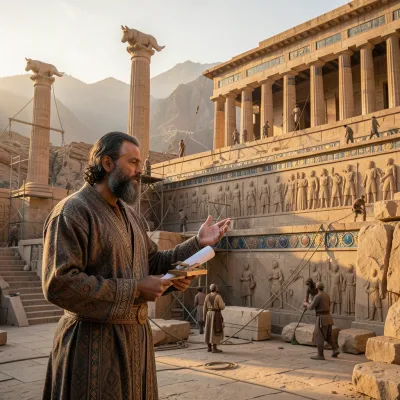
"The Architect of Persepolis" chronicles the arduous and politically charged construction of Darius the Great’s ceremonial capital, Persepolis, seen through the eyes of its chief architect. From the initial survey of the challenging Rahmat ridge, the narrative unfolds as a constant negotiation between imperial ambition, monumental engineering, and the unforgiving realities of geology, logistics, and human nature. The architect grapples with an uneven foundation, unexpected springs, and the necessity of adapting designs to the earth's temperament, learning that true building requires surrendering to the material as much as commanding it.
The project is continually beset by political intrigue and resource scarcity. Satraps compete for influence by controlling timber supplies, the chancellery attempts to impose austerity measures, and the King's own brother questions the architect's methods. The architect navigates these challenges through cunning compromises, like orchestrating a timber competition to secure crucial cedar beams or repurposing quarry waste into a ceremonial road. He relies heavily on a dedicated team including the meticulous surveyor Kuk-Sin, the gifted draftsman Tanahati, and the formidable chief disbursement officer Irdabama, whose mastery of imperial accounts becomes a crucial defense against bureaucratic challenges.
As the palace slowly takes shape—with its towering columns, intricate relief carvings, and vast audience halls—the architect faces a seemingly impossible deadline: to have the Apadana ready for the Nowruz festival, and later, to complete the entire capital within a year to project an image of imperial strength amidst rising unrest in the eastern provinces. Through a combination of architectural ingenuity, strategic deception, and sheer force of will, the team manages to create a semblance of completion, even as the building's hidden flaws and ongoing challenges underscore the immense human and material cost. The narrative culminates with a dramatic winter storm that tests the building's integrity, proving that its true strength lies not in perfection, but in its tenacious ability to endure.
Ultimately, the book reveals Persepolis as more than just a grand edifice; it is a living entity, constantly shaped by the earth, the elements, and the complex web of human decisions. The architect learns that the truest measure of a building lies in its capacity to stand against adversity, and to teach those who interact with it about permanence, compromise, and the indelible truths etched into both stone and human endeavor. The palace becomes a testament to an empire's will, forged through tireless labor, political maneuvering, and a deep respect for the materials and people that bring such a colossal vision to life.
Table of Contents:
- Introduction
- Chapter 1 The Surveyor’s Line
- Chapter 2 A Map of Terraces
- Chapter 3 The King’s Commission
- Chapter 4 Stone Cut to Meet the Sky
- Chapter 5 Satraps at Cross Purposes
- Chapter 6 Cedar over Desert Roads
- Chapter 7 The Foundation Rite
- Chapter 8 Couriers, Seals, and Contracts
- Chapter 9 Columns of Dream and Debt
- Chapter 10 The Relief Carvers’ Oath
- Chapter 11 Winter at Pasargadae
- Chapter 12 Measures and Misgivings
- Chapter 13 Nowruz on the Half-Built Stair
- Chapter 14 Fire, Plumb, and Shadow
- Chapter 15 The Queen’s Garden
- Chapter 16 The Treasury Tablets
- Chapter 17 Dust of a Thousand Sandals
- Chapter 18 The Architect’s Ledger
- Chapter 19 Storm over the Apadana
- Chapter 20 The King’s Brother
- Chapter 21 Rumor from the Eastern March
- Chapter 22 A Stairway for the World
- Chapter 23 The Satrap’s Gambit
- Chapter 24 Night of Lamps and Lintels
- Chapter 25 The Seal in Wet Clay
Author:
Published By:
Date Published:
May 11, 2026
Type:
Fiction
Language:
English
Word Count:
82,544 words
Reading Time:
5 hours 47 minutes
Sample:
MixCache.com Total Access
Get unlimited access to this book + all books published by MixCache.com for $11.99/month
Subscribe to MTAOr purchase this book individually below
Order:
Buy the The Architect of Persepolis ebook on MixCache.com:
Buy Now
Full ebook will be available immediately
- read online or download as a PDF file.
$5 account credit for all new MixCache.com accounts, usable toward any ebook purchase!*




Ratings & Reviews
Ask Questions About This Book
Have a question about the content? Ask our AI assistant!
Start by asking a question about "The Architect of Persepolis"
Example: "Does this book mention William Shakespeare?"
Thinking...