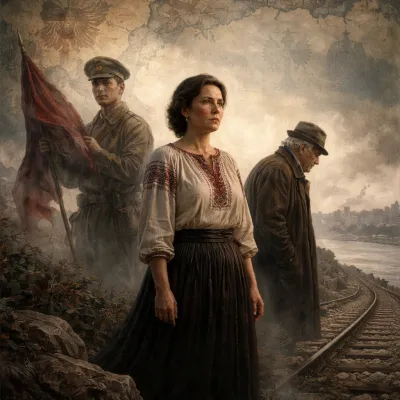
Greece's Modern Transformation
MTA
From Ottoman Rule to Eurozone Membership
About this book:

Greece’s modern transformation began with the decline of the Byzantine Empire and centuries of Ottoman rule, during which the Greek Orthodox Church preserved language and identity while the Phanariotes and klephts kept alive a spirit of resistance. The Enlightenment’s ideas, spread by the diaspora and secret societies like the Filiki Eteria, ignited the War of Independence in 1821. After years of fighting, internal divisions, and foreign intervention—culminating in the Battle of Navarino and the Russo‑Turkish War—Greece was recognized as an independent kingdom in 1830 under the Bavarian Prince Otto. Early state‑building efforts faced economic ruin, political factionalism, and the lingering “Megali Idea” (the vision of uniting all Greek‑speaking lands), which would shape Greek foreign policy for generations.
The Megali Idea drove territorial expansion through the Balkan Wars (1912‑1913), which doubled Greece’s size, but also sowed rivalry with Bulgaria and set the stage for the National Schism of World War I, when Venizelos’s pro‑Allied stance clashed with King Constantine’s neutrality, tearing the nation apart. Greece’s postwar gains—including the occupation of Smyrna—collapsed in the Asia Minor Catastrophe of 1922, prompting a massive population exchange with Turkey and ending the dream of a Greater Greece. The interwar period was marked by political instability, a short‑lived republic, and the rise of Ioannis Metaxas’s authoritarian 4th of August Regime, which imposed order but suppressed dissent until the outbreak of World War II.
Greece’s heroic “Ohi” to Italy in 1940 gave way to a brutal Axis occupation, famine, and a vigorous resistance movement led by EAM‑ELAS and EDES. Liberation in 1944 was followed by a savage civil war (1946‑1949) between communist‑backed forces and the British‑supported government, leaving deep scars, displacing thousands, and cementing Greece’s Western alignment through NATO membership. Post‑war reconstruction relied heavily on U.S. aid, while the Cyprus issue repeatedly strained Greco‑Turkish relations and erupted in violence, culminating in the 1974 Turkish invasion after a junta‑backed coup, which precipitated the fall of the Colonels’ dictatorship and the Metapolitefsi—a transition to democracy under Konstantinos Karamanlis, the abolition of the monarchy, and Greece’s entry into the European Economic Community in 1981.
The 1980s and 1990s saw socialist reforms under Andreas Papandreou, economic modernization, preparation for monetary union, and the adoption of the euro in 2001. Greece showcased its renewed confidence by hosting the 2004 Olympics, but structural weaknesses—high debt, tax evasion, and a bloated public sector—were masked by cheap credit. The global financial crisis exposed these flaws, triggering a sovereign debt crisis, successive bailouts, harsh austerity, and profound social unrest. Subsequent years brought a refugee influx that tested Greece’s humanitarian capacity, ongoing tensions with Turkey over Cyprus and Aegean resources, and a painful path toward recovery. By the late 2010s Greece exited its bailout programs, shifted toward liberal‑conservative reforms, and sought to redefine its identity as a resilient European nation confronting migration, regional security, and the need for sustainable growth within the EU and NATO frameworks.
What You'll Find Inside:
- The book traces Greece's arduous path from Ottoman domination through the War of Independence (1821), highlighting the role of the Klephts, Enlightenment thinkers, and the Filiki Eteria in forging a national consciousness against imperial rule.
- It examines the Megali Idea's rise and catastrophic fall—from Balkan War triumphs to the Asia Minor Catastrophe and 1923 population exchange—showing how expansionist dreams reshaped Greece's borders, society, and foreign policy for generations.
- The narrative details pivotal 20th-century crises: the National Schism during WWI, the ideological civil war (1946-1949), and the brutal Junta dictatorship (1967-1974), revealing how internal divisions repeatedly threatened Greece's democratic development.
- It chronicles Greece's democratic restoration (Metapolitefsi), integration into the European Economic Community (1981), and adoption of the Euro (2001), analyzing both the hopes for stability and the structural vulnerabilities exposed by later crises.
- The book concludes with Greece's 21st-century trials: the sovereign debt crisis, austerity-driven social unrest, migration pressures on Europe's frontier, and ongoing efforts to redefine national identity within the EU and NATO frameworks.
Who's It For:
This book is ideal for students and scholars of modern European history, political science, and international relations seeking a comprehensive understanding of Greece's turbulent journey from empire to EU member state. It will also benefit policymakers and professionals working on EU affairs, Balkan geopolitics, or economic crisis management who need historical context for contemporary challenges. General readers interested in how nationalism, foreign intervention, and economic integration shape national identity will find the narrative both accessible and profoundly informative.
Author:
Published By:
Date Published:
August 8, 2026
Type:
Nonfiction
Language:
English
Word Count:
43,091 words
Reading Time:
3 hours 1 minutes
Sample:
Order:
Click to order this paperback:
Buy NowPrint copy is made to order and ships worldwide. Includes the ebook free, ready to read instantly.
$5 account credit for all new MixCache.com accounts, usable toward any ebook purchase!*