
Browse by Category
Fiction
- Action & Adventure
- African American
- Anthologies
- Children's Fiction
- Classics
- Comics & Graphic Novels
- Coming of Age
- Contemporary
- Cultural & Regional
- Drama
- Erotica
- Fantasy
- General
- Historical Fiction
- Horror
- Humor & Satire
- Literary Fiction
- Mystery, Thriller & Suspense
- Poetry
- Religious & Inspirational
- Romance
- Science Fiction
- Short Stories
- War & Military
- Westerns
- Women's Fiction
- Young Adult
Non-Fiction
- Antiques & Collectibles
- Arts & Photography
- Biographies & Memoirs
- Business & Money
- Children's Non-Fiction
-
Computers & Technology
- Artificial Intelligence
- Computer Science
- Cybersecurity & Cryptography
- Data Science & Analytics
- Databases & Big Data
- Game Development & Design
- General
- Hardware & DIY
- Mobile App Development
- Networking & Cloud Computing
- Operating Systems
- Programming
- Robotics
- Software
- Software Engineering
- User Experience (UX) & Design
- Web Development & Design
- Cooking, Food & Wine
- Crafts, Hobbies & Home
- Education & Teaching
- Engineering
- General
- Health, Fitness & Dieting
-
History
- African History
- African History - North Africa
- African History - Sub-Saharan Africa
- American History
- American History - 20th Century
- American History - Civil War
- American History - Colonial Period
- Ancient History
- Asian History
- Asian History - China
- Asian History - India
- Asian History - Japan
- Asian History - Southeast Asia
- European History
- European History - Ancient Greece
- European History - Ancient Rome
- European History - Medieval
- European History - Modern
- European History - Renaissance
- General
- Middle Eastern History
- Military History
- Military History - Aviation
- Military History - Naval
- Social & Cultural History
- World History
- Humor & Entertainment
- Industrial Technology
- Language Learning
- Law
- LGBTQ+ Non-Fiction
- Literary Criticism
- Medical Books
- Parenting & Relationships
- Philosophy
- Politics & Social Sciences
- Reference
- Religion & Spirituality
-
Science & Math
- Agricultural Sciences
- Astronomy & Space Science
- Behavioral Sciences
- Biological Sciences
- Botany & Plant Science
- Chemistry
- Earth Sciences
- Engineering - Chemical
- Engineering - Civil
- Engineering - Electrical
- Engineering - Mechanical
- Environment
- General
- Geology
- Mathematics
- Nature & Ecology
- Oceanography
- Paleontology
- Physics
- Statistics
- Self-Help
- Sports & Outdoors
- Study Aids
- Sustainability & Green Living
- Textbooks
- Transportation
- Travel
- True Crime
- Urban Planning & Development
- Veterinary Medicine
- Writing & Publishing
Jump to Section
MixCache.com Total Access
Unlimited reading and audiobooks for every book published by MixCache.com.
Included titles carry the MTA badge.
Learn more →
Marriages of State: Dynastic Alliances and International Diplomacy
MTA
The strategic marriages that forged empires, peace treaties, and rivalries
About this book:
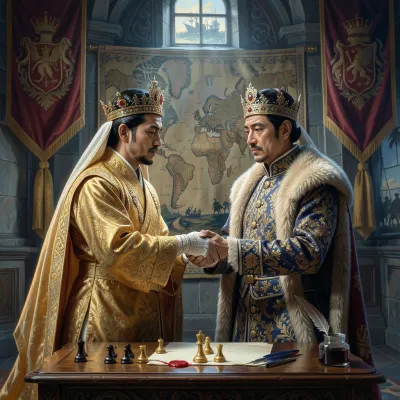
*Marriages of State: Dynastic Alliances and International Diplomacy* explores the historical role of royal unions as a primary instrument of statecraft across Europe, the Middle East, and Asia. The book argues that marriage was far more than a social ritual; it was a "treaty that ate, slept, and reproduced," functioning as a legal and financial mechanism to consolidate territory, secure peace, and project power. By examining diverse realms—including the Habsburg and Ottoman Empires, the Mughal-Rajput alliances, and the Polish-Lithuanian Commonwealth—the text illustrates how kinship served as a universal diplomatic language that turned rivals into kin and provided a credible framework for international commitments where parchment treaties often failed.
The narrative details the sophisticated "political economy" of these unions, highlighting how dowries acted as liquidity and trade concessions served as early forms of economic integration. It places significant emphasis on the agency of queens, consorts, and regents, who are portrayed not as passive pawns but as active political brokers, cultural translators, and managers of soft power. Through the use of genealogical mapping and network analysis, the book reveals how individual matches could redirect succession, reweight the continental balance of power, or bridge deep-seated religious and confessional divides, particularly in contested zones like the Caucasus and Byzantium.
Ultimately, the work traces the "long arc" from the highly personal dynastic diplomacy of the medieval and early modern periods to the emergence of the modern international order. It argues that the transition to the nation-state did not erase the logic of kinship but rather institutionalized it into modern diplomatic protocols, treaties, and the concept of a "family of nations." By bridging regional studies with thematic syntheses on gender and commerce, the book provides a comprehensive overview of how the intimate architecture of the royal household provided the foundational structure for centuries of global political history.
What You'll Find Inside:
- Marriage served as a durable diplomatic instrument that created credible commitments between dynasties, often outlasting written treaties through kinship obligations, hostage effects, and the visibility of consorts at foreign courts.
- The book employs genealogical mapping and network analysis to reveal how marital alliances shaped power structures, identified broker dynasties, and demonstrated how single marriages could redirect succession, reweight continental balances, or unlock commercial privileges.
- Dynastic marriages served multiple strategic purposes beyond territory acquisition: securing trade routes and maritime access, transmitting culture and religion, creating economic liquidity through dowries and credit arrangements, and establishing soft power networks via queenly patronage and diplomatic correspondence.
- Cross-confessional and cross-cultural marriages were strategically employed despite theological barriers, with rulers utilizing pragmatic solutions like conditional conversions, segregated worship, proxy marriages, and legal fictions to build alliances while maintaining doctrinal boundaries.
- Women emerged as active political agents rather than passive symbols, managing households as micro-embassies, negotiating dowry terms, mediating rivalries, serving as regents and patrons, and transmitting cultural, administrative, and intelligence networks across courts.
Who's It For:
This book is ideally suited for graduate students, researchers, and scholars in medieval and early modern history, international relations, diplomatic studies, and gender studies. It will particularly benefit those interested in the intersection of kinship networks, political alliance formation, and the role of women in statecraft, as well as readers seeking to understand how personal marital diplomacy shaped broader geopolitical patterns across Eurasia and beyond.
Table of Contents:
- Introduction
- Chapter 1 The Marriage as Treaty: Law, Ritual, and Political Imagination
- Chapter 2 Mapping Kinship: Methods for Genealogical Networks
- Chapter 3 Ottonians and Salians: Imperial Reach through Matrimony
- Chapter 4 Capetians and Plantagenets: Shaping France and England
- Chapter 5 The Crown of Aragon: Mediterranean Alliances and Maritime Power
- Chapter 6 Iberian Unions: Trastámara Marriages and the Catholic Monarchs
- Chapter 7 Valois vs. Burgundy: Courtship, Partition, and the European Balance
- Chapter 8 The Habsburg Grand Design: Dynastic Webs across a Continent
- Chapter 9 Tudors and Stuarts: Succession, Union, and Civil Conflict
- Chapter 10 Scandinavia and the Baltic: From Kalmar Union to Vasa Strategies
- Chapter 11 Italian Principalities: Medici, Sforza, and Papal Kinship Politics
- Chapter 12 Byzantium and Latin Christendom: Cross-Confessional Marriages
- Chapter 13 Crusader States and the Levant: Alliance, Assimilation, and Survival
- Chapter 14 The Ottoman Path to Empire: Marriage, Concubinage, and Legitimacy
- Chapter 15 Safavid Iran: Qizilbash Kinship, Marriages, and State Formation
- Chapter 16 From Timurids to Mughals: Central Asian Lineages and Indian Thrones
- Chapter 17 Mughal–Rajput Alliances: Integration, Autonomy, and Rebellion
- Chapter 18 The Shaybanid Uzbeks: Steppe Diplomacy and Urban Courts
- Chapter 19 The Caucasus as Bride Bazaar: Georgian and Circassian Connections
- Chapter 20 Muscovy to Romanov: Isolation, Selection, and Western Openings
- Chapter 21 Maritime Empires and Royal Houses: Portugal, Spain, and Overseas Claims
- Chapter 22 Dynastic Unions and Confederations: Poland–Lithuania and Beyond
- Chapter 23 Commerce, Dowries, and Credit: The Political Economy of Marriage
- Chapter 24 Gender, Agency, and Soft Power: Queens, Consorts, and Regents
- Chapter 25 The Long Arc: From Dynastic Diplomacy to Modern International Order
Author:
Published By:
Date Published:
May 2, 2026
Type:
Nonfiction
Language:
English
Word Count:
59,292 words
Reading Time:
4 hours 9 minutes
Sample:
MixCache.com Total Access
Get unlimited access to this book + all books published by MixCache.com for $11.99/month
Subscribe to MTAOr purchase this book individually below
Order:
Buy the Marriages of State: Dynastic Alliances and International Diplomacy ebook on MixCache.com:
Buy Now
Full ebook will be available immediately
- read online or download as a PDF file.
$5 account credit for all new MixCache.com accounts, usable toward any ebook purchase!*


Ratings & Reviews
Ask Questions About This Book
Have a question about the content? Ask our AI assistant!
Start by asking a question about "Marriages of State: Dynastic Alliances and International Diplomacy"
Example: "Does this book mention William Shakespeare?"
Thinking...