Browse by Category
Fiction
- Action & Adventure
- African American
- Anthologies
- Children's Fiction
- Classics
- Comics & Graphic Novels
- Coming of Age
- Contemporary
- Cultural & Regional
- Drama
- Erotica
- Fantasy
- General
- Historical Fiction
- Horror
- Humor & Satire
- Literary Fiction
- Mystery, Thriller & Suspense
- Poetry
- Religious & Inspirational
- Romance
- Science Fiction
- Short Stories
- War & Military
- Westerns
- Women's Fiction
- Young Adult
Non-Fiction
- Antiques & Collectibles
- Arts & Photography
- Biographies & Memoirs
- Business & Money
- Children's Non-Fiction
-
Computers & Technology
- Artificial Intelligence
- Computer Science
- Cybersecurity & Cryptography
- Data Science & Analytics
- Databases & Big Data
- Game Development & Design
- General
- Hardware & DIY
- Mobile App Development
- Networking & Cloud Computing
- Operating Systems
- Programming
- Robotics
- Software
- Software Engineering
- User Experience (UX) & Design
- Web Development & Design
- Cooking, Food & Wine
- Crafts, Hobbies & Home
- Education & Teaching
- Engineering
- General
- Health, Fitness & Dieting
-
History
- African History
- African History - North Africa
- African History - Sub-Saharan Africa
- American History
- American History - 20th Century
- American History - Civil War
- American History - Colonial Period
- Ancient History
- Asian History
- Asian History - China
- Asian History - India
- Asian History - Japan
- Asian History - Southeast Asia
- European History
- European History - Ancient Greece
- European History - Ancient Rome
- European History - Medieval
- European History - Modern
- European History - Renaissance
- General
- Middle Eastern History
- Military History
- Military History - Aviation
- Military History - Naval
- Social & Cultural History
- World History
- Humor & Entertainment
- Industrial Technology
- Language Learning
- Law
- LGBTQ+ Non-Fiction
- Literary Criticism
- Medical Books
- Parenting & Relationships
- Philosophy
- Politics & Social Sciences
- Reference
- Religion & Spirituality
-
Science & Math
- Agricultural Sciences
- Astronomy & Space Science
- Behavioral Sciences
- Biological Sciences
- Botany & Plant Science
- Chemistry
- Earth Sciences
- Engineering - Chemical
- Engineering - Civil
- Engineering - Electrical
- Engineering - Mechanical
- Environment
- General
- Geology
- Mathematics
- Nature & Ecology
- Oceanography
- Paleontology
- Physics
- Statistics
- Self-Help
- Sports & Outdoors
- Study Aids
- Sustainability & Green Living
- Textbooks
- Transportation
- Travel
- True Crime
- Urban Planning & Development
- Veterinary Medicine
- Writing & Publishing
Jump to Section
MixCache.com Total Access
Unlimited reading and audiobooks for every book published by MixCache.com.
Included titles carry the MTA badge.
Learn more →
Industrial Provinces: The Economic Histories of China's Regions
MTA
From artisan workshops to megafactories — provincial case studies, one province per chapter
About this book:
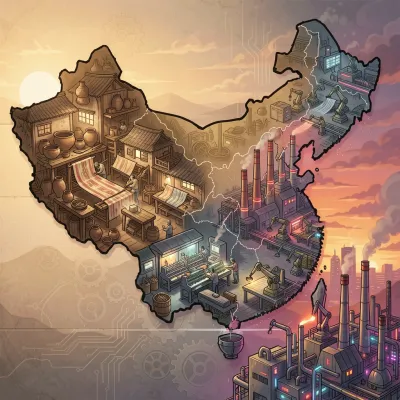
This book examines China’s provincial economic trajectories, tracing the evolution of each region from pre-industrial economies to modern megafactories. It emphasizes three key determinants of industrial development: geographic and resource endowments (such as coastal access, minerals, or agriculture), policy frameworks (including land reforms, SEZs, and environmental mandates), and external capital and market integration (through global supply chains, diaspora networks, or foreign investment). Each chapter applies a standardized analytical lens to compare historical legacies, institutional reforms, firm dynamics, infrastructure, labor migration, and environmental challenges, revealing how provinces evolved into distinct archetypes—export-driven coastal hubs, resource-processing heartlands, SOE-heavy rust belts, innovation-led city-regions, and latecomer catch-up economies.
The coastal provinces, exemplified by Guangdong, Jiangsu, and Zhejiang, illustrate diverse paths to industrialization. Guangdong’s integration into global supply chains via SEZs and foreign capital contrasts with Jiangsu’s grassroots TVE-led growth and Zhejiang’s private entrepreneurship. Inland regions like Sichuan, Henan, and Anhui showcase restructuring and upgrading strategies, leveraging resources (e.g., Sichuan’s semiconductors, Henan’s logistics hub) or transitioning from agricultural economies to advanced manufacturing. Provinces such as Shandong and Hebei remain resource-dependent but grapple with environmental and economic transitions under carbon constraints, reflecting the broader sustainability challenges of heavy industry.
Later chapters highlight unique cases where geography and policy intersect distinctively. Hainan’s transformation into a free trade port exemplifies China’s strategic experiments in economic liberalization. Qinghai’s lithium and salt lakes position it as a critical node in global supply chains for green energy. Guizhou’s leap into big data and digital infrastructure, despite its historical backwardness, underscores adaptive governance and leveraging geographic advantages. Meanwhile, frontier regions like Gansu and Yunnan demonstrate corridor economies and cross-border trade linkages, particularly through the Belt and Road Initiative and Southeast Asian connections.
The book concludes by weaving these provincial narratives into a cohesive analysis of China’s economic mosaic. It underscores how local actors—policymakers, entrepreneurs, and institutions—have shaped distinct developmental models, influenced by resource endowments, governance structures, and global integration. Recurring themes such as environmental degradation, geopolitical shifts, and labor migration highlight the interconnectedness and adaptability of these regions. Ultimately, the study reveals that China’s economic transformation is not a singular story but a collective of interlocking regional histories, each offering lessons on industrial upgrading, innovation, and sustainable development in a rapidly changing global landscape.
What You'll Find Inside:
- Each province's industrial path was shaped by the interaction of local resources, policy choices, and global capital connections
- The book identifies recurring provincial archetypes: export-driven coastal hubs, resource-processing heartlands, SOE-heavy rust belts, innovation-led city-regions, and latecomer catch-up economies
- Key determinants analyzed include factor endowments (geography, minerals, human capital), policy architectures (land-leasing regimes, SOE reforms, environmental mandates), and external capital/diasporic networks
- Cross-cutting themes like land institutions, environmental policy, and geopolitical tensions increasingly discriminate among industrial models and shape provincial trajectories
- Provincial case studies use a common analytical template (historical origins, reforms, firm demography, capital formation, infrastructure, labor, environment, capabilities) enabling systematic comparisons
Who's It For:
This book is designed for economists, policy analysts, and historians seeking to understand China's regional economic development. It will particularly benefit professionals and students interested in industrial policy, comparative economic systems, and China's provincial variations. Readers looking for actionable insights into how local factors interact with global forces to shape economic trajectories will find valuable lessons and templates for analysis.
Table of Contents:
- Introduction
- Chapter 1 Guangdong — From Artisan Workshops to World Factory in the Pearl River Delta
- Chapter 2 Jiangsu — Township-and-Village Enterprises to Advanced Manufacturing on the Yangtze
- Chapter 3 Zhejiang — Private Entrepreneurship and the Wenzhou Model’s Enduring Legacy
- Chapter 4 Shandong — Bohai Rim Heavy Industry, Petrochemicals, and Agribusiness
- Chapter 5 Shanghai — Finance, Ports, and High-End Manufacturing in a Global City-Region
- Chapter 6 Beijing — Policy, R&D, and Platform Economies in the Capital
- Chapter 7 Fujian — Cross-Strait Capital, Footwear, and Electronics along the Minnan Coast
- Chapter 8 Sichuan — Defense Legacies, Supply Chains, and Consumer Electronics in the Chengdu Plain
- Chapter 9 Henan — Scale, Logistics, and the Ascent of Central China Manufacturing
- Chapter 10 Hebei — Steel, Cement, and Environmental Upgrading under Air-Quality Mandates
- Chapter 11 Liaoning — Rust Belt Restructuring: SOEs, Shipbuilding, and Renewables
- Chapter 12 Jilin — Auto Corridors, Petrochemicals, and the Northeast Grain Base
- Chapter 13 Heilongjiang — Resources, Agriculture, and the Sino-Russian Gateway
- Chapter 14 Hubei — Wuhan’s Optics Valley and the Reconfiguration of Riverine Industry
- Chapter 15 Hunan — Machinery, Nonferrous Metals, and Private Champions
- Chapter 16 Anhui — From Rural Reform Origins to Semiconductors in the Yangtze Delta
- Chapter 17 Jiangxi — Copper, Rare Earths, and Green Transformation
- Chapter 18 Shaanxi — Aerospace, Energy, and Innovation on the Silk Road
- Chapter 19 Shanxi — Coal, Carbon Constraints, and Diversification
- Chapter 20 Gansu — Corridor Economies: Petrochemicals, Minerals, and Logistics
- Chapter 21 Qinghai — Salts, Lithium, and Plateau Industry Ecology
- Chapter 22 Yunnan — Border Trade, Hydropower, and Southeast Asian Linkages
- Chapter 23 Guizhou — Big Data Zones, Tobacco, and Latecomer Industrialization
- Chapter 24 Hainan — From Plantations to Free Trade Port
- Chapter 25 Chongqing — Inland Megafactories, Auto Clusters, and the Upper Yangtze
Author:
Published By:
Date Published:
June 12, 2026
Type:
Nonfiction
Language:
English
Word Count:
43,678 words
Reading Time:
3 hours 4 minutes
Sample:
Order:
Order Industrial Provinces: The Economic Histories of China's Regions (Paperback) on MixCache.com:
Buy NowPrint copy is made to order and ships worldwide. Includes the ebook free, ready to read instantly.
$5 account credit for all new MixCache.com accounts, usable toward any ebook purchase!*