
Browse by Category
Fiction
- Action & Adventure
- African American
- Anthologies
- Children's Fiction
- Classics
- Comics & Graphic Novels
- Coming of Age
- Contemporary
- Cultural & Regional
- Drama
- Erotica
- Fantasy
- General
- Historical Fiction
- Horror
- Humor & Satire
- Literary Fiction
- Mystery, Thriller & Suspense
- Poetry
- Religious & Inspirational
- Romance
- Science Fiction
- Short Stories
- War & Military
- Westerns
- Women's Fiction
- Young Adult
Non-Fiction
- Antiques & Collectibles
- Arts & Photography
- Biographies & Memoirs
- Business & Money
- Children's Non-Fiction
-
Computers & Technology
- Artificial Intelligence
- Computer Science
- Cybersecurity & Cryptography
- Data Science & Analytics
- Databases & Big Data
- Game Development & Design
- General
- Hardware & DIY
- Mobile App Development
- Networking & Cloud Computing
- Operating Systems
- Programming
- Robotics
- Software
- Software Engineering
- User Experience (UX) & Design
- Web Development & Design
- Cooking, Food & Wine
- Crafts, Hobbies & Home
- Education & Teaching
- Engineering
- General
- Health, Fitness & Dieting
-
History
- African History
- African History - North Africa
- African History - Sub-Saharan Africa
- American History
- American History - 20th Century
- American History - Civil War
- American History - Colonial Period
- Ancient History
- Asian History
- Asian History - China
- Asian History - India
- Asian History - Japan
- Asian History - Southeast Asia
- European History
- European History - Ancient Greece
- European History - Ancient Rome
- European History - Medieval
- European History - Modern
- European History - Renaissance
- General
- Middle Eastern History
- Military History
- Military History - Aviation
- Military History - Naval
- Social & Cultural History
- World History
- Humor & Entertainment
- Industrial Technology
- Language Learning
- Law
- LGBTQ+ Non-Fiction
- Literary Criticism
- Medical Books
- Parenting & Relationships
- Philosophy
- Politics & Social Sciences
- Reference
- Religion & Spirituality
-
Science & Math
- Agricultural Sciences
- Astronomy & Space Science
- Behavioral Sciences
- Biological Sciences
- Botany & Plant Science
- Chemistry
- Earth Sciences
- Engineering - Chemical
- Engineering - Civil
- Engineering - Electrical
- Engineering - Mechanical
- Environment
- General
- Geology
- Mathematics
- Nature & Ecology
- Oceanography
- Paleontology
- Physics
- Statistics
- Self-Help
- Sports & Outdoors
- Study Aids
- Sustainability & Green Living
- Textbooks
- Transportation
- Travel
- True Crime
- Urban Planning & Development
- Veterinary Medicine
- Writing & Publishing
Jump to Section
MixCache.com Total Access
Unlimited reading and audiobooks for every book published by MixCache.com.
Included titles carry the MTA badge.
Learn more →
Emperors and Republics: A Concise History of China
MTA
A clear chronological introduction to China's political and social evolution from antiquity to the present
About this book:
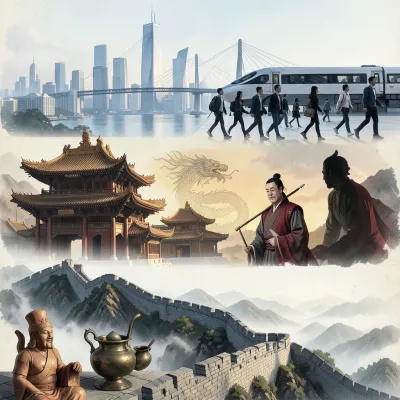
*Emperors and Republics: A Concise History of China* provides a chronological narrative of China’s political and social evolution, tracing the transition from Neolithic cultures to a sophisticated imperial system and, eventually, to modern republican and socialist forms of governance. The early chapters detail the emergence of the "imperial template" under the Qin and Han dynasties, established through bureaucratic centralization, legal standardization, and the construction of infrastructure like the Great Wall and the Grand Canal. These institutions provided a recurring framework for unity that persisted even through centuries of fragmentation, such as the Three Kingdoms and the Northern and Southern Dynasties, where cultural and religious shifts—notably the rise of Buddhism—further integrated a diverse population.
The middle period of Chinese history, spanning the Tang through the Ming dynasties, is characterized by economic and intellectual efflorescence alongside shifting relations with multiethnic conquest states like the Liao, Jin, and Yuan. The Song dynasty formalized a meritocratic civil service through examinations and fostered a commercial revolution, while the subsequent Mongol-led Yuan dynasty expanded China's Eurasian connectivity. The Ming and early Qing dynasties consolidated this power through intensified autocracy and territorial expansion, reaching a peak of prosperity in the eighteenth century before facing the internal decay and foreign incursions of the late nineteenth century. These pressures triggered the collapse of the imperial order in 1911, giving way to decades of republican experimentation and warlordism.
The final section of the book explores the twentieth-century's transformative conflicts, including the war with Japan and the ensuing civil war that culminated in the 1949 Communist victory. Under Mao Zedong, China underwent a radical socialist transformation marked by campaign politics and mass mobilization. Following 1978, the reform era led by Deng Xiaoping shifted the nation toward market-oriented development and global integration, sparking unprecedented urbanization and the rise of a new middle class. The narrative concludes by examining the high-tech governance and global power projection of twenty-first-century China, alongside the enduring significance of Hong Kong, Taiwan, and the global diaspora in shaping the modern Chinese identity.
What You'll Find Inside:
- Traces China's political evolution from ancient Neolithic cultures through imperial dynasties to modern republics, highlighting key turning points and institutional continuities.
- Explores how core institutions like the civil service examination system, legal codes, and bureaucratic administration shaped governance and social order across centuries of change.
- Examines the interplay between geography, economic developments (agricultural innovations, Silk Road trade, urbanization), and social transformation throughout Chinese history.
- Analyzes China's multiethnic character, detailing how frontier peoples and internal diversity influenced state formation, cultural exchange, and concepts of political community.
- Connects macrohistorical trends to everyday life, showing how ordinary people experienced and responded to political change through work, belief systems, family structures, and resistance.
Who's It For:
This book is ideal for general readers, undergraduate students, and anyone seeking an accessible introduction to Chinese history without requiring prior specialized knowledge. It provides a clear chronological framework that helps newcomers understand the major patterns and turning points in China's political and social evolution from antiquity to the present. Readers interested in how institutions, geography, and economic factors shape long-term historical change will find particular value in this concise yet comprehensive overview.
Table of Contents:
- Introduction
- Chapter 1 Before the Dynasties: From Early Cultures to the First Cities
- Chapter 2 Shang and Western Zhou: Bronze, Ritual, and Kingship
- Chapter 3 Eastern Zhou I: Spring and Autumn Reforms
- Chapter 4 Eastern Zhou II: Warring States and the Hundred Schools
- Chapter 5 Qin: Unification, Law, and the Imperial Template
- Chapter 6 Han: Consolidation, Frontiers, and the Silk Roads
- Chapter 7 Age of Fragmentation: Three Kingdoms to the Jin
- Chapter 8 Northern and Southern Dynasties: Buddhism and Cultural Transformation
- Chapter 9 Sui: Reunification and the Grand Canal
- Chapter 10 Tang: Cosmopolitan Empire and Civil Governance
- Chapter 11 Five Dynasties and Ten Kingdoms: Regional Power and Statecraft
- Chapter 12 Song: Markets, Examinations, and Neo-Confucian Thought
- Chapter 13 Liao, Western Xia, and Jin: Conquest States in a Multiethnic Order
- Chapter 14 Yuan: Mongol Rule and a Eurasian Century
- Chapter 15 Ming: Autocracy, Maritime Ventures, and Social Worlds
- Chapter 16 Early Qing: Conquest, Expansion, and High Qing Prosperity
- Chapter 17 Late Qing: Crises, Rebellions, and Self-Strengthening
- Chapter 18 Reform and Revolution: From 1898 to the 1911 Republic
- Chapter 19 The Republic of China: Warlords, Parties, and State-Building
- Chapter 20 Total War and Revolution: Japan’s Invasion and Civil War, 1937–1949
- Chapter 21 Mao’s China: Socialist Transformation and Campaign Politics
- Chapter 22 Reform Era: Markets, Opening, and Social Change, 1978–1992
- Chapter 23 Boom and Dislocation: Urbanization, Inequality, and New Middle Classes
- Chapter 24 Governance and Power in the Twenty-First Century
- Chapter 25 Beyond the Mainland: Hong Kong, Macau, Taiwan, and the Chinese Diaspora
Author:
Published By:
Date Published:
May 4, 2026
Type:
Nonfiction
Language:
English
Word Count:
59,672 words
Reading Time:
4 hours 11 minutes
Sample:
MixCache.com Total Access
Get unlimited access to this book + all books published by MixCache.com for $11.99/month
Subscribe to MTAOr purchase this book individually below
Order:
Buy the Emperors and Republics: A Concise History of China ebook on MixCache.com:
Buy Now
Full ebook will be available immediately
- read online or download as a PDF file.
$5 account credit for all new MixCache.com accounts, usable toward any ebook purchase!*



Ratings & Reviews
Ask Questions About This Book
Have a question about the content? Ask our AI assistant!
Start by asking a question about "Emperors and Republics: A Concise History of China"
Example: "Does this book mention William Shakespeare?"
Thinking...