Browse by Category
Fiction
- Action & Adventure
- African American
- Anthologies
- Children's Fiction
- Classics
- Comics & Graphic Novels
- Coming of Age
- Contemporary
- Cultural & Regional
- Drama
- Erotica
- Family Life
- Fantasy
- General
- Historical Fiction
- Horror
- Humor & Satire
- Literary Fiction
- Mystery, Thriller & Suspense
- Poetry
- Religious & Inspirational
- Romance
- Science Fiction
- Short Stories
- War & Military
- Westerns
- Women's Fiction
- Young Adult
Non-Fiction
- Antiques & Collectibles
- Arts & Photography
- Biographies & Memoirs
- Business & Money
- Children's Non-Fiction
-
Computers & Technology
- Artificial Intelligence
- Computer Science
- Cybersecurity & Cryptography
- Data Science & Analytics
- Databases & Big Data
- Game Development & Design
- General
- Hardware & DIY
- Mobile App Development
- Networking & Cloud Computing
- Operating Systems
- Programming
- Robotics
- Software
- Software Engineering
- User Experience (UX) & Design
- Web Development & Design
- Cooking, Food & Wine
- Crafts, Hobbies & Home
- Education & Teaching
- Engineering
- General
- Health, Fitness & Dieting
-
History
- African History
- African History - North Africa
- African History - Sub-Saharan Africa
- American History
- American History - 20th Century
- American History - Civil War
- American History - Colonial Period
- Ancient History
- Asian History
- Asian History - China
- Asian History - India
- Asian History - Japan
- Asian History - Southeast Asia
- European History
- European History - Ancient Greece
- European History - Ancient Rome
- European History - Medieval
- European History - Modern
- European History - Renaissance
- General
- Middle Eastern History
- Military History
- Military History - Aviation
- Military History - Naval
- Social & Cultural History
- World History
- Humor & Entertainment
- Industrial Technology
- Language Learning
- Law
- LGBTQ+ Non-Fiction
- Literary Criticism
- Medical Books
- Parenting & Relationships
- Philosophy
- Politics & Social Sciences
- Reference
- Religion & Spirituality
-
Science & Math
- Agricultural Sciences
- Astronomy & Space Science
- Behavioral Sciences
- Biological Sciences
- Botany & Plant Science
- Chemistry
- Earth Sciences
- Engineering - Chemical
- Engineering - Civil
- Engineering - Electrical
- Engineering - Mechanical
- Environment
- General
- Geology
- Mathematics
- Nature & Ecology
- Oceanography
- Paleontology
- Physics
- Statistics
- Self-Help
- Sports & Outdoors
- Study Aids
- Sustainability & Green Living
- Textbooks
- Transportation
- Travel
- True Crime
- Urban Planning & Development
- Veterinary Medicine
- Writing & Publishing
Jump to Section
MixCache.com Total Access
Unlimited reading and audiobooks for every book published by MixCache.com.
Included titles carry the MTA badge.
Learn more →
Divine Kingship: Religion, Ritual, and the Sacred Authority of Monarchs
MTA
Religious doctrines and sacred practices that legitimized dynastic rule around the world
About this book:
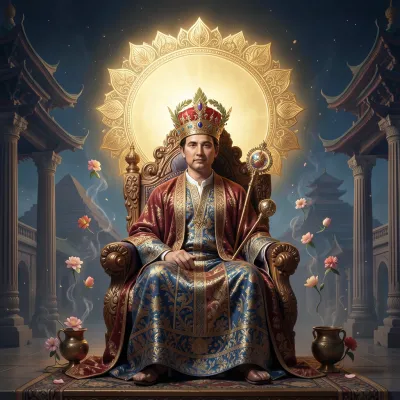
*Divine Kingship: Religion, Ritual, and the Sacred Authority of Monarchs* explores the historical and cross-cultural intersection of political power and religious doctrine. The book traces how various civilizations—from ancient Egypt and Mesopotamia to the empires of East Asia, pre-Columbian America, and the Pacific Islands—legitimized dynastic rule by positioning monarchs as either living gods, divine stewards, or moral pivots of the cosmic order. By analyzing theological texts alongside material culture and ritual practices, the author demonstrates that sacred authority was not merely an ornament of power but the fundamental framework through which societies established legitimacy, maintained social harmony, and explained the natural world.
The narrative emphasizes that while the specific manifestations of divine rule varied, the reliance on ritual remained a universal constant. Elaborate ceremonies such as coronations, anointings, and sacrifices transformed mortal individuals into sacred icons, making political authority visible and indisputable. Whether through the Egyptian Pharaoh’s identification with Horus, the Chinese "Mandate of Heaven," or the West African veneration of ancestral stools, these traditions created a moral universe where loyalty was equated with piety. The text also highlights the role of "sacred speech"—oracles, prophecies, and oaths—and the gendered dimensions of sovereignty, showing how queens and consorts often served as essential conduits for spiritual legitimacy.
As history progressed, the book examines how these models faced existential crises during periods of reformation, revolution, and secularization. The Protestant Reformation, the Enlightenment, and the rise of democratic ideals challenged the theological underpinnings of absolute rule, forcing a revaluation of the "Divine Right of Kings." In many regions, this led to the collapse of traditional monarchies; however, in others, sacral authority adapted rather than disappeared. The shift from absolute to constitutional monarchy transformed the sacred ruler into a ceremonial figurehead, as seen in modern Britain and Japan, where the throne persists as a repository of cultural memory and national identity rather than a source of executive command.
Ultimately, the work concludes that the human impulse to ground political authority in the transcendent remains a potent force. Even in ostensibly secular modern states, the "ghost" of divine kingship lingers in the rituals of civil religion and the charismatic aura of political leaders. By comparing diverse traditions, the book illustrates that while the gods have largely retreated from the halls of government, the symbolic and psychological need for a sacred center continues to shape the way communities organize themselves and interpret the legitimacy of those who lead them.
What You'll Find Inside:
- Divine kingship manifested differently across civilizations - ranging from living gods (Egypt) to divine stewards (Mesopotamia) to conditionally mandated rulers (China) - showing how cultural contexts shaped sacred authority.
- Rituals like coronations, anointings, and regalia weren't merely symbolic but actively constituted royal authority, transforming mortals into sacred figures through performative acts.
- Sacred authority was dynamically negotiated between rulers and religious establishments, adapting to reforms, conquests, and changing theological landscapes while maintaining core legitimacy functions.
- The book employs a comparative diachronic approach, analyzing texts, rituals, material culture, and political practices to reveal both unique expressions and recurring patterns of sacral kingship.
- Though stripped of political power, modern monarchies retain sacral elements through ceremonial functions that articulate national identity, historical continuity, and collective aspiration in secular contexts.
Who's It For:
This book is ideal for students and scholars of comparative religion, political theology, world history, and anthropology who seek to understand how religious concepts have legitimated political authority across cultures and eras. It will particularly benefit readers interested in the intersection of ritual, power, and legitimacy, as well as those studying the historical evolution of monarchy and sacred kingship. General readers with a strong interest in civilizational studies and the enduring influence of religious concepts on political systems will also find valuable insights.
Table of Contents:
- Introduction
- Chapter 1 The Sacred Crown: Concepts and Theories of Divine Kingship
- Chapter 2 Egypt: The Pharaoh as Living God
- Chapter 3 Mesopotamia: Kings as Stewards of the Gods
- Chapter 4 Israel and Judah: Anointed Kingship and Covenant
- Chapter 5 Iran: King of Kings and the Light of Ahura Mazda
- Chapter 6 Hellenistic Ruler Cults and the Roman Imperial Cult
- Chapter 7 Byzantium: The Emperor and the Heavenly Court
- Chapter 8 Latin Christendom: Unction, Coronation, and the Two Swords
- Chapter 9 The Divine Right of Kings in Early Modern Europe
- Chapter 10 China: The Mandate of Heaven and the Dynastic Cycle
- Chapter 11 Japan: The Emperor and the Sun Goddess
- Chapter 12 Korea and Vietnam: Confucian Kingship at the Periphery
- Chapter 13 India: Chakravartin Ideals and Dharma-Rajya
- Chapter 14 Buddhist Kingship in Sri Lanka and Mainland Southeast Asia
- Chapter 15 The Devaraja: God-Kings of Angkor and Java
- Chapter 16 Islam: Caliphate, Sultanate, and Sharifian Descent
- Chapter 17 Shi‘i Kingship: Safavids, Qajars, and the Sacred State
- Chapter 18 Sacred Kingship in Sub-Saharan Africa
- Chapter 19 The Andes and Mesoamerica: Sons of the Sun and Chosen of the Gods
- Chapter 20 Oceania: Mana, Tapu, and Chiefly Divinity
- Chapter 21 Rites of Rule: Anointing, Coronations, and Regalia
- Chapter 22 Speaking with the Sacred: Oracles, Oaths, and Charisma
- Chapter 23 Gendered Sovereignty: Queenship, Consorts, and Sacred Marriage
- Chapter 24 Crises of Legitimacy: Reformation, Revolution, and Secularization
- Chapter 25 After the Throne: Ritual Monarchy in the Modern World
Author:
Published By:
Date Published:
May 2, 2026
Type:
Nonfiction
Language:
English
Word Count:
74,088 words
Reading Time:
5 hours 11 minutes
Sample:
Order:
Order Divine Kingship: Religion, Ritual, and the Sacred Authority of Monarchs (Hardcover) on MixCache.com:
Buy NowPrint copy is made to order and ships worldwide. Includes the ebook free, ready to read instantly.
$5 account credit for all new MixCache.com accounts, usable toward any ebook purchase!*