
Browse by Category
Fiction
- Action & Adventure
- African American
- Anthologies
- Children's Fiction
- Classics
- Comics & Graphic Novels
- Coming of Age
- Contemporary
- Cultural & Regional
- Drama
- Erotica
- Family Life
- Fantasy
- General
- Historical Fiction
- Horror
- Humor & Satire
- Literary Fiction
- Mystery, Thriller & Suspense
- Poetry
- Religious & Inspirational
- Romance
- Science Fiction
- Short Stories
- War & Military
- Westerns
- Women's Fiction
- Young Adult
Non-Fiction
- Antiques & Collectibles
- Arts & Photography
- Biographies & Memoirs
- Business & Money
- Children's Non-Fiction
-
Computers & Technology
- Artificial Intelligence
- Computer Science
- Cybersecurity & Cryptography
- Data Science & Analytics
- Databases & Big Data
- Game Development & Design
- General
- Hardware & DIY
- Mobile App Development
- Networking & Cloud Computing
- Operating Systems
- Programming
- Robotics
- Software
- Software Engineering
- User Experience (UX) & Design
- Web Development & Design
- Cooking, Food & Wine
- Crafts, Hobbies & Home
- Education & Teaching
- Engineering
- General
- Health, Fitness & Dieting
-
History
- African History
- African History - North Africa
- African History - Sub-Saharan Africa
- American History
- American History - 20th Century
- American History - Civil War
- American History - Colonial Period
- Ancient History
- Asian History
- Asian History - China
- Asian History - India
- Asian History - Japan
- Asian History - Southeast Asia
- European History
- European History - Ancient Greece
- European History - Ancient Rome
- European History - Medieval
- European History - Modern
- European History - Renaissance
- General
- Middle Eastern History
- Military History
- Military History - Aviation
- Military History - Naval
- Social & Cultural History
- World History
- Humor & Entertainment
- Industrial Technology
- Language Learning
- Law
- LGBTQ+ Non-Fiction
- Literary Criticism
- Medical Books
- Parenting & Relationships
- Philosophy
- Politics & Social Sciences
- Reference
- Religion & Spirituality
-
Science & Math
- Agricultural Sciences
- Astronomy & Space Science
- Behavioral Sciences
- Biological Sciences
- Botany & Plant Science
- Chemistry
- Earth Sciences
- Engineering - Chemical
- Engineering - Civil
- Engineering - Electrical
- Engineering - Mechanical
- Environment
- General
- Geology
- Mathematics
- Nature & Ecology
- Oceanography
- Paleontology
- Physics
- Statistics
- Self-Help
- Sports & Outdoors
- Study Aids
- Sustainability & Green Living
- Textbooks
- Transportation
- Travel
- True Crime
- Urban Planning & Development
- Veterinary Medicine
- Writing & Publishing
Jump to Section
MixCache.com Total Access
Unlimited reading and audiobooks for every book published by MixCache.com.
Included titles carry the MTA badge.
Learn more →
The Last Skin Sewer of Quinhagak
A Novel
About this book:
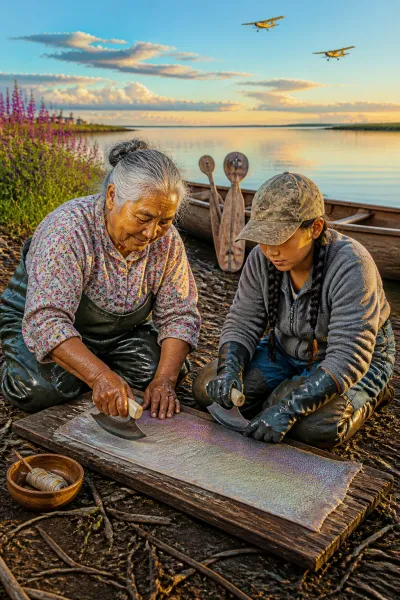 At the mouth of the Kanektok River, sixteen-year-old Elena kneels beside her grandmother, learning to strip the skin from a chum salmon in one perfect, shimmering sheet. Clara Mark is the last skin sewer of Quinhagak—keeper of a craft that once clothed generations against the Bering Sea's fury, now practiced only in the stolen hours before Fish and Game closes the nets. The kings aren't running. The water grows warmer each summer. And the troopers' yellow planes circle overhead, enforcing regulations written in Juneau offices that have never smelled river mud or felt the grain of a fish skin run head-to-tail beneath the needle.
As Elena rows the silent spruce oars into hidden sloughs, defying closure orders to gather the thirty skins her grandmother needs for a single parka, she discovers that every cut of the ulu carries a lesson: which way the salmon swam, how the oil preserves the thread, why chum moves like silk while king skin walks like a spruce log. But the old knowledge is fracturing—Clara's cough deepens, the permafrost thaws beneath the smokehouse, and the museum in Anchorage has already made its offer for the finished hood. To wear the river is to remember it; to sew the skin is to refuse erasure.
Lyrical and unflinching, *The Last Skin Sewer of Quinhagak* stitches together a vanishing Arctic world—where seals bob like cedar buoys in the current, where no-see-ums bite through denim and the fog tastes of iron and kelp—into a story of what we inherit, what we lose, and what one girl chooses to carry forward when the ice forms new.
CHAPTER ONE: The Mouth of the Kanektok
The silt at the mouth of the Kanektok River did not smell like ordinary mud. It carried the heavy, sour tang of crushed kelp, decomposing king salmon heads, and iron-rich tundra water that had traveled down from the Ahklun Mountains through thousands of acres of black spruce and dwarf willow. To Elena, standing ankle-deep in the grey-brown muck in a pair of cracked rubber Xtratufs that had belonged to two older cousins before her, the smell was simply what July meant. It meant wet socks, swarms of blackflies that hovered just below the brim of her ballcap like a living halo, and the rhythmic, hollow thump of her grandmother’s wooden mallet echoing across the gravel bar.
Her grandmother, Clara Mark, did not care much for rubber boots, though she owned a pair from the Native store in Bethel that sat under her porch, gathering cobwebs and dried grass. Instead, Clara wore seal-skin mukluks treated with seal oil until they were as supple as wet flannel. Her knees, swollen from seventy-three years of squatted work on cutting tables and smokehouse floors, rested directly on a square of worn caribou hide laid over the wet stones. She did not swat at the gnats. When one crawled into the corner of her eye, she merely blinked it away with a sharp, bird-like snap of her eyelid and kept her fingers moving.
Enjoying it? The full book includes every chapter.
Table of Contents:
- Chapter 1 The Mouth of the Kanektok Free
- Chapter 2 Silver Scales Free
- Chapter 3 Aana's Hands
- Chapter 4 The Thawing Tundra
- Chapter 5 Scraping the Skins
- Chapter 6 Sinew and Bone
- Chapter 7 The Late Freeze
- Chapter 8 Whispers in the Ulu
- Chapter 9 Empty Nets
- Chapter 10 Patterns of the Ancestors
- Chapter 11 The Warm Current
- Chapter 12 Stitches in the Storm
- Chapter 13 Ghosts of the Fish Camp
- Chapter 14 Thin Ice
- Chapter 15 The Medicine Woman's Cough
- Chapter 16 Leaving Quinhagak
- Chapter 17 The Museum's Offer
- Chapter 18 Returning to the River
- Chapter 19 The Last Salmon Run
- Chapter 20 Waterproof Seams
- Chapter 21 The Bering Sea's Fury
- Chapter 22 Aana's Final Lesson
- Chapter 23 The Finished Hood
- Chapter 24 Wearing the River
- Chapter 25 The New Ice
- Chapter 26 The Skin Sewer's Song
Included when you buy the full book.
Author:
Published By:
Type:
Fiction
Date Published:
November 28, 2026
Sample:
Order:
Click to buy this ebook:
Buy NowIncludes every chapter. Not sure yet? Read the opening free.