
Browse by Category
Fiction
- Action & Adventure
- African American
- Anthologies
- Children's Fiction
- Classics
- Comics & Graphic Novels
- Coming of Age
- Contemporary
- Cultural & Regional
- Drama
- Erotica
- Family Life
- Fantasy
- General
- Historical Fiction
- Horror
- Humor & Satire
- Literary Fiction
- Mystery, Thriller & Suspense
- Poetry
- Religious & Inspirational
- Romance
- Science Fiction
- Short Stories
- War & Military
- Westerns
- Women's Fiction
- Young Adult
Non-Fiction
- Antiques & Collectibles
- Arts & Photography
- Biographies & Memoirs
- Business & Money
- Children's Non-Fiction
-
Computers & Technology
- Artificial Intelligence
- Computer Science
- Cybersecurity & Cryptography
- Data Science & Analytics
- Databases & Big Data
- Game Development & Design
- General
- Hardware & DIY
- Mobile App Development
- Networking & Cloud Computing
- Operating Systems
- Programming
- Robotics
- Software
- Software Engineering
- User Experience (UX) & Design
- Web Development & Design
- Cooking, Food & Wine
- Crafts, Hobbies & Home
- Education & Teaching
- Engineering
- General
- Health, Fitness & Dieting
-
History
- African History
- African History - North Africa
- African History - Sub-Saharan Africa
- American History
- American History - 20th Century
- American History - Civil War
- American History - Colonial Period
- Ancient History
- Asian History
- Asian History - China
- Asian History - India
- Asian History - Japan
- Asian History - Southeast Asia
- European History
- European History - Ancient Greece
- European History - Ancient Rome
- European History - Medieval
- European History - Modern
- European History - Renaissance
- General
- Middle Eastern History
- Military History
- Military History - Aviation
- Military History - Naval
- Social & Cultural History
- World History
- Humor & Entertainment
- Industrial Technology
- Language Learning
- Law
- LGBTQ+ Non-Fiction
- Literary Criticism
- Medical Books
- Parenting & Relationships
- Philosophy
- Politics & Social Sciences
- Reference
- Religion & Spirituality
-
Science & Math
- Agricultural Sciences
- Astronomy & Space Science
- Behavioral Sciences
- Biological Sciences
- Botany & Plant Science
- Chemistry
- Earth Sciences
- Engineering - Chemical
- Engineering - Civil
- Engineering - Electrical
- Engineering - Mechanical
- Environment
- General
- Geology
- Mathematics
- Nature & Ecology
- Oceanography
- Paleontology
- Physics
- Statistics
- Self-Help
- Sports & Outdoors
- Study Aids
- Sustainability & Green Living
- Textbooks
- Transportation
- Travel
- True Crime
- Urban Planning & Development
- Veterinary Medicine
- Writing & Publishing
Jump to Section
MixCache.com Total Access
Unlimited reading and audiobooks for every book published by MixCache.com.
Included titles carry the MTA badge.
Learn more →
When Analogies Ruled the SAT
The Strange History of America's Most Hated Question Type
About this book:
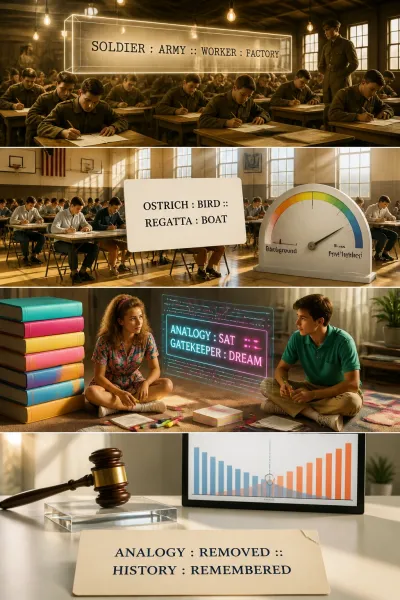 For fifty years, two words separated by two dots—*RUNNER : MARATHON*, *OSTRICH : BIRD*, *REGATTA : CABIN*—stood as the ultimate gatekeepers of the American dream. Born in a desperate WWI Army lab to sort millions of draftees by "pure intellect," the verbal analogy migrated from military barracks to Ivy League admissions offices, promising a meritocracy blind to background. Instead, it became a cultural lightning rod: a proxy for class, a playground for the nascent test-prep industry, and the battlefield where psychometricians, civil rights lawyers, and the University of California system waged war over the very definition of intelligence. This is the biography of a question type that was supposed to measure innate reasoning but ended up measuring exposure—and the dramatic 2005 showdown that finally killed it.
*When Analogies Ruled the SAT* pulls back the curtain on the quiet war rooms where "distractors" were engineered to shatter dreams, the Saturday morning gymnasiums where teenagers sweated over semantic traps, and the executive suites where a single threat from the UC system forced the College Board to execute its crown jewel. From the eugenicist roots of the Army Alpha to Stanley Kaplan’s guerrilla tutoring, from the infamous *REGATTA : CABIN* firestorm to the cognitive science that both vindicated and doomed the format, this book traces how a puzzle designed to level the playing field became the most resented symbol of educational sorting in American history.
By the time the last analogy was scored in March 2005, the SAT had abandoned the dream of measuring raw aptitude for the safer ground of curricular achievement. But the ghost of the analogy haunts every modern debate over standardized testing, equity, and what it means to be "smart" in America. Rigorously researched and narratively electric, this is the definitive account of the rise and fall of the question that ruled a nation—and why we are still living in the shadow of its collapse.
Table of Contents:
- Introduction
- Chapter 1 The Army Alpha and the Dawn of Standardized Logic
- Chapter 2 Carl Brigham’s Big Idea: Measuring Pure Aptitude
- Chapter 3 A is to B: The Mechanics of the Relational Pair
- Chapter 4 The Ivy League Gatekeeper: ETS Takes the Reins
- Chapter 5 The Distractor Factor: The Art of Crafting Wrong Answers
- Chapter 6 OSTRICH : BIRD :: The Architecture of the 1950s SAT
- Chapter 7 The Vocabulary Trap: Words You Only Need Once
- Chapter 8 Stanley Kaplan and the First Test Prep Guerrillas
- Chapter 9 Class Markers and Cultural Codes: The Demographics of Diction
- Chapter 10 The Infamous REGATTA : CABIN Controversy
- Chapter 11 High Stakes, High Stress: Student Narratives from the Golden Era
- Chapter 12 What Cognitive Science Thought Analogies Measured
- Chapter 13 The Psychometric Wars: Aptitude versus Achievement
- Chapter 14 The 1990s Revision: The Analogy Under Siege
- Chapter 15 Decoding the Secret Code: The Rise of Analogy Shortcuts
- Chapter 16 The University of California Threatens to Walk
- Chapter 17 Richard Atkinson and the Battle for the SAT’s Soul
- Chapter 18 The Final Verdict: Why the Analogy Had to Die
- Chapter 19 March 2005: The Last Pair is Scored
- Chapter 20 The Rise of Critical Reading and Sentence Completion
- Chapter 21 The Ghost of Analogies in Modern Cognitive Testing
- Chapter 22 What We Lost When We Lost the Analogy
- Chapter 23 The New Gatekeepers: How Testing Evolved Post-2005
- Chapter 24 The Legacy of America's Most Hated Question Type
- Chapter 25 The Future of Measuring Human Intelligence
Author:
Published By:
Type:
Nonfiction
Date Published:
November 2, 2026
Sample:
Order:
Click to order this hardcover:
Buy Now