
Browse by Category
Fiction
- Action & Adventure
- African American
- Anthologies
- Children's Fiction
- Classics
- Comics & Graphic Novels
- Coming of Age
- Contemporary
- Cultural & Regional
- Drama
- Erotica
- Fantasy
- General
- Historical Fiction
- Horror
- Humor & Satire
- Literary Fiction
- Mystery, Thriller & Suspense
- Poetry
- Religious & Inspirational
- Romance
- Science Fiction
- Short Stories
- War & Military
- Westerns
- Women's Fiction
- Young Adult
Non-Fiction
- Antiques & Collectibles
- Arts & Photography
- Biographies & Memoirs
- Business & Money
- Children's Non-Fiction
-
Computers & Technology
- Artificial Intelligence
- Computer Science
- Cybersecurity & Cryptography
- Data Science & Analytics
- Databases & Big Data
- Game Development & Design
- General
- Hardware & DIY
- Mobile App Development
- Networking & Cloud Computing
- Operating Systems
- Programming
- Robotics
- Software
- Software Engineering
- User Experience (UX) & Design
- Web Development & Design
- Cooking, Food & Wine
- Crafts, Hobbies & Home
- Education & Teaching
- Engineering
- General
- Health, Fitness & Dieting
-
History
- African History
- African History - North Africa
- African History - Sub-Saharan Africa
- American History
- American History - 20th Century
- American History - Civil War
- American History - Colonial Period
- Ancient History
- Asian History
- Asian History - China
- Asian History - India
- Asian History - Japan
- Asian History - Southeast Asia
- European History
- European History - Ancient Greece
- European History - Ancient Rome
- European History - Medieval
- European History - Modern
- European History - Renaissance
- General
- Middle Eastern History
- Military History
- Military History - Aviation
- Military History - Naval
- Social & Cultural History
- World History
- Humor & Entertainment
- Industrial Technology
- Language Learning
- Law
- LGBTQ+ Non-Fiction
- Literary Criticism
- Medical Books
- Parenting & Relationships
- Philosophy
- Politics & Social Sciences
- Reference
- Religion & Spirituality
-
Science & Math
- Agricultural Sciences
- Astronomy & Space Science
- Behavioral Sciences
- Biological Sciences
- Botany & Plant Science
- Chemistry
- Earth Sciences
- Engineering - Chemical
- Engineering - Civil
- Engineering - Electrical
- Engineering - Mechanical
- Environment
- General
- Geology
- Mathematics
- Nature & Ecology
- Oceanography
- Paleontology
- Physics
- Statistics
- Self-Help
- Sports & Outdoors
- Study Aids
- Sustainability & Green Living
- Textbooks
- Transportation
- Travel
- True Crime
- Urban Planning & Development
- Veterinary Medicine
- Writing & Publishing
Jump to Section
MixCache.com Total Access
Unlimited reading and audiobooks for every book published by MixCache.com.
Included titles carry the MTA badge.
Learn more →
Stalin's Locust War: Science and Famine on the Steppe
The Ideological Corruption of Soviet Entomology
About this book:
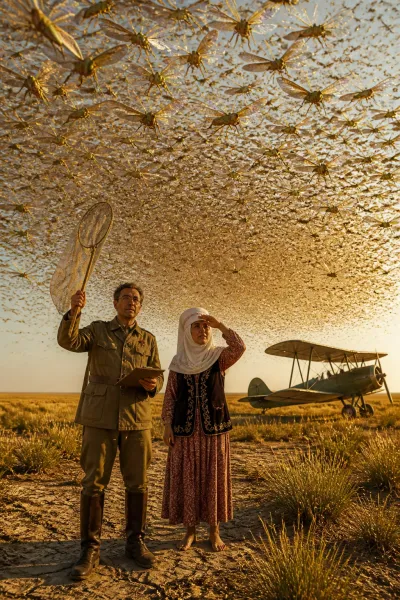 In the summer of 1932, the horizon across Ukraine and Kazakhstan darkened—not with storm clouds, but with billions of migratory locust wings. The Soviet Union possessed the world's most advanced entomological science: a network of field stations, pioneering aerial crop-dusting, and a revolutionary understanding of locust phase theory. Yet when the swarms came, the regime chose ideology over evidence. *Stalin's Locust War* reveals how Trofim Lysenko's pseudo-scientific ascent dismantled empirical pest control, rebranded ecology as "bourgeois sabotage," and silenced the scientists who could have stopped the catastrophe. The result was a force multiplier for famine: in Ukraine, locusts devoured the few crops that escaped Holodomor requisition brigades; in Kazakhstan, they stripped the steppe bare, accelerating a demographic collapse that killed over a third of the Kazakh population.
Drawing on long-suppressed institute archives, purge-era field reports, and state agricultural records, this book traces the full lifecycle of a man-made ecological disaster—from the laboratory purges of geneticists to the show trials that blamed "wreckers" for the regime's own failures. It exposes the terrifying mechanics of a system that demanded nature obey dialectical materialism, deploying untrained peasants with politically vetted magic bullets while qualified entomologists rotted in gulags. The insect was not the root cause of the famines, but the destruction of science ensured that ecology became an accomplice to state-sponsored murder.
A gripping fusion of environmental history and political analysis, *Stalin's Locust War* stands as a stark warning for our era of resurgent science denial. It demonstrates with chilling precision how totalitarian systems weaponize agronomy, replace truth with doctrine, and transform technical institutions into engines of self-destruction. The ruined harvests of the Eurasian steppe remain a monument to what happens when power cuts itself off from nature—and a reminder that the cost of ideological hubris is always paid in human lives.
Table of Contents:
- Introduction
- Chapter 1 Shadows Over the Steppe: Early Soviet Applied Entomology
- Chapter 2 The Swarm's Cycle: Ecology of the Migratory Locust
- Chapter 3 Science in the Field: Pre-Stalinist Pest Control Networks
- Chapter 4 The Seeds of Dogma: Trofim Lysenko’s Agrarian Ascendancy
- Chapter 5 Bourgeois Biology: The Purge of Soviet Geneticists and Ecologists
- Chapter 6 Dialectics of the Soil: Redefining Nature Under High Stalinism
- Chapter 7 Collectivization and Chaos: Breaking the Steppe’s Ecological Balance
- Chapter 8 The Vernalization Myth: Pseudo-Science Applied to Agronomy
- Chapter 9 Repression at the Institute: The Silencing of the Entomological Union
- Chapter 10 Kazakhstan Bound: Early Warnings Ignored on the Asian Frontier
- Chapter 11 The Ukrainian Breadbasket Under Siege: Monoculture and Vulnerability
- Chapter 12 War on the Parasite: Ideological Campaigns Replace Chemical Defense
- Chapter 13 The Great Surge: The Locust Outbreaks of 1931–1932
- Chapter 14 Bureaucratic Blindness: False Reports and Plan Fulfillments
- Chapter 15 Famine Amplified: The Intersection of Locust Swarms and Holodomor
- Chapter 16 Tragedy on the Kazakh Steppe: Pastoral Collapse and Pest Swarms
- Chapter 17 The Denunciation of Ecology: Pest Control as Anti-Soviet Sabotage
- Chapter 18 Improvised Disasters: Untested Lysenkoist Methods in the Field
- Chapter 19 The Shattered Harvests: Desperation and Starvation in 1933
- Chapter 20 Cover-Ups and Show Trials: Blaming Wreckers for Agricultural Disasters
- Chapter 21 The Aftermath of the Swarms: Environmental Ruin in the South
- Chapter 22 Totalitarian Entomology: The Final Triumph of Party Doctrine
- Chapter 23 Post-Famine Reorganization: The Deep Scars of Lysenkoism
- Chapter 24 The Silent Field: Long-Term Consequences for Soviet Science
- Chapter 25 Lessons of the Locust War: Ideology, Ecology, and Catastrophe
Author:
Published By:
Type:
Nonfiction
Date Published:
October 31, 2026
Sample:
Order:
Click to buy this ebook:
Buy Now