
Browse by Category
Fiction
- Action & Adventure
- African American
- Anthologies
- Children's Fiction
- Classics
- Comics & Graphic Novels
- Coming of Age
- Contemporary
- Cultural & Regional
- Drama
- Erotica
- Family Life
- Fantasy
- General
- Historical Fiction
- Horror
- Humor & Satire
- Literary Fiction
- Mystery, Thriller & Suspense
- Poetry
- Religious & Inspirational
- Romance
- Science Fiction
- Short Stories
- War & Military
- Westerns
- Women's Fiction
- Young Adult
Non-Fiction
- Antiques & Collectibles
- Arts & Photography
- Biographies & Memoirs
- Business & Money
- Children's Non-Fiction
-
Computers & Technology
- Artificial Intelligence
- Computer Science
- Cybersecurity & Cryptography
- Data Science & Analytics
- Databases & Big Data
- Game Development & Design
- General
- Hardware & DIY
- Mobile App Development
- Networking & Cloud Computing
- Operating Systems
- Programming
- Robotics
- Software
- Software Engineering
- User Experience (UX) & Design
- Web Development & Design
- Cooking, Food & Wine
- Crafts, Hobbies & Home
- Education & Teaching
- Engineering
- General
- Health, Fitness & Dieting
-
History
- African History
- African History - North Africa
- African History - Sub-Saharan Africa
- American History
- American History - 20th Century
- American History - Civil War
- American History - Colonial Period
- Ancient History
- Asian History
- Asian History - China
- Asian History - India
- Asian History - Japan
- Asian History - Southeast Asia
- European History
- European History - Ancient Greece
- European History - Ancient Rome
- European History - Medieval
- European History - Modern
- European History - Renaissance
- General
- Middle Eastern History
- Military History
- Military History - Aviation
- Military History - Naval
- Social & Cultural History
- World History
- Humor & Entertainment
- Industrial Technology
- Language Learning
- Law
- LGBTQ+ Non-Fiction
- Literary Criticism
- Medical Books
- Parenting & Relationships
- Philosophy
- Politics & Social Sciences
- Reference
- Religion & Spirituality
-
Science & Math
- Agricultural Sciences
- Astronomy & Space Science
- Behavioral Sciences
- Biological Sciences
- Botany & Plant Science
- Chemistry
- Earth Sciences
- Engineering - Chemical
- Engineering - Civil
- Engineering - Electrical
- Engineering - Mechanical
- Environment
- General
- Geology
- Mathematics
- Nature & Ecology
- Oceanography
- Paleontology
- Physics
- Statistics
- Self-Help
- Sports & Outdoors
- Study Aids
- Sustainability & Green Living
- Textbooks
- Transportation
- Travel
- True Crime
- Urban Planning & Development
- Veterinary Medicine
- Writing & Publishing
Jump to Section
MixCache.com Total Access
Unlimited reading and audiobooks for every book published by MixCache.com.
Included titles carry the MTA badge.
Learn more →
Reading the Storm: Ten Worked Case Studies in Pre-1900 Weather and Climate
How Historical Extremes Built the Science of the Atmosphere
About this book:
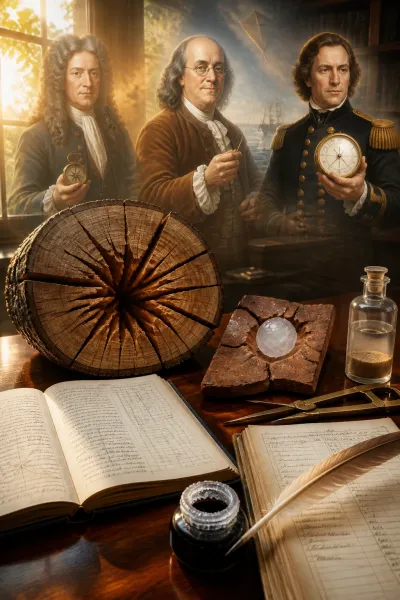 Long before satellites and supercomputers, the atmosphere wrote its autobiography in the wreckage it left behind: the directional fall of oak trees in 1703, the frozen ink in a diplomat’s well, the salinity of a pond miles inland, the precise diameter of a hailstone that shattered a clay roof tile. *Reading the Storm* treats ten catastrophic pre-1900 events not as mere curiosities, but as massive natural experiments that forced the invention of modern dynamical meteorology. Through meticulous forensic reconstruction—calibrating ship logs as moving weather stations, wine harvest dates as biological thermometers, and church ledgers as tide gauges—this book reveals how observers like Daniel Defoe, Benjamin Franklin, and Robert FitzRoy decoded the mechanics of cyclones, volcanic winters, and nor'easters using nothing but parchment, quill, and ruthless empirical logic.
Each chapter is a worked case study in atmospheric detection: tracking the rotary wind field of the 1821 September Gale through the contradictory testimony of fallen New England timber; diagnosing the volcanic aerosol veil of 1783 through Franklin’s speculations on solar attenuation; calculating the updraft velocity of an 1788 French supercell from the weight of hailstones preserved in a notary’s pocket. You will witness the ferocious intellectual duel between William Redfield and James Espy over the very structure of a storm, and see how the wreck of the *Royal Charter* in 1859 birthed the synoptic chart and the first storm warnings. The narrative moves fluidly from the microphysics of a hailstone to the teleconnections of Tambora’s 1816 "Year Without a Summer," demonstrating how to translate the "ink of the past" into pressure gradients, wind vectors, and thermodynamic indices with startling precision.
In an era of accelerating climate change, our instrumental record is a blink of an eye—wholly inadequate for gauging the true tail risks of the climate system. *Reading the Storm* provides the essential deep-time baseline, proving that the "unthinkable" megastorms, mega-droughts, and continental blocks of the twenty-first century have precursors written in the administrative dust of centuries past. It is an indispensable guide for climate scientists, historians, and anyone who has ever watched the sky darken and wondered: *How do we really know what the air is capable of?*
Table of Contents:
- Introduction
- Chapter 1 The Archives of the Air: Documentary Clues and Pre-Instrumental Meteorology
- Chapter 2 Case 1: The Great Storm of 1703 and Daniel Defoe's Forensic Baseline
- Chapter 3 Mapping the Tempest: Barometric Whispers and Wind Fields in Early Modern Britain
- Chapter 4 Conceptualizing Low-Pressure Systems Before Isobars
- Chapter 5 Case 2: The Frost Fair of 1709 and the Great European Freeze
- Chapter 6 River Ice, Tree Rings, and the First Theories of Continental Cold Blocks
- Chapter 7 Case 3: The 1737 Calcutta Cyclone and the Mystery of the Storm Surge
- Chapter 8 Sailors' Logs and the Anatomy of Bay of Bengal Monsoons
- Chapter 9 Case 4: The Dry Fog of 1783 and the Laki Volcanic Eruption
- Chapter 10 Benjamin Franklin, Atmospheric Hazes, and Early Solar Attenuation Theory
- Chapter 11 Case 5: The 1788 French Hailstorms and the Microphysics of Severe Convection
- Chapter 12 Hail Swaths, Crop Failure, and Early Thermodynamic Debates
- Chapter 13 Case 6: The Year Without a Summer in 1816 and Tambora’s Global Shadow
- Chapter 14 Pioneer Diaries and the Discovery of Volcanic Aerosols and Climate Teleconnections
- Chapter 15 Case 7: The Great September Gale of 1821 and the Birth of Cyclone Dynamics
- Chapter 16 Redfield vs. Espy: The Rotary Storm Controversy Over New England's Woods
- Chapter 17 Case 8: The Irish Night of the Big Wind in 1839
- Chapter 18 Tracing the Extratropical Cyclone Across Church Spires and Folk Memory
- Chapter 19 Case 9: The Royal Charter Gale of 1859 and Robert FitzRoy’s Telegraph Network
- Chapter 20 From Wreckage to Forecasts: The Mechanics of Depressions Decoded
- Chapter 21 Case 10: The Great Blizzard of 1888 and the Anatomy of Nor'easters
- Chapter 22 Urban Paralysis, Snow Drifts, and the Reconstruction of Frontal Boundaries
- Chapter 23 Reconciling the Ink: Analytical Methods for Calibrating Historical Testimony
- Chapter 24 The Legacy of Empirical Deduction in Modern Dynamical Meteorology
- Chapter 25 Listening to the Past: Historical Extremes and the Future of Climate Reconstruction
Author:
Published By:
Type:
Nonfiction
Date Published:
October 29, 2026
Sample:
Order:
Click to buy this ebook:
Buy Now