
Browse by Category
Fiction
- Action & Adventure
- African American
- Anthologies
- Children's Fiction
- Classics
- Comics & Graphic Novels
- Coming of Age
- Contemporary
- Cultural & Regional
- Drama
- Erotica
- Fantasy
- General
- Historical Fiction
- Horror
- Humor & Satire
- Literary Fiction
- Mystery, Thriller & Suspense
- Poetry
- Religious & Inspirational
- Romance
- Science Fiction
- Short Stories
- War & Military
- Westerns
- Women's Fiction
- Young Adult
Non-Fiction
- Antiques & Collectibles
- Arts & Photography
- Biographies & Memoirs
- Business & Money
- Children's Non-Fiction
-
Computers & Technology
- Artificial Intelligence
- Computer Science
- Cybersecurity & Cryptography
- Data Science & Analytics
- Databases & Big Data
- Game Development & Design
- General
- Hardware & DIY
- Mobile App Development
- Networking & Cloud Computing
- Operating Systems
- Programming
- Robotics
- Software
- Software Engineering
- User Experience (UX) & Design
- Web Development & Design
- Cooking, Food & Wine
- Crafts, Hobbies & Home
- Education & Teaching
- Engineering
- General
- Health, Fitness & Dieting
-
History
- African History
- African History - North Africa
- African History - Sub-Saharan Africa
- American History
- American History - 20th Century
- American History - Civil War
- American History - Colonial Period
- Ancient History
- Asian History
- Asian History - China
- Asian History - India
- Asian History - Japan
- Asian History - Southeast Asia
- European History
- European History - Ancient Greece
- European History - Ancient Rome
- European History - Medieval
- European History - Modern
- European History - Renaissance
- General
- Middle Eastern History
- Military History
- Military History - Aviation
- Military History - Naval
- Social & Cultural History
- World History
- Humor & Entertainment
- Industrial Technology
- Language Learning
- Law
- LGBTQ+ Non-Fiction
- Literary Criticism
- Medical Books
- Parenting & Relationships
- Philosophy
- Politics & Social Sciences
- Reference
- Religion & Spirituality
-
Science & Math
- Agricultural Sciences
- Astronomy & Space Science
- Behavioral Sciences
- Biological Sciences
- Botany & Plant Science
- Chemistry
- Earth Sciences
- Engineering - Chemical
- Engineering - Civil
- Engineering - Electrical
- Engineering - Mechanical
- Environment
- General
- Geology
- Mathematics
- Nature & Ecology
- Oceanography
- Paleontology
- Physics
- Statistics
- Self-Help
- Sports & Outdoors
- Study Aids
- Sustainability & Green Living
- Textbooks
- Transportation
- Travel
- True Crime
- Urban Planning & Development
- Veterinary Medicine
- Writing & Publishing
Jump to Section
MixCache.com Total Access
Unlimited reading and audiobooks for every book published by MixCache.com.
Included titles carry the MTA badge.
Learn more →
The Efficiency Paradox in Modern Irrigation
How Pressurized Systems Rewrote the Trade and the Arguments That Remain
About this book:
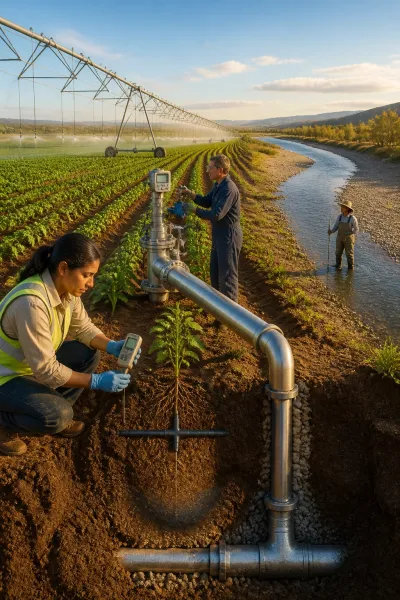 **The Efficiency Paradox in Modern Irrigation** dismantles the comforting myth that high-tech irrigation saves water. With rigorous interdisciplinary analysis, this book reveals why the global shift from gravity-fed canals to pressurized pipes—drip lines, center pivots, micro-sprinklers—has repeatedly failed to reduce basin-scale consumption. Instead, field-level efficiency gains trigger a cascade of unintended consequences: expanded irrigated acreage, shifts to thirstier high-value crops, hardened demand that eliminates drought resilience, and the severing of return flows that downstream communities and ecosystems have depended on for generations. From the physics of infiltration to the economics of capital-intensive agriculture, the authors expose the structural mechanism that converts "saved" water into intensified use.
Spanning the fluid mechanics of the pipe, the agronomy of the root zone, and the political economy of the river basin, this volume connects domains usually treated in isolation. It traces how pressurized systems disrupt salt balances, accelerate groundwater depletion beneath high-tech landscapes, and demand massive energy inputs that link water security to carbon constraints. Through deep case studies—the Colorado and Rio Grande basins, Southern Europe’s modernization drive, smallholder transitions across the Global South—it grounds theoretical insight in the operational realities that determine whether a modernization project conserves water or merely reallocates it. Chapters on sensor networks, subsidy structures, water rights friction, and cap-and-trade frameworks equip readers to diagnose why institutional metrics remain stuck in the open-channel era.
Written for engineers, economists, hydrologists, legal scholars, and policy practitioners who can no longer afford simplistic "more crop per drop" slogans, this book provides the analytical framework to evaluate irrigation projects on their true hydrological merits. It offers a path beyond the paradox: not by rejecting technology, but by stripping away its ideological blind spots to build governance that respects the non-negotiable boundaries of the basin. Essential reading for anyone tasked with reconciling agricultural productivity with the reality of a water-scarce future.
Table of Contents:
- Introduction
- Chapter 1: The Gravity Legacy: Canals, Furrows, and the Open Flow Era
- Chapter 2: The Turn to Pressure: Pumps, Pipes, and the Quest for Control
- Chapter 3: Engineering the Uniform Drop: The Mechanics of Modern Precision
- Chapter 4: The Classical Doctrine of Application Efficiency
- Chapter 5: The Basin Accounting Revolution: From Field Edge to Catchment
- Chapter 6: Return Flows and the Illusion of Recoverable Losses
- Chapter 7: Jevons at the Headgate: The Rebound Effect in Agricultural Water
- Chapter 8: Crop Shifts and Capital Density: The Economic Driver of Hardened Demand
- Chapter 9: Consumptive Use Versus Applied Depth: Unpacking the Agronomic Ledger
- Chapter 10: The Energy-Water Nexus of Pressurized Distribution
- Chapter 11: Groundwater Depletion Beneath High-Tech Landscapes
- Chapter 12: Salinity, Leaching, and the Disrupted Salt Balance
- Chapter 13: The Subsidized Pipe: Public Policy and Technology Adoption
- Chapter 14: Water Rights, Transfers, and the Paper Water Friction
- Chapter 15: Displaced Downstreamers: Equity, Customary Rights, and Return Flow Dependents
- Chapter 16: Environmental Flows Stranded by Sealed Systems
- Chapter 17: Sensor Networks, Telemetry, and the Myth of Autonomous Management
- Chapter 18: Maintenance, Degradation, and the True Lifecycle of Pressurized Infrastructure
- Chapter 19: Lessons from the Arid West: The Colorado and Rio Grande Basins
- Chapter 20: The Mediterranean Transition: Modernization and Fiscal Realities in Southern Europe
- Chapter 21: Smallholders and Pressurized Systems: Dynamics Across the Global South
- Chapter 22: Institutional Resistance: River Basin Authorities and Antiquated Metrics
- Chapter 23: Cap-and-Trade Frameworks Under Altered Hydrological Regimes
- Chapter 24: Redefining Water Productivity: Moving Beyond Yield per Drop
- Chapter 25: Reconciling Basin Hydrology with Modern Tech: Pathways for Future Governance
Author:
Published By:
Type:
Nonfiction
Date Published:
October 27, 2026
Sample:
Order:
Click to order this paperback:
Buy Now