
Browse by Category
Fiction
- Action & Adventure
- African American
- Anthologies
- Children's Fiction
- Classics
- Comics & Graphic Novels
- Coming of Age
- Contemporary
- Cultural & Regional
- Drama
- Erotica
- Fantasy
- General
- Historical Fiction
- Horror
- Humor & Satire
- Literary Fiction
- Mystery, Thriller & Suspense
- Poetry
- Religious & Inspirational
- Romance
- Science Fiction
- Short Stories
- War & Military
- Westerns
- Women's Fiction
- Young Adult
Non-Fiction
- Antiques & Collectibles
- Arts & Photography
- Biographies & Memoirs
- Business & Money
- Children's Non-Fiction
-
Computers & Technology
- Artificial Intelligence
- Computer Science
- Cybersecurity & Cryptography
- Data Science & Analytics
- Databases & Big Data
- Game Development & Design
- General
- Hardware & DIY
- Mobile App Development
- Networking & Cloud Computing
- Operating Systems
- Programming
- Robotics
- Software
- Software Engineering
- User Experience (UX) & Design
- Web Development & Design
- Cooking, Food & Wine
- Crafts, Hobbies & Home
- Education & Teaching
- Engineering
- General
- Health, Fitness & Dieting
-
History
- African History
- African History - North Africa
- African History - Sub-Saharan Africa
- American History
- American History - 20th Century
- American History - Civil War
- American History - Colonial Period
- Ancient History
- Asian History
- Asian History - China
- Asian History - India
- Asian History - Japan
- Asian History - Southeast Asia
- European History
- European History - Ancient Greece
- European History - Ancient Rome
- European History - Medieval
- European History - Modern
- European History - Renaissance
- General
- Middle Eastern History
- Military History
- Military History - Aviation
- Military History - Naval
- Social & Cultural History
- World History
- Humor & Entertainment
- Industrial Technology
- Language Learning
- Law
- LGBTQ+ Non-Fiction
- Literary Criticism
- Medical Books
- Parenting & Relationships
- Philosophy
- Politics & Social Sciences
- Reference
- Religion & Spirituality
-
Science & Math
- Agricultural Sciences
- Astronomy & Space Science
- Behavioral Sciences
- Biological Sciences
- Botany & Plant Science
- Chemistry
- Earth Sciences
- Engineering - Chemical
- Engineering - Civil
- Engineering - Electrical
- Engineering - Mechanical
- Environment
- General
- Geology
- Mathematics
- Nature & Ecology
- Oceanography
- Paleontology
- Physics
- Statistics
- Self-Help
- Sports & Outdoors
- Study Aids
- Sustainability & Green Living
- Textbooks
- Transportation
- Travel
- True Crime
- Urban Planning & Development
- Veterinary Medicine
- Writing & Publishing
Jump to Section
MixCache.com Total Access
Unlimited reading and audiobooks for every book published by MixCache.com.
Included titles carry the MTA badge.
Learn more →
The Spanish Diplodocus: A Jurassic Migration Mystery
How a Fossil Find Rewrote the Map of the Late Jurassic
About this book:
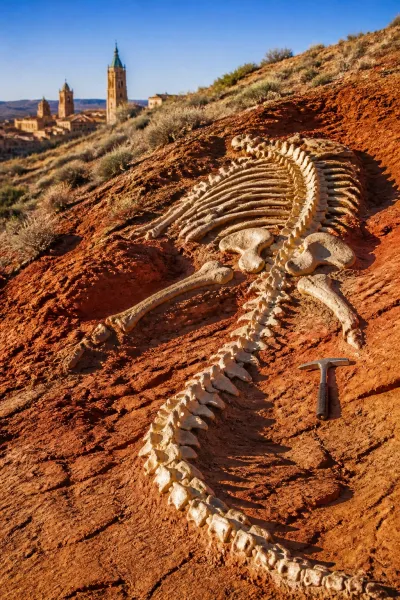 For over a century, *Diplodocus* was the undisputed emblem of the American West—a ninety-foot, whip-tailed titan entombed in the Morrison Formation, separated from Europe by a vast, impassable Jurassic ocean. Andrew Carnegie even shipped plaster casts of "Dippy" to European capitals as diplomatic gifts, marvels from a lost world that Europeans could only visit in museum halls. But in the sun-bleached hills of Teruel, Spain, a rusted hammer struck bone that rewrote the map of the Late Jurassic: unmistakable *Diplodocus* remains, lying in Iberian red clays where no North American giant had any business being.
*The Spanish Diplodocus* follows the high-stakes forensic investigation that erupted from this impossible find. From the Bone Wars quarries of Wyoming to the micro-CT scanners and isotope labs of modern paleontology, this is a scientific detective story that spans continents and disciplines. How did a twelve-ton herbivore cross an expanding Atlantic? Did dropping sea levels expose fleeting land bridges across shattered archipelagos? Did tectonic rifting stall, leaving forgotten corridors of dry land? Or did evolution pull off a staggering case of convergence, building the same impossible skeleton twice? The answer shatters the old picture of isolated island faunas, revealing a Late Jurassic world of "island hopping" titans, volatile coastlines, and migration highways far more dynamic than we ever imagined.
Blending the grit of fieldwork with the sweep of deep-time geology, this book invites you into the trenches where a single bump on a tail vertebra can topple a paradigm. It is a tale of scientific dogma confronted by stubborn evidence, of Carnegie's industrial ambition and a Spanish hillside's quiet revolution. In the end, the Spanish *Diplodocus* does more than redraw a paleontological map—it reminds us that the ground beneath our feet has always been moving, and that the borders between worlds are far more porous than we dare to believe.
Table of Contents:
- Introduction
- Chapter 1 The American Monopoly on Giants
- Chapter 2 Shadows in the Morrison Formation
- Chapter 3 A Whispering Earth in Teruel
- Chapter 4 The Unlikely Iberian Bonebed
- Chapter 5 Echoes of Carnegie's Monster
- Chapter 6 Unearthing the Spanish Titan
- Chapter 7 Anatomical Detective Work in the Field
- Chapter 8 Neural Spines and Tail Vertebrae: Identifying a Legend
- Chapter 9 The European Jurassic Landscape
- Chapter 10 Breaking the Atlantic Barrier
- Chapter 11 The Fragmenting Supercontinent
- Chapter 12 Seaways, Reefs, and Island Hopping
- Chapter 13 The Iberian Corridor Hypothesis
- Chapter 14 Trace Fossils and Footprints Across Ephemeral Bridges
- Chapter 15 Late Jurassic Climate and Coastal Ecosystems
- Chapter 16 Parallel Evolution vs. True Transatlantic Migration
- Chapter 17 Biogeography of the Long-Necked Wonders
- Chapter 18 Clocks in the Rock: Dating the Iberian Strata
- Chapter 19 Comparing Morrison and Iberian Apex Predators and Herbivores
- Chapter 20 The Great Jurassic Highway
- Chapter 21 Scientific Skepticism and the Shifting Paradigm
- Chapter 22 Isotope Trajectories: Bone Chemistry and Migration Routes
- Chapter 23 The Broader Sauropod
Author:
Published By:
Type:
Nonfiction
Sample:
Order:
Click to order this hardcover:
Buy Now