
Browse by Category
Fiction
- Action & Adventure
- African American
- Anthologies
- Children's Fiction
- Classics
- Comics & Graphic Novels
- Coming of Age
- Contemporary
- Cultural & Regional
- Drama
- Erotica
- Fantasy
- General
- Historical Fiction
- Horror
- Humor & Satire
- Literary Fiction
- Mystery, Thriller & Suspense
- Poetry
- Religious & Inspirational
- Romance
- Science Fiction
- Short Stories
- War & Military
- Westerns
- Women's Fiction
- Young Adult
Non-Fiction
- Antiques & Collectibles
- Arts & Photography
- Biographies & Memoirs
- Business & Money
- Children's Non-Fiction
-
Computers & Technology
- Artificial Intelligence
- Computer Science
- Cybersecurity & Cryptography
- Data Science & Analytics
- Databases & Big Data
- Game Development & Design
- General
- Hardware & DIY
- Mobile App Development
- Networking & Cloud Computing
- Operating Systems
- Programming
- Robotics
- Software
- Software Engineering
- User Experience (UX) & Design
- Web Development & Design
- Cooking, Food & Wine
- Crafts, Hobbies & Home
- Education & Teaching
- Engineering
- General
- Health, Fitness & Dieting
-
History
- African History
- African History - North Africa
- African History - Sub-Saharan Africa
- American History
- American History - 20th Century
- American History - Civil War
- American History - Colonial Period
- Ancient History
- Asian History
- Asian History - China
- Asian History - India
- Asian History - Japan
- Asian History - Southeast Asia
- European History
- European History - Ancient Greece
- European History - Ancient Rome
- European History - Medieval
- European History - Modern
- European History - Renaissance
- General
- Middle Eastern History
- Military History
- Military History - Aviation
- Military History - Naval
- Social & Cultural History
- World History
- Humor & Entertainment
- Industrial Technology
- Language Learning
- Law
- LGBTQ+ Non-Fiction
- Literary Criticism
- Medical Books
- Parenting & Relationships
- Philosophy
- Politics & Social Sciences
- Reference
- Religion & Spirituality
-
Science & Math
- Agricultural Sciences
- Astronomy & Space Science
- Behavioral Sciences
- Biological Sciences
- Botany & Plant Science
- Chemistry
- Earth Sciences
- Engineering - Chemical
- Engineering - Civil
- Engineering - Electrical
- Engineering - Mechanical
- Environment
- General
- Geology
- Mathematics
- Nature & Ecology
- Oceanography
- Paleontology
- Physics
- Statistics
- Self-Help
- Sports & Outdoors
- Study Aids
- Sustainability & Green Living
- Textbooks
- Transportation
- Travel
- True Crime
- Urban Planning & Development
- Veterinary Medicine
- Writing & Publishing
Jump to Section
MixCache.com Total Access
Unlimited reading and audiobooks for every book published by MixCache.com.
Included titles carry the MTA badge.
Learn more →
The Vindolanda Letters: Voices from Rome's Northern Frontier
The Discovery and Decipherment of Britain's Oldest Handwritten Documents
About this book:
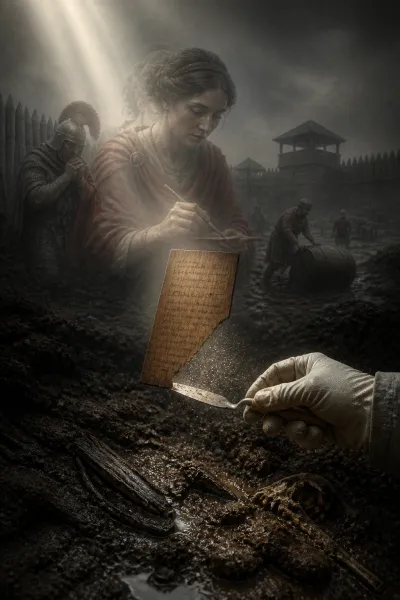 Buried for nearly two millennia in the waterlogged mud of a Northumberland fort, a cache of razor-thin wooden leaves has yielded the most intimate portrait of Roman Britain ever found. These are not grand inscriptions carved in stone, but the fleeting, ink-scrawled minutiae of daily life: a birthday invitation from Claudia Severa to Sulpicia Lepidina—the earliest known woman's handwriting in Latin—a soldier's desperate plea for warm socks and underwear, duty rosters listing missing men and lame horses, a slave named Masclus ordering beer for his unit. Preserved by the anaerobic peat that defeated every rule of archaeological survival, the Vindolanda tablets let us overhear the unfiltered voices of commanders, cavalrymen, merchants, and enslaved workers living on the knife's edge of empire.
*The Vindolanda Letters* tells the full story of this miraculous archive, from the heart-stopping moment in 1973 when a trowel struck the first fragile leaf and the ink began vanishing in the open air, to the cutting-edge infrared imaging and painstaking palaeography that rescued hundreds of texts from illegibility. It follows the Birley family's generations-long dedication to a site that transformed our understanding of the frontier, revealing a vibrant, multiethnic community of Tungrians, Batavians, and native Britons decades before Hadrian's Wall rose on the horizon. Here is the Roman army stripped of marble grandeur: its logistics, its prejudices (*brittunculi*—"wretched little Britons"), its infirmaries and stables, its household gods and brutal discipline, its hidden economy thriving in the shadow of the fort.
To read these letters is to collapse two thousand years of distance. The rain still falls on the Whin Sill; the longing for news from home, the frustration with bureaucracy, the warmth of a friend's invitation—these remain instantly recognizable. This book invites you into the officer's quarters where flavius Cerialis managed a garrison, the vicus where merchants haggled, the trenches where conservators raced against oxidation. It is a rare work of archaeology that reads like a novel, populated by real people whose voices survived only because the ground beneath them refused to let them go.
Table of Contents:
- Introduction
- Chapter 1 The Bog Beneath the Turf: An Accidental Discovery
- Chapter 2 Life on the Edge: The Frontier Before Hadrian's Wall
- Chapter 3 Wood, Wax, and Ink: The Anatomy of Roman Writing
- Chapter 4 Preserved in Mud: The Science of Anaerobic Survival
- Chapter 5 Reading the Unreadable: Infrared Light and Decipherment
- Chapter 6 The Birley Legacy: Excavating Vindolanda Across Generations
- Chapter 7 A Birthday Invitation: Claudia Severa and Roman Womanhood
- Chapter 8 The Commander's Household: Flavius Cerialis and Sulpicia Lepidina
- Chapter 9 Britannia’s Weather: Mud, Rain, and Demands for Warm Clothing
- Chapter 10 Socks, Underwear, and Sandals: Everyday Logistics of the Auxilia
- Chapter 11 The Grain Ratios: Bread, Beer, and Daily Rations
- Chapter 12 Brittunculi: Roman Attitudes Toward the Native Peoples
- Chapter 13 The Morning Parade: Duty Rosters and Missing Soldiers
- Chapter 14 The Stables and the Sick: Equine Care and the Fort Infirmary
- Chapter 15 Letters to Rome: Petitions, Patronage, and Imperial Favors
- Chapter 16 The Slave Masclus and the Brewer: Commercial Life Outside the Walls
- Chapter 17 Merchants and Camp Followers: The Hidden Economy of the Vicus
- Chapter 18 Cursive and Calligraphy: The Scripts of the Frontier Scribes
- Chapter 19 Religion and Superstition: Spirits, Shrines, and Household Gods
- Chapter 20 Violence and Punishment: The Darker Side of Garrison Discipline
- Chapter 21 The Changing Garrison: Tungrians, Batavians, and Foreign Recruits
- Chapter 22 Building Hadrian's Wall: The Shifting Purpose of the Fort
- Chapter 23 The Burning of the Archives: How the Tablets Came to be Buried
- Chapter 24 The Conservation Battle: Saving Brittle Birch and Alder
- Chapter 25 Whispers in the Peat: What the Tablets Teach Us About Rome
Author:
Published By:
Type:
Nonfiction
Sample:
Order:
Click to buy this ebook:
Buy Now