
Browse by Category
Fiction
- Action & Adventure
- African American
- Anthologies
- Children's Fiction
- Classics
- Comics & Graphic Novels
- Coming of Age
- Contemporary
- Cultural & Regional
- Drama
- Erotica
- Fantasy
- General
- Historical Fiction
- Horror
- Humor & Satire
- Literary Fiction
- Mystery, Thriller & Suspense
- Poetry
- Religious & Inspirational
- Romance
- Science Fiction
- Short Stories
- War & Military
- Westerns
- Women's Fiction
- Young Adult
Non-Fiction
- Antiques & Collectibles
- Arts & Photography
- Biographies & Memoirs
- Business & Money
- Children's Non-Fiction
-
Computers & Technology
- Artificial Intelligence
- Computer Science
- Cybersecurity & Cryptography
- Data Science & Analytics
- Databases & Big Data
- Game Development & Design
- General
- Hardware & DIY
- Mobile App Development
- Networking & Cloud Computing
- Operating Systems
- Programming
- Robotics
- Software
- Software Engineering
- User Experience (UX) & Design
- Web Development & Design
- Cooking, Food & Wine
- Crafts, Hobbies & Home
- Education & Teaching
- Engineering
- General
- Health, Fitness & Dieting
-
History
- African History
- African History - North Africa
- African History - Sub-Saharan Africa
- American History
- American History - 20th Century
- American History - Civil War
- American History - Colonial Period
- Ancient History
- Asian History
- Asian History - China
- Asian History - India
- Asian History - Japan
- Asian History - Southeast Asia
- European History
- European History - Ancient Greece
- European History - Ancient Rome
- European History - Medieval
- European History - Modern
- European History - Renaissance
- General
- Middle Eastern History
- Military History
- Military History - Aviation
- Military History - Naval
- Social & Cultural History
- World History
- Humor & Entertainment
- Industrial Technology
- Language Learning
- Law
- LGBTQ+ Non-Fiction
- Literary Criticism
- Medical Books
- Parenting & Relationships
- Philosophy
- Politics & Social Sciences
- Reference
- Religion & Spirituality
-
Science & Math
- Agricultural Sciences
- Astronomy & Space Science
- Behavioral Sciences
- Biological Sciences
- Botany & Plant Science
- Chemistry
- Earth Sciences
- Engineering - Chemical
- Engineering - Civil
- Engineering - Electrical
- Engineering - Mechanical
- Environment
- General
- Geology
- Mathematics
- Nature & Ecology
- Oceanography
- Paleontology
- Physics
- Statistics
- Self-Help
- Sports & Outdoors
- Study Aids
- Sustainability & Green Living
- Textbooks
- Transportation
- Travel
- True Crime
- Urban Planning & Development
- Veterinary Medicine
- Writing & Publishing
Jump to Section

Want unlimited access to all books published by MixCache.com (plus their audiobooks)? Try MixCache.com Total Access. Look for the MTA badge on book covers to identify included titles.
Access to infinite ebooks: Don't see the book you want? Suggest it and we'll create it (free!) for you from scratch with our powerful AI book writer. Then read it with MTA - besides profiting from any sales it makes!
The Filioque Clause Controversy
The Latin Phrase That Fractured the Christian Church
About this book:
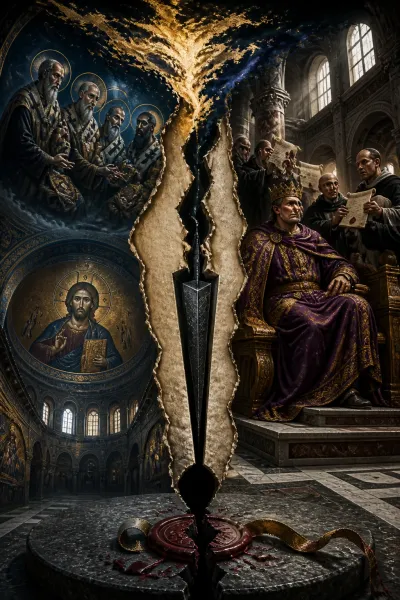 It began with a single Latin word—*Filioque*, "and the Son"—slipped into the ancient creed like a wedge into a fault line. What started as a local hedge against heresy in Visigothic Spain became the theological fault line that shattered Christian unity, separating East from West in a rupture that has endured for a millennium. In *The Filioque Clause Controversy*, that single phrase becomes the protagonist of a sweeping historical biography, guiding readers from the wind-swept *ruach* of Genesis through the philosophical labs of the Cappadocian Fathers and Augustine, into the imperial courts of Charlemagne, and onto the altar of Hagia Sophia where Cardinal Humbert’s bull of excommunication fell like a hammer blow in 1054.
This is not merely a history of doctrine; it is a thriller of ideas and power. You will witness how the precise metaphysics of the Greek East collided with the juridical genius of the Latin West, turning a mystery of divine procession into a weapon of political sovereignty. Follow the tragedy of the Council of Florence, where Emperor and Patriarchs knelt for a union that died in the streets of Constantinople, and hear Mark of Ephesus’s defiant cry: "Better the Turkish turban than the Latin mitre." The narrative carries you through the Reformation’s inheritance of the clause, the complex survival of Eastern Catholic churches, and into the modern ecumenical laboratories where theologians now struggle to turn a wall into a bridge.
Ultimately, this book reveals that the fight over *Filioque* was never just about a preposition. It was a battle over the very grammar of God: Who holds the pen that writes the Creed? Can the mystery of the Trinity be captured in human syntax without breaking it? Whether you are a student of theology, a lover of medieval history, or a seeker wondering how the Church fractured—and whether it can ever be whole again—this masterful account proves that the deepest divides are often born of the smallest words, and that healing them requires understanding not just what was said, but why it was spoken.
Author:
Published By:
Type:
Nonfiction
Sample:
Order:
Click to order this hardcover:
Buy Now