
Browse by Category
Fiction
- Action & Adventure
- African American
- Anthologies
- Children's Fiction
- Classics
- Comics & Graphic Novels
- Coming of Age
- Contemporary
- Cultural & Regional
- Drama
- Erotica
- Fantasy
- General
- Historical Fiction
- Horror
- Humor & Satire
- Literary Fiction
- Mystery, Thriller & Suspense
- Poetry
- Religious & Inspirational
- Romance
- Science Fiction
- Short Stories
- War & Military
- Westerns
- Women's Fiction
- Young Adult
Non-Fiction
- Antiques & Collectibles
- Arts & Photography
- Biographies & Memoirs
- Business & Money
- Children's Non-Fiction
-
Computers & Technology
- Artificial Intelligence
- Computer Science
- Cybersecurity & Cryptography
- Data Science & Analytics
- Databases & Big Data
- Game Development & Design
- General
- Hardware & DIY
- Mobile App Development
- Networking & Cloud Computing
- Operating Systems
- Programming
- Robotics
- Software
- Software Engineering
- User Experience (UX) & Design
- Web Development & Design
- Cooking, Food & Wine
- Crafts, Hobbies & Home
- Education & Teaching
- Engineering
- General
- Health, Fitness & Dieting
-
History
- African History
- African History - North Africa
- African History - Sub-Saharan Africa
- American History
- American History - 20th Century
- American History - Civil War
- American History - Colonial Period
- Ancient History
- Asian History
- Asian History - China
- Asian History - India
- Asian History - Japan
- Asian History - Southeast Asia
- European History
- European History - Ancient Greece
- European History - Ancient Rome
- European History - Medieval
- European History - Modern
- European History - Renaissance
- General
- Middle Eastern History
- Military History
- Military History - Aviation
- Military History - Naval
- Social & Cultural History
- World History
- Humor & Entertainment
- Industrial Technology
- Language Learning
- Law
- LGBTQ+ Non-Fiction
- Literary Criticism
- Medical Books
- Parenting & Relationships
- Philosophy
- Politics & Social Sciences
- Reference
- Religion & Spirituality
-
Science & Math
- Agricultural Sciences
- Astronomy & Space Science
- Behavioral Sciences
- Biological Sciences
- Botany & Plant Science
- Chemistry
- Earth Sciences
- Engineering - Chemical
- Engineering - Civil
- Engineering - Electrical
- Engineering - Mechanical
- Environment
- General
- Geology
- Mathematics
- Nature & Ecology
- Oceanography
- Paleontology
- Physics
- Statistics
- Self-Help
- Sports & Outdoors
- Study Aids
- Sustainability & Green Living
- Textbooks
- Transportation
- Travel
- True Crime
- Urban Planning & Development
- Veterinary Medicine
- Writing & Publishing
Jump to Section

Want unlimited access to all books published by MixCache.com (plus their audiobooks)? Try MixCache.com Total Access. Look for the MTA badge on book covers to identify included titles.
Access to infinite ebooks: Don't see the book you want? Suggest it and we'll create it (free!) for you from scratch with our powerful AI book writer. Then read it with MTA - besides profiting from any sales it makes!
The Stored-Program Computer Debate: von Neumann vs. Eckert and Mauchly
A Teaching Text with Exercises on Early Computer Architecture
About this book:
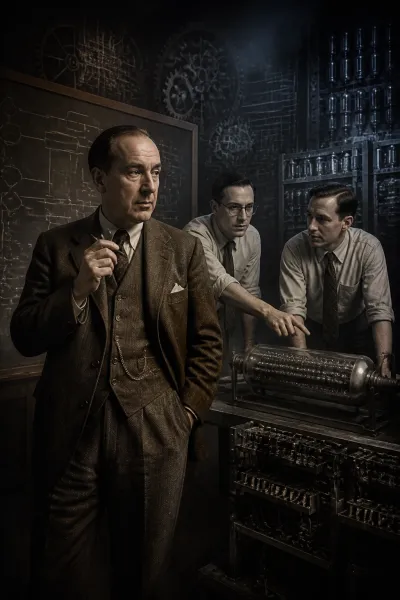 Who really invented the architecture that powers every modern device? The *First Draft of a Report on the EDVAC* bore only John von Neumann’s name, yet it crystallized years of breakthrough engineering by J. Presper Eckert and John Mauchly at the Moore School. *The Stored-Program Computer Debate* cuts through decades of mythology to reconstruct the explosive collision of mathematical theory and wartime engineering that birthed the digital age. From the mechanical gears of Babbage and the relay logic of Zuse to the mercury delay lines that made high-speed memory possible, this book traces the technical lineage that made the stored-program concept inevitable—and the human conflict that made its attribution controversial.
Designed as a rigorous teaching text, this volume moves beyond passive narrative to put the evidence in your hands. You will dissect the logical schemata of the *First Draft*, compare the architectural realities of the EDVAC and IAS machines, and analyze the courtroom transcripts of *Honeywell v. Sperry Rand* where history was litigated under oath. Structured exercises guide you through primary source memos, patent filings, and the shifting historiography of the 1950s to the present, equipping you to evaluate the roles of von Neumann’s synthesis, Eckert’s hardware genius, and Mauchly’s systems vision on their own merits.
Whether you are a computer scientist seeking the structural roots of your discipline, a historian of technology navigating the sociology of credit, or a student learning to read technical history critically, this book offers the definitive framework for understanding computing’s most consequential priority dispute. It reveals how the unification of data and instruction in a single address space was not a single "eureka" moment, but a hard-won convergence of physics, logic, and institutional power. Engage with the blueprints, the testimony, and the arguments—and decide for yourself how the modern world was architected.
Author:
Published By:
Type:
Nonfiction
Sample:
Order:
Click to order this hardcover:
Buy Now