
Browse by Category
Fiction
- Action & Adventure
- African American
- Anthologies
- Children's Fiction
- Classics
- Comics & Graphic Novels
- Coming of Age
- Contemporary
- Cultural & Regional
- Drama
- Erotica
- Fantasy
- General
- Historical Fiction
- Horror
- Humor & Satire
- Literary Fiction
- Mystery, Thriller & Suspense
- Poetry
- Religious & Inspirational
- Romance
- Science Fiction
- Short Stories
- War & Military
- Westerns
- Women's Fiction
- Young Adult
Non-Fiction
- Antiques & Collectibles
- Arts & Photography
- Biographies & Memoirs
- Business & Money
- Children's Non-Fiction
-
Computers & Technology
- Artificial Intelligence
- Computer Science
- Cybersecurity & Cryptography
- Data Science & Analytics
- Databases & Big Data
- Game Development & Design
- General
- Hardware & DIY
- Mobile App Development
- Networking & Cloud Computing
- Operating Systems
- Programming
- Robotics
- Software
- Software Engineering
- User Experience (UX) & Design
- Web Development & Design
- Cooking, Food & Wine
- Crafts, Hobbies & Home
- Education & Teaching
- Engineering
- General
- Health, Fitness & Dieting
-
History
- African History
- African History - North Africa
- African History - Sub-Saharan Africa
- American History
- American History - 20th Century
- American History - Civil War
- American History - Colonial Period
- Ancient History
- Asian History
- Asian History - China
- Asian History - India
- Asian History - Japan
- Asian History - Southeast Asia
- European History
- European History - Ancient Greece
- European History - Ancient Rome
- European History - Medieval
- European History - Modern
- European History - Renaissance
- General
- Middle Eastern History
- Military History
- Military History - Aviation
- Military History - Naval
- Social & Cultural History
- World History
- Humor & Entertainment
- Industrial Technology
- Language Learning
- Law
- LGBTQ+ Non-Fiction
- Literary Criticism
- Medical Books
- Parenting & Relationships
- Philosophy
- Politics & Social Sciences
- Reference
- Religion & Spirituality
-
Science & Math
- Agricultural Sciences
- Astronomy & Space Science
- Behavioral Sciences
- Biological Sciences
- Botany & Plant Science
- Chemistry
- Earth Sciences
- Engineering - Chemical
- Engineering - Civil
- Engineering - Electrical
- Engineering - Mechanical
- Environment
- General
- Geology
- Mathematics
- Nature & Ecology
- Oceanography
- Paleontology
- Physics
- Statistics
- Self-Help
- Sports & Outdoors
- Study Aids
- Sustainability & Green Living
- Textbooks
- Transportation
- Travel
- True Crime
- Urban Planning & Development
- Veterinary Medicine
- Writing & Publishing
Jump to Section

Want unlimited access to all books published by MixCache.com (plus their audiobooks)? Try MixCache.com Total Access. Look for the MTA badge on book covers to identify included titles.
Access to infinite ebooks: Don't see the book you want? Suggest it and we'll create it (free!) for you from scratch with our powerful AI book writer. Then read it with MTA - besides profiting from any sales it makes!
The Aqueducts of Ancient Rome
How Water Shaped an Empire
About this book:
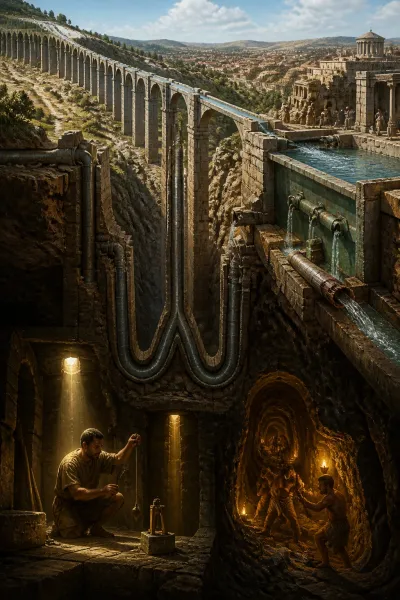 Rome's million-person population didn't thrive on luck—it thrived on a hydraulic revolution. *The Aqueducts of Ancient Rome* traces the staggering five-century engineering campaign that turned a cluster of thirsty hill villages into the ancient world's first metropolis of a million souls. From the subterranean tunnels that carried 80% of the empire's water unseen beneath mountains, to the inverted siphons that defied gravity under crushing pressure, to the pozzolanic concrete that rendered channels virtually immortal—this is the definitive biography of the infrastructure that made Rome possible. You'll walk beside the surveyors who plotted gradients of mere inches per mile using only plumb lines and water levels, descend the sinking shafts where slaves hacked through limestone by lamplight, and stand in the *castella* where Frontinus waged bureaucratic war against corrosion, corruption, and the endless theft of imperial water.
But this is no mere technical manual. Water was the currency of Roman power: the public fountains that hydrated plebeians and slaves alike, the thermae that turned sanitation into civic theater, the provincial aqueducts that announced *Romanitas* from Spain to Syria. When the Goths severed the aqueducts in 537 CE, they didn't just cut pipes—they killed the city, collapsing its population from a million to thirty thousand in a generation. Through twenty-five vivid chapters spanning geology, labor, law, and the daily miracle of clean water at every street corner, this book reveals how a civilization mastered gravity to sustain an empire—and why the lessons of their pipes, their bureaucracy, and their ultimate failure remain urgently relevant to every modern city living on borrowed water and aging infrastructure.
Author:
Published By:
Type:
Nonfiction
Sample:
Order:
Click to buy this ebook:
Buy Now