
Browse by Category
Fiction
- Action & Adventure
- African American
- Anthologies
- Children's Fiction
- Classics
- Comics & Graphic Novels
- Coming of Age
- Contemporary
- Cultural & Regional
- Drama
- Erotica
- Family Life
- Fantasy
- General
- Historical Fiction
- Horror
- Humor & Satire
- Literary Fiction
- Mystery, Thriller & Suspense
- Poetry
- Religious & Inspirational
- Romance
- Science Fiction
- Short Stories
- War & Military
- Westerns
- Women's Fiction
- Young Adult
Non-Fiction
- Antiques & Collectibles
- Arts & Photography
- Biographies & Memoirs
- Business & Money
- Children's Non-Fiction
-
Computers & Technology
- Artificial Intelligence
- Computer Science
- Cybersecurity & Cryptography
- Data Science & Analytics
- Databases & Big Data
- Game Development & Design
- General
- Hardware & DIY
- Mobile App Development
- Networking & Cloud Computing
- Operating Systems
- Programming
- Robotics
- Software
- Software Engineering
- User Experience (UX) & Design
- Web Development & Design
- Cooking, Food & Wine
- Crafts, Hobbies & Home
- Education & Teaching
- Engineering
- General
- Health, Fitness & Dieting
-
History
- African History
- African History - North Africa
- African History - Sub-Saharan Africa
- American History
- American History - 20th Century
- American History - Civil War
- American History - Colonial Period
- Ancient History
- Asian History
- Asian History - China
- Asian History - India
- Asian History - Japan
- Asian History - Southeast Asia
- European History
- European History - Ancient Greece
- European History - Ancient Rome
- European History - Medieval
- European History - Modern
- European History - Renaissance
- General
- Middle Eastern History
- Military History
- Military History - Aviation
- Military History - Naval
- Social & Cultural History
- World History
- Humor & Entertainment
- Industrial Technology
- Language Learning
- Law
- LGBTQ+ Non-Fiction
- Literary Criticism
- Medical Books
- Parenting & Relationships
- Philosophy
- Politics & Social Sciences
- Reference
- Religion & Spirituality
-
Science & Math
- Agricultural Sciences
- Astronomy & Space Science
- Behavioral Sciences
- Biological Sciences
- Botany & Plant Science
- Chemistry
- Earth Sciences
- Engineering - Chemical
- Engineering - Civil
- Engineering - Electrical
- Engineering - Mechanical
- Environment
- General
- Geology
- Mathematics
- Nature & Ecology
- Oceanography
- Paleontology
- Physics
- Statistics
- Self-Help
- Sports & Outdoors
- Study Aids
- Sustainability & Green Living
- Textbooks
- Transportation
- Travel
- True Crime
- Urban Planning & Development
- Veterinary Medicine
- Writing & Publishing
Jump to Section
MixCache.com Total Access
Unlimited reading and audiobooks for every book published by MixCache.com.
Included titles carry the MTA badge.
Learn more →
Eisenhower
MTA
The Life of an American President
About this book:
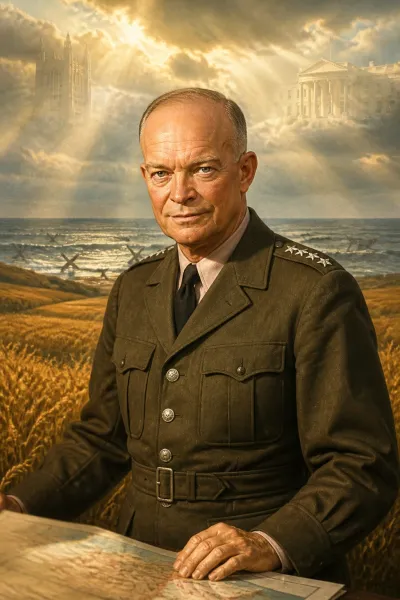
Dwight D. Eisenhower’s journey from a modest Kansas upbringing to the pinnacle of global power is a testament to steady, principled leadership forged in adversity. After a solid but unspectacular West Point career, Eisenhower spent the interwar years honing his logistical and administrative genius under mentors like Fox Conner and Douglas MacArthur, serving in the Philippines and stateside posts. World War II catapulted him from obscurity to Supreme Allied Commander, where his unique talent for coalition management and meticulous planning orchestrated the invasions of North Africa, Sicily, and ultimately, the D-Day landing in Normandy. His calm demeanor and strategic patience guided the Allied forces through the Battle of the Bulge to final victory in Europe, establishing him as the indispensable architect of the Western Alliance.
Transitioning from military to political leadership, Eisenhower served as Army Chief of Staff, President of Columbia University, and the first Supreme Commander of NATO, where he solidified the Western defense structure against Soviet expansion. Drafted by the Republican Party in 1952, he won the presidency in a landslide on a platform of ending the Korean War and restoring integrity to government. His two terms defined "Modern Republicanism"—preserving New Deal social programs while enforcing fiscal discipline and launching the transformative Interstate Highway System. In foreign policy, his "New Look" strategy prioritized nuclear deterrence and alliances over costly conventional deployments, successfully navigating crises in Suez, Lebanon, and Berlin, though his tenure was marred by the U-2 spy plane incident that derailed a hoped-for détente with the Soviet Union.
Domestically, Eisenhower’s record on civil rights was cautious yet pivotal; he completed military desegregation, appointed Chief Justice Earl Warren, and decisively deployed federal troops to enforce school integration in Little Rock, affirming federal supremacy over state defiance. The Soviet launch of Sputnik spurred him to create NASA and champion science education, laying the groundwork for American space dominance. In his prescient 1961 Farewell Address, he warned the nation against the "military-industrial complex," urging vigilance against the undue influence of the permanent defense establishment on democratic processes. Retiring to Gettysburg, he spent his final years writing memoirs and advising successors, leaving a legacy of peace, prosperity, and pragmatic moderation that historians increasingly recognize as a masterclass in steady, constitutional leadership during a perilous era.
What You'll Find Inside:
- Eisenhower's remarkable rise from a modest Kansas upbringing through West Point to becoming Supreme Allied Commander in WWII, revealing how his early experiences shaped his leadership philosophy.
- Detailed accounts of his WWII command including Operation Torch, D-Day planning, the Normandy campaign, and Victory in Europe, showcasing his coalition management and strategic decision-making under immense pressure.
- His two-term presidency examined through the lens of 'Modern Republicanism' — balancing fiscal conservatism with social programs, creating the Interstate Highway System, and navigating Civil Rights challenges like Little Rock.
- Cold War leadership including NATO's creation, the Suez Crisis, U-2 incident, Korea armistice, and his prescient warnings about Vietnam and the military-industrial complex in his famous Farewell Address.
- A nuanced portrait of Eisenhower's 'hidden-hand' leadership style — his emphasis on integrity, delegation, consensus-building, and balance — and how it influenced both military command and presidential governance.
Who's It For:
This biography is ideal for history enthusiasts seeking a comprehensive examination of Eisenhower's military and presidential leadership during WWII and the Cold War. Readers interested in leadership studies will appreciate the detailed analysis of his coalition-building, decision-making, and management philosophy. Political science students and general readers alike will benefit from the nuanced portrayal of his domestic policies, foreign policy challenges, and enduring institutional legacies like NATO and the Interstate Highway System.
Table of Contents:
- Introduction
- Chapter 1 Early Life and West Point
- Chapter 2 Junior Officer and Marriage
- Chapter 3 The Philippines and MacArthur's Influence
- Chapter 4 Rising Through the Ranks
- Chapter 5 World War II: North Africa and Sicily
- Chapter 6 D-Day Planning and Execution
- Chapter 7 Supreme Allied Commander
- Chapter 8 Victory in Europe
- Chapter 9 Post-War Germany and Army Chief of Staff
- Chapter 10 Columbia University Presidency
- Chapter 11 NATO Supreme Commander
- Chapter 12 The Call to Politics
- Chapter 13 The 1952 Presidential Campaign
- Chapter 14 First Term: Domestic Policies
- Chapter 15 Cold War Beginnings and Foreign Policy Challenges
- Chapter 16 The Suez Crisis
- Chapter 17 Civil Rights and Little Rock
- Chapter 18 The Space Race and Sputnik
- Chapter 19 Second Term: Continuing Challenges
- Chapter 20 U-2 Incident and Khrushchev
- Chapter 21 Farewell Address and Military-Industrial Complex Warning
- Chapter 22 Retirement and Memoirs
- Chapter 23 Reflections on Leadership
- Chapter 24 Legacy of a President
- Chapter 25 Eisenhower's Enduring Influence
Author:
Published By:
Date Published:
November 24, 2026
Type:
Nonfiction
Language:
English
Word Count:
40,866 words
Reading Time:
2 hours 52 minutes
Sample:
Order:
Order Eisenhower (Paperback) on MixCache.com:
Buy NowPrint copy is made to order and ships worldwide. Includes the ebook free, ready to read instantly.
$5 account credit for all new MixCache.com accounts, usable toward any ebook purchase!*





 Includes Audiobook