
Browse by Category
Fiction
- Action & Adventure
- African American
- Anthologies
- Children's Fiction
- Classics
- Comics & Graphic Novels
- Coming of Age
- Contemporary
- Cultural & Regional
- Drama
- Erotica
- Family Life
- Fantasy
- General
- Historical Fiction
- Horror
- Humor & Satire
- Literary Fiction
- Mystery, Thriller & Suspense
- Poetry
- Religious & Inspirational
- Romance
- Science Fiction
- Short Stories
- War & Military
- Westerns
- Women's Fiction
- Young Adult
Non-Fiction
- Antiques & Collectibles
- Arts & Photography
- Biographies & Memoirs
- Business & Money
- Children's Non-Fiction
-
Computers & Technology
- Artificial Intelligence
- Computer Science
- Cybersecurity & Cryptography
- Data Science & Analytics
- Databases & Big Data
- Game Development & Design
- General
- Hardware & DIY
- Mobile App Development
- Networking & Cloud Computing
- Operating Systems
- Programming
- Robotics
- Software
- Software Engineering
- User Experience (UX) & Design
- Web Development & Design
- Cooking, Food & Wine
- Crafts, Hobbies & Home
- Education & Teaching
- Engineering
- General
- Health, Fitness & Dieting
-
History
- African History
- African History - North Africa
- African History - Sub-Saharan Africa
- American History
- American History - 20th Century
- American History - Civil War
- American History - Colonial Period
- Ancient History
- Asian History
- Asian History - China
- Asian History - India
- Asian History - Japan
- Asian History - Southeast Asia
- European History
- European History - Ancient Greece
- European History - Ancient Rome
- European History - Medieval
- European History - Modern
- European History - Renaissance
- General
- Middle Eastern History
- Military History
- Military History - Aviation
- Military History - Naval
- Social & Cultural History
- World History
- Humor & Entertainment
- Industrial Technology
- Language Learning
- Law
- LGBTQ+ Non-Fiction
- Literary Criticism
- Medical Books
- Parenting & Relationships
- Philosophy
- Politics & Social Sciences
- Reference
- Religion & Spirituality
-
Science & Math
- Agricultural Sciences
- Astronomy & Space Science
- Behavioral Sciences
- Biological Sciences
- Botany & Plant Science
- Chemistry
- Earth Sciences
- Engineering - Chemical
- Engineering - Civil
- Engineering - Electrical
- Engineering - Mechanical
- Environment
- General
- Geology
- Mathematics
- Nature & Ecology
- Oceanography
- Paleontology
- Physics
- Statistics
- Self-Help
- Sports & Outdoors
- Study Aids
- Sustainability & Green Living
- Textbooks
- Transportation
- Travel
- True Crime
- Urban Planning & Development
- Veterinary Medicine
- Writing & Publishing
Jump to Section
MixCache.com Total Access
Unlimited reading and audiobooks for every book published by MixCache.com.
Included titles carry the MTA badge.
Learn more →Kim Jong Il MTA
About this book:
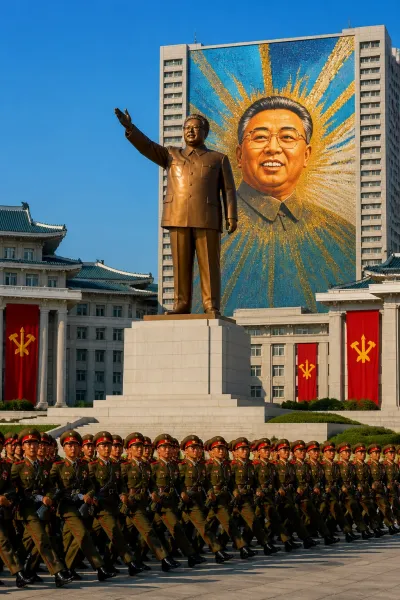
Kim Jong Il’s life and seventeen-year rule over North Korea were defined by the meticulous consolidation of a dynastic totalitarian state forged in the shadow of his father, Kim Il Sung. Groomed for power through the Workers' Party’s Organization and Guidance Department and the propaganda apparatus, he cultivated a personality cult portraying him as the "Dear Leader"—a military genius and cultural visionary—while suppressing dissent through a pervasive surveillance state, a rigid songbun caste system, and a vast network of political prison camps. His leadership style blended obsessive micro-management with calculated brinkmanship, elevating the military to the supreme institution via the "Songun" (Military-First) policy to ensure regime survival amidst the collapse of the Soviet bloc.
The defining catastrophe of his tenure was the "Arduous March" famine of the 1990s, triggered by the loss of Soviet aid, systemic economic failure, and natural disasters, which killed hundreds of thousands and shattered the state’s public distribution system. This crisis birthed the informal jangmadang markets, forcing a reluctant, bottom-up marketization that the regime tolerated but never fully embraced, even as it pursued limited, often contradictory top-down reforms. Simultaneously, Kim Jong Il relentlessly advanced a clandestine nuclear weapons program—supplemented by chemical and biological arsenals—viewing it as the ultimate guarantor of sovereignty against perceived U.S. hostility. He masterfully leveraged this program through diplomatic brinkmanship, extracting aid and concessions via the Agreed Framework and Six-Party Talks while steadily moving toward weaponization, culminating in nuclear tests in 2006 and 2009.
Despite severe human rights abuses and economic stagnation, Kim Jong Il maintained absolute control through a complex inner circle of family loyalists—most notably his sister Kim Kyong Hui and her husband Jang Song Thaek—and a privileged Pyongyang elite bought off with luxury goods and status. His personal passion for cinema manifested in the state’s total weaponization of culture, from mass games to the infamous abduction of South Korean filmmakers, to reinforce ideological conformity. As his health declined following a 2008 stroke, he engineered a rapid, unprecedented third-generation succession for his youngest son, Kim Jong Un, securing military and party allegiance before his death in December 2011.
Kim Jong Il’s enduring legacy is a nuclear-armed, deeply isolated state structured around a quasi-divine family dynasty and a militarized economy that prioritizes regime security over human welfare. He successfully defied predictions of collapse, bequeathing to his son a potent nuclear deterrent, a entrenched Songun system, a resilient but uncontrolled market economy, and a totalitarian apparatus of control that continues to define North Korea’s internal repression and external unpredictability. His shadow remains the foundational architecture of the modern Hermit Kingdom.
What You'll Find Inside:
- The meticulous, decades-long grooming of Kim Jong Il as the heir to Kim Il Sung, establishing the world's first communist dynastic succession through control of the party apparatus (OGD) and propaganda.
- The institutionalization of 'Songun' (Military-First Politics) as the governing ideology, prioritizing the Korean People's Army over the party and civilian economy to secure regime survival and justify nuclear development.
- The catastrophic 'Arduous March' famine of the 1990s, caused by systemic economic failure and the loss of Soviet aid, which killed hundreds of thousands and birthed the informal 'jangmadang' markets that quietly undermined state control.
- The weaponization of culture and an all-encompassing personality cult—including cinema, mass games, and information blockade—to deify the Kim family and enforce ideological conformity across a closed society.
- A foreign policy defined by nuclear brinkmanship and diplomatic maneuvering, leveraging weapons of mass destruction to extract aid and security guarantees while maintaining a strategic alliance with China and a hostile stance toward the U.S. and South Korea.
Who's It For:
This book is essential reading for students and scholars of East Asian politics, international relations, and authoritarian regimes, as well as policy analysts and intelligence professionals focused on Korean Peninsula security. General readers interested in modern history, human rights, and the mechanics of totalitarian propaganda will find a comprehensive, accessible analysis of one of the 20th century's most enigmatic dictatorships.
Table of Contents:
- Introduction
- Chapter 1 The Early Years: A Son of the Revolution
- Chapter 2 Shaping a Successor: Under Kim Il Sung's Shadow
- Chapter 3 Rise to Power: Consolidating Influence
- Chapter 4 The Arduous March: Famine and Hardship
- Chapter 5 Nuclear Ambitions: A Nation's Quest
- Chapter 6 Songun: Military-First Politics
- Chapter 7 The Hermit Kingdom: Isolation and Control
- Chapter 8 Propaganda and Personality Cult: Crafting the Image
- Chapter 9 Economic Struggles: Attempts at Reform
- Chapter 10 International Relations: A Complex Web
- Chapter 11 Inter-Korean Dialogue: Hopes and Setbacks
- Chapter 12 The Entertainment Mogul: Cinema and Culture
- Chapter 13 Health and Succession: Whispers of Change
- Chapter 14 The Dear Leader's Inner Circle: Power Dynamics
- Chapter 15 Defectors' Stories: Glimpses Outside
- Chapter 16 Human Rights: A Troubling Record
- Chapter 17 The Cult of Personality: Beyond Kim Il Sung
- Chapter 18 Weapons of Mass Destruction: A Global Concern
- Chapter 19 Diplomacy and Brinkmanship: Playing the Long Game
- Chapter 20 The Pyongyang Elite: Life at the Top
- Chapter 21 Daily Life in North Korea: Surviving the System
- Chapter 22 Leadership Style: Charisma and Control
- Chapter 23 The End of an Era: Transition and Legacy
- Chapter 24 The World Reacts: Kim Jong Il's Passing
- Chapter 25 Enduring Impact: Kim Jong Il's Shadow on North Korea
Author:
Published By:
Date Published:
November 23, 2026
Type:
Nonfiction
Language:
English
Word Count:
38,791 words
Reading Time:
2 hours 43 minutes
Sample:
Order:
Buy the Kim Jong Il ebook on MixCache.com:
Buy Now
Full ebook will be available immediately
- read online or download as a PDF file.
$5 account credit for all new MixCache.com accounts, usable toward any ebook purchase!*
MixCache.com Total Access
Get unlimited access to this book + all books published by MixCache.com for $11.99/month
Subscribe to MTA




Ratings & Reviews
Ask Questions About This Book
Have a question about the content? Ask our AI assistant!
Start by asking a question about "Kim Jong Il"
Example: "Does this book mention William Shakespeare?"
Thinking...