
Browse by Category
Fiction
- Action & Adventure
- African American
- Anthologies
- Children's Fiction
- Classics
- Comics & Graphic Novels
- Coming of Age
- Contemporary
- Cultural & Regional
- Drama
- Erotica
- Family Life
- Fantasy
- General
- Historical Fiction
- Horror
- Humor & Satire
- Literary Fiction
- Mystery, Thriller & Suspense
- Poetry
- Religious & Inspirational
- Romance
- Science Fiction
- Short Stories
- War & Military
- Westerns
- Women's Fiction
- Young Adult
Non-Fiction
- Antiques & Collectibles
- Arts & Photography
- Biographies & Memoirs
- Business & Money
- Children's Non-Fiction
-
Computers & Technology
- Artificial Intelligence
- Computer Science
- Cybersecurity & Cryptography
- Data Science & Analytics
- Databases & Big Data
- Game Development & Design
- General
- Hardware & DIY
- Mobile App Development
- Networking & Cloud Computing
- Operating Systems
- Programming
- Robotics
- Software
- Software Engineering
- User Experience (UX) & Design
- Web Development & Design
- Cooking, Food & Wine
- Crafts, Hobbies & Home
- Education & Teaching
- Engineering
- General
- Health, Fitness & Dieting
-
History
- African History
- African History - North Africa
- African History - Sub-Saharan Africa
- American History
- American History - 20th Century
- American History - Civil War
- American History - Colonial Period
- Ancient History
- Asian History
- Asian History - China
- Asian History - India
- Asian History - Japan
- Asian History - Southeast Asia
- European History
- European History - Ancient Greece
- European History - Ancient Rome
- European History - Medieval
- European History - Modern
- European History - Renaissance
- General
- Middle Eastern History
- Military History
- Military History - Aviation
- Military History - Naval
- Social & Cultural History
- World History
- Humor & Entertainment
- Industrial Technology
- Language Learning
- Law
- LGBTQ+ Non-Fiction
- Literary Criticism
- Medical Books
- Parenting & Relationships
- Philosophy
- Politics & Social Sciences
- Reference
- Religion & Spirituality
-
Science & Math
- Agricultural Sciences
- Astronomy & Space Science
- Behavioral Sciences
- Biological Sciences
- Botany & Plant Science
- Chemistry
- Earth Sciences
- Engineering - Chemical
- Engineering - Civil
- Engineering - Electrical
- Engineering - Mechanical
- Environment
- General
- Geology
- Mathematics
- Nature & Ecology
- Oceanography
- Paleontology
- Physics
- Statistics
- Self-Help
- Sports & Outdoors
- Study Aids
- Sustainability & Green Living
- Textbooks
- Transportation
- Travel
- True Crime
- Urban Planning & Development
- Veterinary Medicine
- Writing & Publishing
Jump to Section
MixCache.com Total Access
Unlimited reading and audiobooks for every book published by MixCache.com.
Included titles carry the MTA badge.
Learn more →
A History of JPMorgan Chase
MTA
The Story of an S&P 500 Company
About this book:

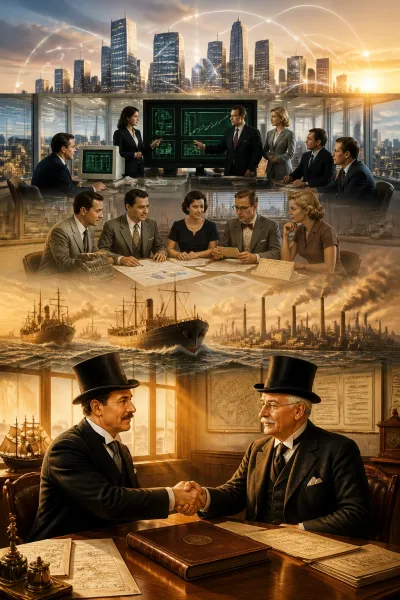
The history of JPMorgan Chase traces a remarkable lineage from the founding of The Bank of the Manhattan Company in 1799 and the rise of J. Pierpont Morgan’s merchant banking empire in the mid-19th century. These distinct threads—one rooted in commercial banking innovation and the other in high-finance industrial consolidation—forged the bedrock of American finance. The 20th century tested these institutions through world wars, the Great Depression, and the regulatory straitjacket of the Glass-Steagall Act, which forcibly separated commercial and investment banking. This split created two powerful descendants: the commercial banking giants Chase Manhattan and Chemical Bank, and the investment banking powerhouse Morgan Stanley, while J.P. Morgan & Co. navigated a constrained but prestigious wholesale banking path.
The final decades of the 20th century witnessed a reversal of this fragmentation, driven by deregulation, technological revolution, and a relentless drive for scale. A cascade of mega-mergers—Chemical absorbing Manufacturers Hanover, then merging with Chase Manhattan, and finally the 2000 union of Chase Manhattan with J.P. Morgan & Co.—reassembled the "House of Morgan" into a modern universal bank: JPMorgan Chase & Co. This new superpower leveraged the Gramm-Leach-Bliley Act to integrate commercial lending, investment banking, asset management, and retail banking under one roof, establishing a dominant global footprint and a diversified revenue base that promised stability through economic cycles.
The firm’s resilience was decisively proven during the 2008 financial crisis. Under CEO Jamie Dimon, JPMorgan Chase entered the turmoil with a "fortress balance sheet" and limited subprime exposure, allowing it to act as a stabilizing force rather than a victim. At the government's behest, it acquired the failing Bear Stearns and Washington Mutual, emerging from the crisis larger and more systemically critical. However, the post-crisis era brought intense regulatory scrutiny via Dodd-Frank, the Volcker Rule, and massive compliance costs, alongside significant legal settlements—including the "London Whale" trading loss and legacy mortgage liabilities—that forced a cultural pivot toward rigorous risk management and ethical conduct.
Today, JPMorgan Chase stands as an enduring S&P 500 giant, defined by its ability to continuously reinvent itself across centuries. The firm is now navigating a landscape shaped by artificial intelligence, blockchain, fintech disruption, and the imperatives of sustainable finance and financial inclusion. By balancing its historical prudence with massive investments in technology and talent, the institution seeks to maintain its leadership in a dynamic world, demonstrating that the strategic vision and adaptability forged by figures from Aaron Burr to Jamie Dimon remain the ultimate drivers of its sustained success.
What You'll Find Inside:
- The 200+ year evolution from Aaron Burr's Bank of the Manhattan Company (1799) through J. Pierpont Morgan's industrial consolidations to the modern JPMorgan Chase & Co. universal banking giant.
- J. Pierpont Morgan's transformative role as a de facto central banker who reshaped American industry through railroad and steel consolidations, and his decisive intervention during the Panic of 1907 that catalyzed the creation of the Federal Reserve.
- The profound impact of regulatory regimes — Glass-Steagall's forced separation of commercial and investment banking, Gramm-Leach-Bliley's repeal enabling universal banking, and Dodd-Frank's post-2008 compliance overhaul — on the firm's structure and strategy.
- A century of strategic mergers (Chemical Bank, Manufacturers Hanover, Chase Manhattan, J.P. Morgan & Co., Bear Stearns, Washington Mutual) that systematically built scale, diversified revenue, and created a global financial superpower.
- The firm's resilience through successive crises — the Great Depression, 9/11, the 2008 financial crisis — driven by conservative risk management, a 'fortress balance sheet' philosophy, and leadership from figures like Jamie Dimon.
Who's It For:
This book is ideal for financial history enthusiasts, banking professionals, and investors seeking a comprehensive case study of institutional longevity. Students of economics and business will value its detailed analysis of how regulatory shifts, technological disruption, and crisis management shape a global financial leader. General readers interested in American capitalism's evolution will appreciate the narrative weaving together iconic figures, pivotal mergers, and the transformation of finance from colonial trade to digital banking.
Table of Contents:
- Introduction
- Chapter 1: The Roots of American Finance: Tracing the Earliest Predecessors
- Chapter 2: Founding Fathers and Financial Firsts: The Bank of the Manhattan Company's Genesis
- Chapter 3: From Merchant Banking to Modern Finance: The Rise of J. Pierpont Morgan
- Chapter 4: Consolidations and Cartels: Forging the House of Morgan
- Chapter 5: The Panic of 1907: Morgan's Intervention and the Birth of the Federal Reserve Idea
- Chapter 6: War, Boom, and Bust: JPMorgan During the Roaring Twenties and the Great Depression
- Chapter 7: Navigating Regulatory Seas: Glass-Steagall and the Post-War Banking Landscape
- Chapter 8: Chemical Bank's Ascent: A Parallel Journey of Growth and Innovation
- Chapter 9: The Dawn of the Modern Era: Mergers and Global Expansion in the Late 20th Century
- Chapter 10: Manufacturers Hanover and Chase Manhattan: A Union of Banking Giants
- Chapter 11: The Investment Banking Revolution: Adapting to New Markets and Technologies
- Chapter 12: The Turn of the Millennium: Preparing for a New Financial Landscape
- Chapter 13: The J.P. Morgan & Co. and Chase Manhattan Bank Merger: Creating a Superpower
- Chapter 14: Post-Merger Integration: Forging a Unified Corporate Culture
- Chapter 15: Innovation and Technology: Driving the Digital Transformation of Banking
- Chapter 16: Global Reach: Expanding Influence Across Continents
- Chapter 17: Navigating Financial Crises: From the Dot-Com Bubble to the Subprime Meltdown
- Chapter 18: The 2008 Financial Crisis: A Test of Resilience and Leadership
- Chapter 19: Regulatory Aftermath: Dodd-Frank and a New Era of Compliance
- Chapter 20: Acquisitions and Divestitures: Shaping the Modern JPMorgan Chase
- Chapter 21: Leadership and Legacy: The Enduring Impact of Key Figures
- Chapter 22: Corporate Social Responsibility: Community Engagement and Philanthropy
- Chapter 23: Challenges and Controversies: Addressing Ethical and Legal Complexities
- Chapter 24: The Future of Finance: JPMorgan Chase in the 21st Century
- Chapter 25: An Enduring S&P 500 Giant: Sustaining Success in a Dynamic World
Author:
Published By:
Date Published:
November 19, 2026
Type:
Nonfiction
Language:
English
Word Count:
45,867 words
Reading Time:
3 hours 13 minutes
Sample:
Order:
Buy the A History of JPMorgan Chase ebook on MixCache.com:
Buy Now
Full ebook will be available immediately
- read online or download as a PDF file.
$5 account credit for all new MixCache.com accounts, usable toward any ebook purchase!*
MixCache.com Total Access
Get unlimited access to this book + all books published by MixCache.com for $11.99/month
Subscribe to MTA




Ratings & Reviews
Ask Questions About This Book
Have a question about the content? Ask our AI assistant!
Start by asking a question about "A History of JPMorgan Chase"
Example: "Does this book mention William Shakespeare?"
Thinking...