
Browse by Category
Fiction
- Action & Adventure
- African American
- Anthologies
- Children's Fiction
- Classics
- Comics & Graphic Novels
- Coming of Age
- Contemporary
- Cultural & Regional
- Drama
- Erotica
- Fantasy
- General
- Historical Fiction
- Horror
- Humor & Satire
- Literary Fiction
- Mystery, Thriller & Suspense
- Poetry
- Religious & Inspirational
- Romance
- Science Fiction
- Short Stories
- War & Military
- Westerns
- Women's Fiction
- Young Adult
Non-Fiction
- Antiques & Collectibles
- Arts & Photography
- Biographies & Memoirs
- Business & Money
- Children's Non-Fiction
-
Computers & Technology
- Artificial Intelligence
- Computer Science
- Cybersecurity & Cryptography
- Data Science & Analytics
- Databases & Big Data
- Game Development & Design
- General
- Hardware & DIY
- Mobile App Development
- Networking & Cloud Computing
- Operating Systems
- Programming
- Robotics
- Software
- Software Engineering
- User Experience (UX) & Design
- Web Development & Design
- Cooking, Food & Wine
- Crafts, Hobbies & Home
- Education & Teaching
- Engineering
- General
- Health, Fitness & Dieting
-
History
- African History
- African History - North Africa
- African History - Sub-Saharan Africa
- American History
- American History - 20th Century
- American History - Civil War
- American History - Colonial Period
- Ancient History
- Asian History
- Asian History - China
- Asian History - India
- Asian History - Japan
- Asian History - Southeast Asia
- European History
- European History - Ancient Greece
- European History - Ancient Rome
- European History - Medieval
- European History - Modern
- European History - Renaissance
- General
- Middle Eastern History
- Military History
- Military History - Aviation
- Military History - Naval
- Social & Cultural History
- World History
- Humor & Entertainment
- Industrial Technology
- Language Learning
- Law
- LGBTQ+ Non-Fiction
- Literary Criticism
- Medical Books
- Parenting & Relationships
- Philosophy
- Politics & Social Sciences
- Reference
- Religion & Spirituality
-
Science & Math
- Agricultural Sciences
- Astronomy & Space Science
- Behavioral Sciences
- Biological Sciences
- Botany & Plant Science
- Chemistry
- Earth Sciences
- Engineering - Chemical
- Engineering - Civil
- Engineering - Electrical
- Engineering - Mechanical
- Environment
- General
- Geology
- Mathematics
- Nature & Ecology
- Oceanography
- Paleontology
- Physics
- Statistics
- Self-Help
- Sports & Outdoors
- Study Aids
- Sustainability & Green Living
- Textbooks
- Transportation
- Travel
- True Crime
- Urban Planning & Development
- Veterinary Medicine
- Writing & Publishing
Jump to Section
MixCache.com Total Access
Unlimited reading and audiobooks for every book published by MixCache.com.
Included titles carry the MTA badge.
Learn more →
A History of Kroger
MTA
The Story of an S&P 500 Company
About this book:
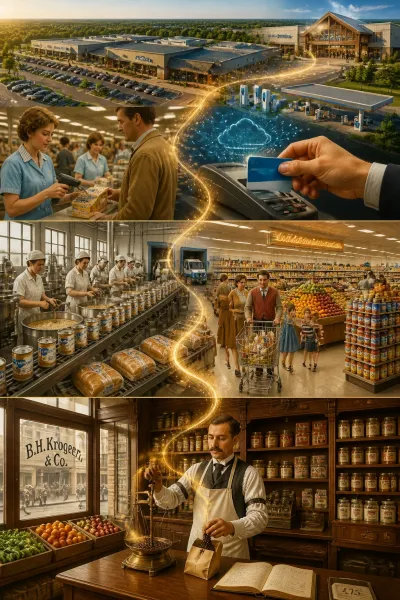
From a single Cincinnati storefront founded in 1883 with $372 in life savings, Kroger evolved into a national S&P 500 powerhouse by adhering to Bernard Kroger’s core principles: cutting out middlemen to offer quality goods at fair prices, pioneering private labels, and vertically integrating manufacturing and supply chains. The company navigated the Great Depression and World War II by doubling down on value and efficiency, then capitalized on the post-war suburban boom to define the modern supermarket format. Throughout the late 20th century, aggressive mergers and acquisitions—most notably the transformative 1998 Fred Meyer deal—expanded Kroger’s geographic footprint and diversified its retail formats, while the early adoption of UPC scanning technology and the groundbreaking Kroger Plus loyalty card established a data-driven competitive advantage that optimized everything from inventory to personalized marketing.
Facing the 21st century, Kroger met the rise of discounters, warehouse clubs, and e-commerce giants by accelerating its omnichannel strategy, leveraging its vast physical network as fulfillment centers for pickup and delivery. The company invested heavily in supply chain automation, advanced analytics through its 84.51° subsidiary, and premium private label brands like Simple Truth to capture the surging demand for organic and natural foods. This digital and operational agility proved critical during the COVID-19 pandemic, allowing Kroger to scale online services rapidly and maintain supply chain resilience amid unprecedented disruption, all while advancing its ambitious "Zero Hunger | Zero Waste" social responsibility platform.
Financially, Kroger has maintained a disciplined approach to capital allocation, balancing strategic investments in technology and store remodels with consistent shareholder returns through dividends and buybacks. Its ability to generate strong cash flow and manage debt through economic cycles—from the Great Recession to inflationary pressures—underscores a management philosophy rooted in long-term sustainable growth rather than short-term speculation. The company’s enduring legacy lies in its unique capacity to continuously reinvent itself—transitioning from horse-drawn wagons to autonomous delivery pilots, from clerk-service counters to AI-driven personalization—without abandoning the founder’s original commitment to serving communities with affordable, fresh food.
What You'll Find Inside:
- The founding principles of Bernard Kroger—direct-to-consumer model, quality commitment, and early private label innovation—established a resilient business DNA that powered over 140 years of growth and adaptation.
- Strategic mergers and acquisitions (including Fred Meyer, Ralphs, and Harris Teeter) transformed Kroger from a regional chain into a national, multi-banner retail powerhouse with diversified formats and expanded geographic reach.
- Pioneering technology adoption—from UPC scanning and the Kroger Plus loyalty card to the 84.51° data science joint venture—positioned Kroger as a leader in data-driven retail, personalized marketing, and omnichannel commerce.
- Vertical integration and supply chain mastery (owned manufacturing, private fleet, advanced logistics) provided cost control, quality assurance, and operational resilience through economic crises and market disruptions.
- Consistent adaptation through major crises—the Great Depression, WWII, the Great Recession, and COVID-19—combined with a formalized commitment to social responsibility (Zero Hunger | Zero Waste) and sustainability, cemented Kroger's enduring community impact and S&P 500 status.
Who's It For:
This book is ideal for business leaders, retail industry professionals, corporate strategists, and investors seeking a detailed case study of long-term corporate resilience and innovation. It will particularly benefit those interested in grocery retail dynamics, supply chain evolution, data-driven customer engagement, and how legacy companies navigate digital transformation while maintaining core values. Students of business history and American enterprise will also find value in its century-spanning narrative of strategic adaptation.
Table of Contents:
- Introduction
- Chapter 1 The Early Years: Bernard Kroger's Vision
- Chapter 2 From Small Shop to Regional Powerhouse
- Chapter 3 Innovation and Expansion in the Early 20th Century
- Chapter 4 The Great Depression and World War II: Navigating Hardship
- Chapter 5 Post-War Boom and the Rise of Supermarkets
- Chapter 6 Diversification and New Formats in the Mid-Century
- Chapter 7 The Merger Mania of the 1960s and 70s
- Chapter 8 Facing New Competition: Discount Retailers and Warehouse Clubs
- Chapter 9 Technology and Transformation: The Dawn of UPC Codes
- Chapter 10 The Eighties: Consolidation and Growth
- Chapter 11 Private Labels and Customer Loyalty Programs
- Chapter 12 The Acquisition Spree of the 1990s
- Chapter 13 E-commerce and the Digital Age
- Chapter 14 Supply Chain Innovation and Logistics
- Chapter 15 Social Responsibility and Sustainability Initiatives
- Chapter 16 The Great Recession and Adapting to Economic Shifts
- Chapter 17 The Rise of Organic and Natural Foods
- Chapter 18 Competition from Non-Traditional Grocers
- Chapter 19 Data Analytics and Personalized Marketing
- Chapter 20 Navigating the 21st Century's Challenges
- Chapter 21 The Future of Food Retail
- Chapter 22 Leadership and Corporate Culture
- Chapter 23 Kroger's Impact on Communities
- Chapter 24 Financial Performance and Shareholder Value
- Chapter 25 The Enduring Legacy of an S&P 500 Company
Author:
Published By:
Date Published:
October 30, 2026
Type:
Nonfiction
Language:
English
Word Count:
39,575 words
Reading Time:
2 hours 46 minutes
Sample:
MixCache.com Total Access
Get unlimited access to this book + all books published by MixCache.com for $11.99/month
Subscribe to MTAOr purchase this book individually below
Order:
Buy the A History of Kroger ebook on MixCache.com:
Buy Now
Full ebook will be available immediately
- read online or download as a PDF file.
$5 account credit for all new MixCache.com accounts, usable toward any ebook purchase!*






Ratings & Reviews
Ask Questions About This Book
Have a question about the content? Ask our AI assistant!
Start by asking a question about "A History of Kroger"
Example: "Does this book mention William Shakespeare?"
Thinking...