
Browse by Category
Fiction
- Action & Adventure
- African American
- Anthologies
- Children's Fiction
- Classics
- Comics & Graphic Novels
- Coming of Age
- Contemporary
- Cultural & Regional
- Drama
- Erotica
- Fantasy
- General
- Historical Fiction
- Horror
- Humor & Satire
- Literary Fiction
- Mystery, Thriller & Suspense
- Poetry
- Religious & Inspirational
- Romance
- Science Fiction
- Short Stories
- War & Military
- Westerns
- Women's Fiction
- Young Adult
Non-Fiction
- Antiques & Collectibles
- Arts & Photography
- Biographies & Memoirs
- Business & Money
- Children's Non-Fiction
-
Computers & Technology
- Artificial Intelligence
- Computer Science
- Cybersecurity & Cryptography
- Data Science & Analytics
- Databases & Big Data
- Game Development & Design
- General
- Hardware & DIY
- Mobile App Development
- Networking & Cloud Computing
- Operating Systems
- Programming
- Robotics
- Software
- Software Engineering
- User Experience (UX) & Design
- Web Development & Design
- Cooking, Food & Wine
- Crafts, Hobbies & Home
- Education & Teaching
- Engineering
- General
- Health, Fitness & Dieting
-
History
- African History
- African History - North Africa
- African History - Sub-Saharan Africa
- American History
- American History - 20th Century
- American History - Civil War
- American History - Colonial Period
- Ancient History
- Asian History
- Asian History - China
- Asian History - India
- Asian History - Japan
- Asian History - Southeast Asia
- European History
- European History - Ancient Greece
- European History - Ancient Rome
- European History - Medieval
- European History - Modern
- European History - Renaissance
- General
- Middle Eastern History
- Military History
- Military History - Aviation
- Military History - Naval
- Social & Cultural History
- World History
- Humor & Entertainment
- Industrial Technology
- Language Learning
- Law
- LGBTQ+ Non-Fiction
- Literary Criticism
- Medical Books
- Parenting & Relationships
- Philosophy
- Politics & Social Sciences
- Reference
- Religion & Spirituality
-
Science & Math
- Agricultural Sciences
- Astronomy & Space Science
- Behavioral Sciences
- Biological Sciences
- Botany & Plant Science
- Chemistry
- Earth Sciences
- Engineering - Chemical
- Engineering - Civil
- Engineering - Electrical
- Engineering - Mechanical
- Environment
- General
- Geology
- Mathematics
- Nature & Ecology
- Oceanography
- Paleontology
- Physics
- Statistics
- Self-Help
- Sports & Outdoors
- Study Aids
- Sustainability & Green Living
- Textbooks
- Transportation
- Travel
- True Crime
- Urban Planning & Development
- Veterinary Medicine
- Writing & Publishing
Jump to Section
MixCache.com Total Access
Unlimited reading and audiobooks for every book published by MixCache.com.
Included titles carry the MTA badge.
Learn more →
A History of NXP Semiconductors
MTA
The Story of an S&P 500 Company
About this book:
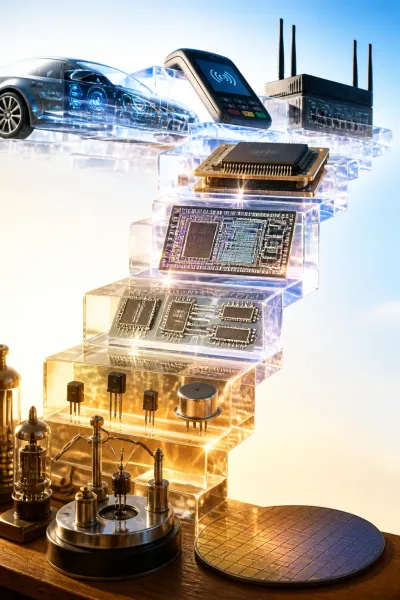
The story of NXP Semiconductors traces a remarkable evolution from its origins as the semiconductor division of Royal Philips Electronics, established in 1953, to its current status as a global S&P 500 powerhouse. For decades, Philips Semiconductors laid critical groundwork in solid-state physics, pioneering transistors, integrated circuits, and foundational technologies like LOCOS isolation. The division navigated the digital revolution of the 1980s and 1990s by focusing on microcontrollers and digital signal processors, establishing strongholds in automotive electronics, secure identification, and consumer applications. However, the cyclical nature of the industry and the immense capital requirements of advanced fabrication led Philips to spin off the division in 2006. Backed by a private equity consortium, the newly independent NXP—derived from "next experience"—immediately sharpened its strategic focus on high-growth, high-value markets: automotive, secure connectivity, and embedded processing.
Under CEO Rick Clemmer, NXP executed a disciplined "fab-lite" manufacturing strategy and pursued targeted acquisitions to bolster its portfolio in NFC, automotive radio, and digital TV. The company’s successful IPO in 2010 provided further capital and visibility, but the defining transformative moment arrived in 2015 with the $11.8 billion merger with Freescale Semiconductor. This combination created an industry leader in automotive semiconductors and general-purpose microcontrollers, merging NXP’s strength in secure car access and mixed-signal design with Freescale’s robust embedded processing and RF power portfolios. The integration, while complex, delivered significant synergies and positioned the combined entity at the forefront of the connected car, industrial IoT, and secure edge processing revolutions.
As a public company, NXP demonstrated resilience through economic headwinds, trade tensions, and supply chain disruptions by doubling down on its core megatrends: vehicle electrification and autonomy, pervasive IoT connectivity, and hardware-based security. The company cultivated a culture of innovation rooted in its Philips NatLab heritage and Freescale’s engineering rigor, investing heavily in R&D for edge AI, radar, advanced cryptography, and ultra-low-power architectures. Strategic divestitures, such as the Standard Products business, further refined its focus on differentiated, high-margin solutions. This operational excellence and strategic clarity culminated in NXP’s inclusion in the S&P 500, a benchmark validating its maturity, financial health, and essential role in the global technology infrastructure.
Today, NXP’s enduring legacy is defined by its invisible ubiquity: its silicon secures billions of digital transactions and identities, powers the intelligence behind autonomous driving and industrial automation, and connects the expanding Internet of Things. By consistently embedding security and intelligence at the hardware level, NXP has become a foundational enabler of the digital age. Its journey reflects a continuous adaptation—from a conglomerate division to an agile independent entity—driven by a vision of a "smarter, safer, and more connected world," ensuring its impact on the semiconductor landscape remains profound and enduring.
What You'll Find Inside:
- The transformation of NXP from a Philips division into an independent S&P 500 semiconductor leader through strategic spin-off, IPO, and the transformative Freescale merger.
- NXP's strategic pivot to dominate high-growth markets, particularly automotive electronics (ADAS, electrification) and secure connectivity solutions (NFC, secure elements, IoT security).
- The company's innovation engine, rooted in Philips' NatLab legacy, driving breakthroughs in process technology (LOCOS), mixed-signal design, and edge AI for embedded intelligence.
- Operational excellence via a 'fab-lite' manufacturing strategy and resilient global supply chain management, balancing internal fabs with foundry partnerships.
- The enduring influence of corporate culture, sustainability commitments, and ethical governance in navigating economic cycles and building long-term stakeholder value.
Who's It For:
This book is ideal for semiconductor industry professionals, business strategists, and investors seeking a detailed case study of corporate transformation and market leadership. It also appeals to technology historians and students of innovation management interested in the evolution of a major tech company from conglomerate division to S&P 500 constituent. Readers will gain insights into strategic decision-making, M&A integration, and the interplay between R&D and commercial success in the global chip industry.
Table of Contents:
- Introduction: From Philips to NXP – A Legacy of Innovation
- Chapter 1: The Genesis – Philips Semiconductors' Early Years (1953-1960s)
- Chapter 2: Solid-State Revolution – Transistors and Integrated Circuits Emerge (1960s-1970s)
- Chapter 3: Global Expansion and Diversification – Philips' Semiconductor Footprint Grows (1970s-1980s)
- Chapter 4: Digital Dawn – The Rise of Microcontrollers and DSPs (1980s-1990s)
- Chapter 5: Shifting Sands – Navigating Industry Consolidations and Market Changes (1990s)
- Chapter 6: The Dot-Com Era and Beyond – Innovation Amidst Volatility (Late 1990s-Early 2000s)
- Chapter 7: The Seeds of Independence – Preparing for a Spin-Off (Early 2000s)
- Chapter 8: Birth of a New Identity – NXP Semiconductors Becomes an Independent Entity (2006)
- Chapter 9: Charting a New Course – Initial Strategies and Market Positioning
- Chapter 10: Early Acquisitions and Partnerships – Building a Portfolio
- Chapter 11: Focus on Automotive – A Strategic Imperative
- Chapter 12: Secure Connections for a Smarter World – The Rise of Security Solutions
- Chapter 13: The Mobile Revolution – Enabling Connectivity and Performance
- Chapter 14: Internet of Things (IoT) – Expanding Horizons
- Chapter 15: Going Public – NXP's IPO and Life as a Public Company
- Chapter 16: Freescale Semiconductor Merger – A Transformative Integration (2015)
- Chapter 17: Synergies and Challenges – Realizing the Promise of the Merger
- Chapter 18: Innovation Engine – Research & Development at NXP
- Chapter 19: Global Manufacturing and Supply Chain – Ensuring Operational Excellence
- Chapter 20: Corporate Culture and Values – The People Behind the Technology
- Chapter 21: Navigating Economic Headwinds – Resilience and Adaptation
- Chapter 22: Sustainability and Corporate Responsibility – Beyond the Bottom Line
- Chapter 23: NXP in the S&P 500 – A Benchmark of Success
- Chapter 24: Strategic Vision for the Future – Emerging Technologies and Market Trends
- Chapter 25: The Enduring Legacy – NXP's Impact on the Semiconductor Landscape
Author:
Published By:
Date Published:
October 30, 2026
Type:
Nonfiction
Language:
English
Word Count:
36,261 words
Reading Time:
2 hours 32 minutes
Sample:
MixCache.com Total Access
Get unlimited access to this book + all books published by MixCache.com for $11.99/month
Subscribe to MTAOr purchase this book individually below
Order:
Buy the A History of NXP Semiconductors ebook on MixCache.com:
Buy Now
Full ebook will be available immediately
- read online or download as a PDF file.
$5 account credit for all new MixCache.com accounts, usable toward any ebook purchase!*




Ratings & Reviews
Ask Questions About This Book
Have a question about the content? Ask our AI assistant!
Start by asking a question about "A History of NXP Semiconductors"
Example: "Does this book mention William Shakespeare?"
Thinking...