
Browse by Category
Fiction
- Action & Adventure
- African American
- Anthologies
- Children's Fiction
- Classics
- Comics & Graphic Novels
- Coming of Age
- Contemporary
- Cultural & Regional
- Drama
- Erotica
- Fantasy
- General
- Historical Fiction
- Horror
- Humor & Satire
- Literary Fiction
- Mystery, Thriller & Suspense
- Poetry
- Religious & Inspirational
- Romance
- Science Fiction
- Short Stories
- War & Military
- Westerns
- Women's Fiction
- Young Adult
Non-Fiction
- Antiques & Collectibles
- Arts & Photography
- Biographies & Memoirs
- Business & Money
- Children's Non-Fiction
-
Computers & Technology
- Artificial Intelligence
- Computer Science
- Cybersecurity & Cryptography
- Data Science & Analytics
- Databases & Big Data
- Game Development & Design
- General
- Hardware & DIY
- Mobile App Development
- Networking & Cloud Computing
- Operating Systems
- Programming
- Robotics
- Software
- Software Engineering
- User Experience (UX) & Design
- Web Development & Design
- Cooking, Food & Wine
- Crafts, Hobbies & Home
- Education & Teaching
- Engineering
- General
- Health, Fitness & Dieting
-
History
- African History
- African History - North Africa
- African History - Sub-Saharan Africa
- American History
- American History - 20th Century
- American History - Civil War
- American History - Colonial Period
- Ancient History
- Asian History
- Asian History - China
- Asian History - India
- Asian History - Japan
- Asian History - Southeast Asia
- European History
- European History - Ancient Greece
- European History - Ancient Rome
- European History - Medieval
- European History - Modern
- European History - Renaissance
- General
- Middle Eastern History
- Military History
- Military History - Aviation
- Military History - Naval
- Social & Cultural History
- World History
- Humor & Entertainment
- Industrial Technology
- Language Learning
- Law
- LGBTQ+ Non-Fiction
- Literary Criticism
- Medical Books
- Parenting & Relationships
- Philosophy
- Politics & Social Sciences
- Reference
- Religion & Spirituality
-
Science & Math
- Agricultural Sciences
- Astronomy & Space Science
- Behavioral Sciences
- Biological Sciences
- Botany & Plant Science
- Chemistry
- Earth Sciences
- Engineering - Chemical
- Engineering - Civil
- Engineering - Electrical
- Engineering - Mechanical
- Environment
- General
- Geology
- Mathematics
- Nature & Ecology
- Oceanography
- Paleontology
- Physics
- Statistics
- Self-Help
- Sports & Outdoors
- Study Aids
- Sustainability & Green Living
- Textbooks
- Transportation
- Travel
- True Crime
- Urban Planning & Development
- Veterinary Medicine
- Writing & Publishing
Jump to Section
MixCache.com Total Access
Unlimited reading and audiobooks for every book published by MixCache.com.
Included titles carry the MTA badge.
Learn more →
A History of Union Pacific Corporation
MTA
The Story of an S&P 500 Company
About this book:
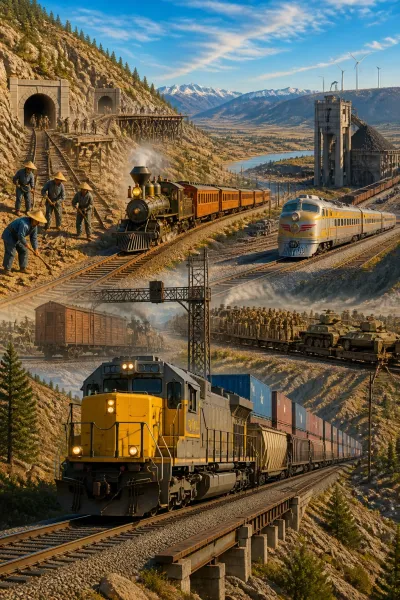
Union Pacific Corporation’s history mirrors the development of the United States itself, beginning with the 1862 Pacific Railway Act that chartered the railroad to forge the first transcontinental link. Despite early financial scandals like Credit Mobilier, crippling panics in 1873 and 1893, and receivership, the railroad was resurrected by E.H. Harriman in the late 1890s. His philosophy of heavy reinvestment in infrastructure and operational efficiency transformed the bankrupt property into a modern, profitable system. The company subsequently navigated two World Wars—operating under federal control in WWI and serving as a critical logistics artery in WWII—while transitioning from steam to diesel power and pioneering streamlined passenger service during the Great Depression.
The post-war era brought new competitive pressures from highways and aviation, prompting strategic diversification into oil, gas, mining, and real estate during the 1960s and 70s. The landmark Staggers Rail Act of 1980 deregulated the industry, unleashing a wave of mergers that saw Union Pacific absorb the Western Pacific, Missouri Pacific, Chicago and North Western, and Southern Pacific railroads. While the Southern Pacific integration caused a severe operational crisis, the company ultimately emerged as a dominant Western rail carrier. This consolidation, combined with the rise of intermodal shipping, allowed Union Pacific to pivot from bulk commodities to a diverse freight mix, securing its position as a vital link in global supply chains and a stalwart of the S&P 500.
Entering the 21st century, Union Pacific has focused on technological modernization and precision scheduled railroading to enhance network fluidity, safety, and asset utilization. The company has implemented advanced systems like Positive Train Control, wayside detectors, and AI-driven predictive analytics while investing heavily in fuel efficiency and emissions reduction to meet sustainability goals. Despite challenges such as declining coal volumes, extreme weather events, and evolving labor dynamics, the railroad continues to leverage its vast land holdings and port access to drive growth. Looking ahead, Union Pacific is exploring alternative locomotive technologies like battery-electric and hydrogen power, deepening digital integration, and fortifying infrastructure resilience to maintain its role as an indispensable artery of North American commerce.
What You'll Find Inside:
- Comprehensive chronicle of Union Pacific from the 1862 Pacific Railway Act through 21st-century digital transformation, detailing transcontinental construction, the Credit Mobilier scandal, and corporate evolution.
- In-depth analysis of pivotal leadership eras—from Durant and Harriman to modern CEOs—and how strategic mergers (Western Pacific, Missouri Pacific, Southern Pacific) forged a dominant Western rail network.
- Examination of technological adaptation across eras: steam-to-diesel conversion, intermodal shipping revolution, Precision Scheduled Railroading, and AI-driven predictive maintenance and network optimization.
- Exploration of the railroad's integral role in national development—community building, wartime logistics, economic cycle navigation, and sustained financial performance as an S&P 500 component.
- Forward-looking assessment of sustainability initiatives, alternative locomotive fuels (battery/hydrogen), autonomous operations, climate resilience, and evolving freight demographics shaping future strategy.
Who's It For:
This book is ideal for business historians, railroad industry professionals, and investors seeking a detailed case study in long-term corporate resilience and strategic adaptation. It also serves students of American industrial history and transportation logistics who want a comprehensive view of how a 19th-century infrastructure project evolved into a modern S&P 500 giant. Readers interested in the interplay between technology, regulation, labor, and capital allocation in a capital-intensive industry will find it particularly valuable.
Table of Contents:
- Introduction
- Chapter 1 The Genesis of a Railroad Empire
- Chapter 2 Forging the Transcontinental Link
- Chapter 3 Early Challenges and Consolidation
- Chapter 4 Growth and Expansion in the Late 19th Century
- Chapter 5 The Harriman Era and Reorganization
- Chapter 6 Union Pacific During the World Wars
- Chapter 7 Post-War Prosperity and Modernization
- Chapter 8 Diversification and New Ventures (1960s-1970s)
- Chapter 9 The Era of Deregulation
- Chapter 10 Mergers, Acquisitions, and Corporate Strategy
- Chapter 11 Navigating Economic Downturns
- Chapter 12 Technological Advancements in Railroading
- Chapter 13 The Rise of Intermodal Shipping
- Chapter 14 Environmental Stewardship and Sustainability
- Chapter 15 Union Pacific and Community Development
- Chapter 16 Labor Relations and Workforce Evolution
- Chapter 17 Safety Innovations and Practices
- Chapter 18 Financial Performance and Shareholder Value
- Chapter 19 Union Pacific's Role in the S&P 500
- Chapter 20 Leadership and Corporate Governance
- Chapter 21 Adapting to a Changing Freight Landscape
- Chapter 22 The Digital Transformation of Rail Operations
- Chapter 23 Challenges and Opportunities in the 21st Century
- Chapter 24 Union Pacific's Enduring Legacy
- Chapter 25 The Future of a Railroad Giant
Author:
Published By:
Date Published:
October 25, 2026
Type:
Nonfiction
Language:
English
Word Count:
38,872 words
Reading Time:
2 hours 43 minutes
Sample:
MixCache.com Total Access
Get unlimited access to this book + all books published by MixCache.com for $11.99/month
Subscribe to MTAOr purchase this book individually below
Order:
Buy the A History of Union Pacific Corporation ebook on MixCache.com:
Buy Now
Full ebook will be available immediately
- read online or download as a PDF file.
$5 account credit for all new MixCache.com accounts, usable toward any ebook purchase!*





Ratings & Reviews
Ask Questions About This Book
Have a question about the content? Ask our AI assistant!
Start by asking a question about "A History of Union Pacific Corporation"
Example: "Does this book mention William Shakespeare?"
Thinking...