
Browse by Category
Fiction
- Action & Adventure
- African American
- Anthologies
- Children's Fiction
- Classics
- Comics & Graphic Novels
- Coming of Age
- Contemporary
- Cultural & Regional
- Drama
- Erotica
- Fantasy
- General
- Historical Fiction
- Horror
- Humor & Satire
- Literary Fiction
- Mystery, Thriller & Suspense
- Poetry
- Religious & Inspirational
- Romance
- Science Fiction
- Short Stories
- War & Military
- Westerns
- Women's Fiction
- Young Adult
Non-Fiction
- Antiques & Collectibles
- Arts & Photography
- Biographies & Memoirs
- Business & Money
- Children's Non-Fiction
-
Computers & Technology
- Artificial Intelligence
- Computer Science
- Cybersecurity & Cryptography
- Data Science & Analytics
- Databases & Big Data
- Game Development & Design
- General
- Hardware & DIY
- Mobile App Development
- Networking & Cloud Computing
- Operating Systems
- Programming
- Robotics
- Software
- Software Engineering
- User Experience (UX) & Design
- Web Development & Design
- Cooking, Food & Wine
- Crafts, Hobbies & Home
- Education & Teaching
- Engineering
- General
- Health, Fitness & Dieting
-
History
- African History
- African History - North Africa
- African History - Sub-Saharan Africa
- American History
- American History - 20th Century
- American History - Civil War
- American History - Colonial Period
- Ancient History
- Asian History
- Asian History - China
- Asian History - India
- Asian History - Japan
- Asian History - Southeast Asia
- European History
- European History - Ancient Greece
- European History - Ancient Rome
- European History - Medieval
- European History - Modern
- European History - Renaissance
- General
- Middle Eastern History
- Military History
- Military History - Aviation
- Military History - Naval
- Social & Cultural History
- World History
- Humor & Entertainment
- Industrial Technology
- Language Learning
- Law
- LGBTQ+ Non-Fiction
- Literary Criticism
- Medical Books
- Parenting & Relationships
- Philosophy
- Politics & Social Sciences
- Reference
- Religion & Spirituality
-
Science & Math
- Agricultural Sciences
- Astronomy & Space Science
- Behavioral Sciences
- Biological Sciences
- Botany & Plant Science
- Chemistry
- Earth Sciences
- Engineering - Chemical
- Engineering - Civil
- Engineering - Electrical
- Engineering - Mechanical
- Environment
- General
- Geology
- Mathematics
- Nature & Ecology
- Oceanography
- Paleontology
- Physics
- Statistics
- Self-Help
- Sports & Outdoors
- Study Aids
- Sustainability & Green Living
- Textbooks
- Transportation
- Travel
- True Crime
- Urban Planning & Development
- Veterinary Medicine
- Writing & Publishing
Jump to Section
MixCache.com Total Access
Unlimited reading and audiobooks for every book published by MixCache.com.
Included titles carry the MTA badge.
Learn more →
A History of Darden Restaurants
MTA
The Story of an S&P 500 Company
About this book:
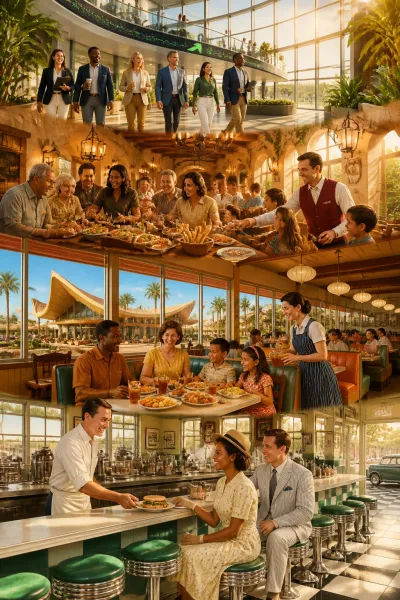
From a modest 25-seat luncheonette called The Green Frog opened in Waycross, Georgia, in 1938, Bill Darden built a restaurant empire rooted in inclusive hospitality, quality, and value. His vision crystallized with the 1968 launch of Red Lobster in landlocked Lakeland, Florida, a daring concept that brought affordable, fresh seafood to the American mainstream. Acquired by General Mills in 1970, Red Lobster became the engine for a new Restaurant Group that diversified through the acquisition of Chart House and the wildly successful 1982 launch of Olive Garden. Under General Mills' capital and operational discipline, these brands scaled nationally, defining the casual dining segment and establishing a playbook for multi-brand management that blended entrepreneurial spirit with corporate rigor.
In 1995, the Restaurant Group was spun off as the independent, publicly traded Darden Restaurants, Inc., unlocking shareholder value and allowing a singular focus on foodservice. The new entity accelerated its multi-brand strategy by incubating innovative concepts like the tropical-themed Bahama Breeze and the health-forward Seasons 52, while fine-dining brands The Capital Grille and Eddie V’s expanded the portfolio’s upper end. However, the Great Recession and subsequent pressure from activist investors—most notably Starboard Value—exposed the lagging performance of the founding brand, Red Lobster. In a pivotal 2014 decision, Darden sold Red Lobster to Golden Gate Capital for $2.1 billion, shedding debt and sharpening focus on its remaining high-growth assets. This strategic clarity paved the way for the 2017 acquisition of Cheddar’s Scratch Kitchen, a complementary comfort-food brand that bolstered Darden’s casual dining dominance.
The COVID-19 pandemic presented an existential crisis, shuttering dining rooms and demanding an instantaneous pivot to off-premise operations. Darden leveraged its scale, supply chain resilience, and prior digital investments to rapidly scale curbside pickup, delivery, and online ordering, transforming a survival tactic into a permanent strategic pillar. This acceleration of technology—spanning AI-driven analytics, kitchen automation, and personalized loyalty platforms—modernized the guest experience while preserving the human hospitality central to Darden’s culture. Simultaneously, the company deepened its commitments to sustainable sourcing, waste reduction, and ethical labor practices, recognizing that operational excellence and corporate responsibility are inseparable from long-term brand equity.
Today, Darden Restaurants stands as an S&P 500 leader defined by a balanced portfolio—anchored by a revitalized Olive Garden, the rising Cheddar’s, and a distinct Specialty Restaurant Group—and a culture that prioritizes its 180,000-plus employees as the primary drivers of guest satisfaction. From Bill Darden’s segregated-South defiance at The Green Frog to a modern enterprise navigating digital disruption and evolving consumer tastes, the company’s history demonstrates a consistent ability to adapt without compromising its founding principles. By maintaining rigorous financial discipline, investing in its people and communities, and relentlessly refining the intersection of technology and hospitality, Darden has sustained its relevance across generations, positioning itself to define the future of full-service dining.
What You'll Find Inside:
- The entrepreneurial journey of Bill Darden, from a 25-seat luncheonette (The Green Frog) in 1938 to pioneering inclusive hospitality and the revolutionary inland seafood concept of Red Lobster.
- The strategic evolution under General Mills that scaled Red Lobster nationally and launched Olive Garden, followed by the 1995 spin-off creating independent Darden Restaurants as an S&P 500 company.
- The deliberate multi-brand diversification strategy that developed proprietary concepts like Bahama Breeze and Seasons 52, acquired fine dining brands (The Capital Grille, Eddie V's), and added Cheddar's Scratch Kitchen for comfort-food market penetration.
- Resilience through major crises: navigating the Great Recession, surviving activist investor pressure (Starboard Value) leading to the pivotal $2.1B sale of founding brand Red Lobster, and adapting operations during the COVID-19 pandemic.
- Modern transformation embracing digital technology, off-premise dining infrastructure, supply chain sustainability, and employee culture as core drivers for sustaining 21st-century relevance and shareholder value.
Who's It For:
This book is ideal for business leaders, entrepreneurs, and corporate strategists seeking lessons in scaling multi-brand portfolios and navigating shareholder activism. Restaurant industry professionals and hospitality students will value the operational insights on supply chain management, brand differentiation, and crisis adaptation. Investors and financial analysts will appreciate the detailed case study of an S&P 500 company's evolution through spin-offs, acquisitions, and divestitures. Anyone interested in American corporate history or the transformation of casual dining will find a compelling narrative of innovation, resilience, and strategic reinvention.
Table of Contents:
- Introduction
- Chapter 1: The Roots of a Restaurant Empire
- Chapter 2: Bill Darden's Vision and Early Ventures
- Chapter 3: Red Lobster: The Catch That Started It All
- Chapter 4: Expanding Horizons: Chart House and Beyond
- Chapter 5: General Mills and the Restaurant Group Era
- Chapter 6: Olive Garden: A New Flavor of Success
- Chapter 7: Navigating the 1980s: Growth and Challenges
- Chapter 8: The Spin-Off: Darden Restaurants Becomes Independent
- Chapter 9: A New Public Company: Finding Its Stride
- Chapter 10: Acquisition and Diversification: The Multi-Brand Strategy
- Chapter 11: Bahama Breeze and Seasons 52: Innovation in Casual Dining
- Chapter 12: Leadership Transitions and Strategic Shifts
- Chapter 13: Economic Headwinds and Industry Evolution
- Chapter 14: Modernizing the Brands: Reinvention and Relevance
- Chapter 15: The Digital Age: Technology in the Restaurant Business
- Chapter 16: Supply Chain and Sustainability Initiatives
- Chapter 17: Employee Culture and Customer Experience
- Chapter 18: The Great Recession and Resilience
- Chapter 19: The Activist Investor Era and Portfolio Adjustments
- Chapter 20: The Sale of Red Lobster: A Pivotal Decision
- Chapter 21: Acquisitions and Growth: The Cheddar's Scratch Kitchen Story
- Chapter 22: Navigating the Pandemic: Unprecedented Challenges
- Chapter 23: Off-Premise Dining and Future Trends
- Chapter 24: Darden's Philanthropic Efforts and Community Impact
- Chapter 25: Sustaining Success: Darden Restaurants in the 21st Century
Author:
Published By:
Date Published:
October 22, 2026
Type:
Nonfiction
Language:
English
Word Count:
38,432 words
Reading Time:
2 hours 41 minutes
Sample:
MixCache.com Total Access
Get unlimited access to this book + all books published by MixCache.com for $11.99/month
Subscribe to MTAOr purchase this book individually below
Order:
Buy the A History of Darden Restaurants ebook on MixCache.com:
Buy Now
Full ebook will be available immediately
- read online or download as a PDF file.
$5 account credit for all new MixCache.com accounts, usable toward any ebook purchase!*



Ratings & Reviews
Ask Questions About This Book
Have a question about the content? Ask our AI assistant!
Start by asking a question about "A History of Darden Restaurants"
Example: "Does this book mention William Shakespeare?"
Thinking...