
Browse by Category
Fiction
- Action & Adventure
- African American
- Anthologies
- Children's Fiction
- Classics
- Comics & Graphic Novels
- Coming of Age
- Contemporary
- Cultural & Regional
- Drama
- Erotica
- Fantasy
- General
- Historical Fiction
- Horror
- Humor & Satire
- Literary Fiction
- Mystery, Thriller & Suspense
- Poetry
- Religious & Inspirational
- Romance
- Science Fiction
- Short Stories
- War & Military
- Westerns
- Women's Fiction
- Young Adult
Non-Fiction
- Antiques & Collectibles
- Arts & Photography
- Biographies & Memoirs
- Business & Money
- Children's Non-Fiction
-
Computers & Technology
- Artificial Intelligence
- Computer Science
- Cybersecurity & Cryptography
- Data Science & Analytics
- Databases & Big Data
- Game Development & Design
- General
- Hardware & DIY
- Mobile App Development
- Networking & Cloud Computing
- Operating Systems
- Programming
- Robotics
- Software
- Software Engineering
- User Experience (UX) & Design
- Web Development & Design
- Cooking, Food & Wine
- Crafts, Hobbies & Home
- Education & Teaching
- Engineering
- General
- Health, Fitness & Dieting
-
History
- African History
- African History - North Africa
- African History - Sub-Saharan Africa
- American History
- American History - 20th Century
- American History - Civil War
- American History - Colonial Period
- Ancient History
- Asian History
- Asian History - China
- Asian History - India
- Asian History - Japan
- Asian History - Southeast Asia
- European History
- European History - Ancient Greece
- European History - Ancient Rome
- European History - Medieval
- European History - Modern
- European History - Renaissance
- General
- Middle Eastern History
- Military History
- Military History - Aviation
- Military History - Naval
- Social & Cultural History
- World History
- Humor & Entertainment
- Industrial Technology
- Language Learning
- Law
- LGBTQ+ Non-Fiction
- Literary Criticism
- Medical Books
- Parenting & Relationships
- Philosophy
- Politics & Social Sciences
- Reference
- Religion & Spirituality
-
Science & Math
- Agricultural Sciences
- Astronomy & Space Science
- Behavioral Sciences
- Biological Sciences
- Botany & Plant Science
- Chemistry
- Earth Sciences
- Engineering - Chemical
- Engineering - Civil
- Engineering - Electrical
- Engineering - Mechanical
- Environment
- General
- Geology
- Mathematics
- Nature & Ecology
- Oceanography
- Paleontology
- Physics
- Statistics
- Self-Help
- Sports & Outdoors
- Study Aids
- Sustainability & Green Living
- Textbooks
- Transportation
- Travel
- True Crime
- Urban Planning & Development
- Veterinary Medicine
- Writing & Publishing
Jump to Section
MixCache.com Total Access
Unlimited reading and audiobooks for every book published by MixCache.com.
Included titles carry the MTA badge.
Learn more →
A History of Merck & Co.
MTA
The Story of an S&P 500 Company
About this book:
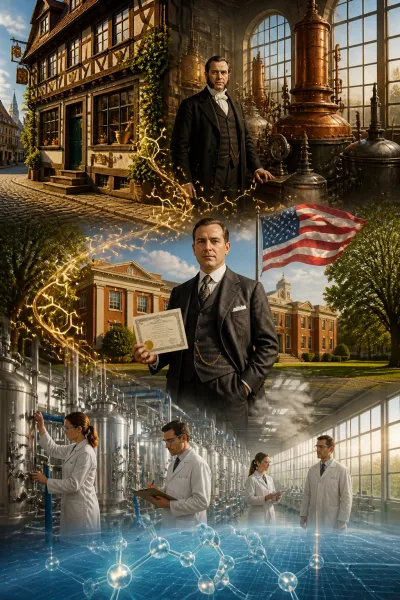
From its origins as the Engel-Apotheke in 17th-century Darmstadt, Germany, the Merck enterprise evolved over centuries from a family-run pharmacy into a pioneering chemical-pharmaceutical factory under Emanuel Merck in the 1820s. The American chapter began in 1891 when George Merck emigrated to establish Merck & Co. in New York, soon moving manufacturing to Rahway, New Jersey. World War I proved a pivotal rupture: the U.S. government seized the company as enemy property, but George Merck repurchased it in 1919, forging a fully independent American corporation. This autonomy allowed the company to invest heavily in research during the Great Depression, a counter-cyclical bet that fueled breakthroughs in vitamins and steroid chemistry and positioned Merck to lead the wartime mass production of penicillin, transforming it into a global pharmaceutical powerhouse.
The post-war "Golden Age" saw Merck translate its fermentation and chemical synthesis expertise into a cascade of life-saving medicines, including streptomycin for tuberculosis, cortisone and prednisone for inflammation, and a broadening vaccine portfolio. This scientific momentum was matched by strategic globalization and a growing commitment to public health that transcended profit, epitomized by the 1987 decision to donate Mectizan (ivermectin) indefinitely to eradicate river blindness. The late 20th century brought the challenges of patent cliffs, regulatory complexity, and the Vioxx controversy, prompting strategic adaptations including the Medco acquisition and divestiture, the transformative 2009 merger with Schering-Plough, and a decisive pivot toward biotechnology and immunology.
In the 21st century, Merck has focused its formidable R&D engine on oncology, vaccines, and antimicrobial resistance, yielding blockbusters like the immunotherapy Keytruda and the HPV vaccine Gardasil while mobilizing rapidly for global crises such as Ebola and COVID-19. Throughout its history, the company has maintained a consistent presence on the S&P 500, reflecting enduring financial strength derived from a philosophy—articulated by George W. Merck—that medicine is for the patient, and profits follow. Today, Merck’s legacy is defined not only by its vast portfolio of innovative therapies but by a culture of scientific rigor, ethical responsibility, and adaptive resilience that continues to drive its mission to invent for life.
What You'll Find Inside:
- Traces Merck & Co.'s evolution from a 1668 German apothecary to a global pharmaceutical leader and S&P 500 stalwart, highlighting pivotal moments like the 1917 U.S. government seizure that forced its independence from its German parent company.
- Details how World War II catalyzed Merck's transformation into a research powerhouse through its pivotal role in the industrial-scale production of penicillin and antimalarials, establishing capabilities that fueled the post-war Golden Age of Pharmaceuticals.
- Explores the company's counter-cyclical strategy of increasing R&D investment during the Great Depression, which led to breakthroughs in vitamins, steroids, and antibiotics that defined mid-century medicine.
- Examines Merck's enduring ethical philosophy—"Medicine is for the people"—exemplified by landmark public health initiatives like the Mectizan Donation Program for river blindness and equitable access strategies for HIV/AIDS and COVID-19 treatments.
- Analyzes strategic adaptation through mergers (Schering-Plough), acquisitions, divestitures (Medco, consumer care, animal health), and the embrace of biotechnology, positioning Merck for 21st-century challenges in oncology, vaccines, and precision medicine.
Who's It For:
This book is ideal for pharmaceutical industry professionals, business historians, and corporate strategists seeking a comprehensive case study of long-term innovation management. Investors and analysts will value its insights into how sustained R&D commitment and ethical leadership drive multi-decade S&P 500 performance. Students of medical history and public policy will appreciate the detailed chronicle of drug development milestones and global health initiatives. General readers interested in the intersection of science, business, and social responsibility will find an engaging narrative of corporate resilience across centuries of global upheaval.
Table of Contents:
- Introduction: The Legacy Begins
- Chapter 1: Humble Roots – The Merck Family in Germany
- Chapter 2: Emigrating to America – George Merck's Vision
- Chapter 3: Early Days in the U.S. – Establishing Merck & Co.
- Chapter 4: The Turn of the Century – Growth and Industrialization
- Chapter 5: World War I and Its Aftermath – Navigating Global Conflict
- Chapter 6: The Roaring Twenties – Innovation and Expansion
- Chapter 7: The Great Depression – Resilience in Hard Times
- Chapter 8: World War II – Contributions to the War Effort
- Chapter 9: The Post-War Boom – Penicillin and Beyond
- Chapter 10: The Golden Age of Pharmaceuticals – Discoveries and Development
- Chapter 11: From the Lab to the Market – Bringing Drugs to Patients
- Chapter 12: The Rise of Research and Development – Investing in Science
- Chapter 13: Global Reach – Expanding International Operations
- Chapter 14: Challenges and Controversies – Navigating the Pharmaceutical Landscape
- Chapter 15: Adapting to Change – Mergers, Acquisitions, and Divestitures
- Chapter 16: The Dawn of Biotechnology – Embracing New Frontiers
- Chapter 17: Public Health Initiatives – Beyond Profit Motives
- Chapter 18: Leadership Through the Decades – Guiding the Company's Course
- Chapter 19: Pharmaceutical Marketing and Ethics – Reaching Patients Responsibly
- Chapter 20: The S&P 500 Journey – A Benchmark of Success
- Chapter 21: Innovation in the 21st Century – Addressing Modern Health Challenges
- Chapter 22: Corporate Social Responsibility – Merck's Role in Society
- Chapter 23: Global Health Challenges – Facing Pandemics and Epidemics
- Chapter 24: The Future of Medicine – Merck's Vision for Tomorrow
- Chapter 25: A Lasting Impact – Merck & Co.'s Enduring Legacy
Author:
Published By:
Date Published:
October 21, 2026
Type:
Nonfiction
Language:
English
Word Count:
39,519 words
Reading Time:
2 hours 46 minutes
Sample:
MixCache.com Total Access
Get unlimited access to this book + all books published by MixCache.com for $11.99/month
Subscribe to MTAOr purchase this book individually below
Order:
Buy the A History of Merck & Co. ebook on MixCache.com:
Buy Now
Full ebook will be available immediately
- read online or download as a PDF file.
$5 account credit for all new MixCache.com accounts, usable toward any ebook purchase!*





Ratings & Reviews
Ask Questions About This Book
Have a question about the content? Ask our AI assistant!
Start by asking a question about "A History of Merck & Co."
Example: "Does this book mention William Shakespeare?"
Thinking...