Browse by Category
Fiction
- Action & Adventure
- African American
- Anthologies
- Children's Fiction
- Classics
- Comics & Graphic Novels
- Coming of Age
- Contemporary
- Cultural & Regional
- Drama
- Erotica
- Fantasy
- General
- Historical Fiction
- Horror
- Humor & Satire
- Literary Fiction
- Mystery, Thriller & Suspense
- Poetry
- Religious & Inspirational
- Romance
- Science Fiction
- Short Stories
- War & Military
- Westerns
- Women's Fiction
- Young Adult
Non-Fiction
- Antiques & Collectibles
- Arts & Photography
- Biographies & Memoirs
- Business & Money
- Children's Non-Fiction
-
Computers & Technology
- Artificial Intelligence
- Computer Science
- Cybersecurity & Cryptography
- Data Science & Analytics
- Databases & Big Data
- Game Development & Design
- General
- Hardware & DIY
- Mobile App Development
- Networking & Cloud Computing
- Operating Systems
- Programming
- Robotics
- Software
- Software Engineering
- User Experience (UX) & Design
- Web Development & Design
- Cooking, Food & Wine
- Crafts, Hobbies & Home
- Education & Teaching
- Engineering
- General
- Health, Fitness & Dieting
-
History
- African History
- African History - North Africa
- African History - Sub-Saharan Africa
- American History
- American History - 20th Century
- American History - Civil War
- American History - Colonial Period
- Ancient History
- Asian History
- Asian History - China
- Asian History - India
- Asian History - Japan
- Asian History - Southeast Asia
- European History
- European History - Ancient Greece
- European History - Ancient Rome
- European History - Medieval
- European History - Modern
- European History - Renaissance
- General
- Middle Eastern History
- Military History
- Military History - Aviation
- Military History - Naval
- Social & Cultural History
- World History
- Humor & Entertainment
- Industrial Technology
- Language Learning
- Law
- LGBTQ+ Non-Fiction
- Literary Criticism
- Medical Books
- Parenting & Relationships
- Philosophy
- Politics & Social Sciences
- Reference
- Religion & Spirituality
-
Science & Math
- Agricultural Sciences
- Astronomy & Space Science
- Behavioral Sciences
- Biological Sciences
- Botany & Plant Science
- Chemistry
- Earth Sciences
- Engineering - Chemical
- Engineering - Civil
- Engineering - Electrical
- Engineering - Mechanical
- Environment
- General
- Geology
- Mathematics
- Nature & Ecology
- Oceanography
- Paleontology
- Physics
- Statistics
- Self-Help
- Sports & Outdoors
- Study Aids
- Sustainability & Green Living
- Textbooks
- Transportation
- Travel
- True Crime
- Urban Planning & Development
- Veterinary Medicine
- Writing & Publishing
Jump to Section
MixCache.com Total Access
Unlimited reading and audiobooks for every book published by MixCache.com.
Included titles carry the MTA badge.
Learn more →
A History of PG&E Corporation
MTA
The Story of an S&P 500 Company
About this book:
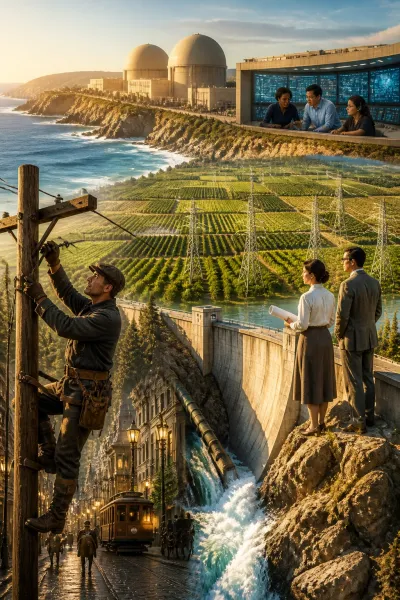
PG&E Corporation’s history traces the evolution of California’s energy infrastructure from a fragmented collection of manufactured gas and electric companies in the post-Gold Rush era into a unified, S&P 500 utility powering the nation’s most populous state. Formed through aggressive consolidation in 1905 and tested immediately by the 1906 San Francisco earthquake, the company engineered monumental hydroelectric systems in the Sierra Nevada and pioneered long-distance transmission to fuel the state’s agricultural and industrial booms. The mid-20th century saw a pivot to thermal generation and nuclear power at Diablo Canyon, alongside a massive expansion of natural gas pipelines, cementing PG&E’s role as the backbone of California’s economic growth while navigating increasing environmental awareness and regulatory scrutiny.
The turn of the millennium brought existential crisis. Flawed deregulation exposed PG&E to volatile wholesale markets, triggering the 2000-2001 energy crisis and the company’s first bankruptcy. Emerging in 2004, PG&E committed to a renewable energy revolution, investing heavily in solar, wind, and geothermal while modernizing its grid with smart-meter technology. However, the accelerating impacts of climate change soon overshadowed this progress. Catastrophic wildfires in 2017 and 2018, ignited by aging equipment amid extreme weather, caused massive loss of life and property, leading to a second bankruptcy in 2019 and forcing a fundamental reckoning with the utility’s operational culture and infrastructure vulnerability.
Since its 2020 reorganization, PG&E has undertaken a sweeping, multi-billion-dollar safety transformation defined by aggressive vegetation management, system hardening, and an unprecedented commitment to undergrounding 10,000 miles of power lines in high-fire-threat districts. This "Safety First" mandate is paired with a strategic pivot toward decarbonization, integrating renewable natural gas and hydrogen into its pipeline network while deploying massive battery storage to stabilize a grid increasingly reliant on intermittent renewables. Operating under intense regulatory oversight from the CPUC and the new Office of Energy Infrastructure Safety, the company is leveraging artificial intelligence, advanced sensors, and distributed energy resources to build a predictive, self-healing grid.
Looking ahead, PG&E’s trajectory in the 21st century is defined by the dual imperatives of climate resilience and clean energy transition. The utility faces the immense financial and engineering challenge of hardening its vast territory against a "new normal" of extreme weather while simultaneously executing California’s mandate for 100% clean electricity by 2045. Its ability to maintain financial stability, retain public trust, and attract capital—signaled by its re-entry into the S&P 500 in 2022—depends on successfully transforming from a traditional commodity provider into a digitally enabled, safety-obsessed platform essential to a decarbonized, climate-adapted California.
What You'll Find Inside:
- The complete evolution of PG&E from Gold Rush-era gas and electric startups into California's dominant utility, including the 1905 consolidation and survival of the 1906 San Francisco earthquake.
- Detailed accounts of monumental infrastructure projects that powered California's growth: hydroelectric "Stairway of Power" systems, the Diablo Canyon nuclear plant, and the 500-mile "Super Inch" natural gas pipeline.
- In-depth analysis of PG&E's two bankruptcies—the 2001 energy crisis driven by flawed deregulation and the 2019 collapse triggered by catastrophic wildfire liabilities—and the complex reorganizations that followed.
- The company's strategic pivot from fossil fuels to renewable energy leadership, covering massive investments in solar, wind, geothermal, and emerging clean fuels like renewable natural gas and hydrogen.
- A comprehensive examination of climate-driven existential threats, including the Camp Fire tragedy, the implementation of Public Safety Power Shutoffs, and the multi-billion-dollar undergrounding initiative to build a wildfire-resilient grid.
Who's It For:
This book is ideal for business historians, energy sector professionals, and investors seeking a deep understanding of utility economics and regulatory dynamics. It will particularly benefit readers interested in corporate crisis management, climate adaptation strategies, and the intersection of infrastructure, policy, and finance in California's transformation into a clean energy leader.
Table of Contents:
- Introduction
- Chapter 1: The Genesis of Power: Early Days and Predecessors
- Chapter 2: Uniting the Golden State: Formation of PG&E
- Chapter 3: Powering Progress: Electrification and Expansion in the Early 20th Century
- Chapter 4: The Great Depression and World War II: Navigating Through Crisis
- Chapter 5: Post-War Boom: Meeting California's Growing Energy Demands
- Chapter 6: Innovation and Infrastructure: Building Dams and Power Plants
- Chapter 7: The Nuclear Age: Diablo Canyon and the Promise of Atomic Energy
- Chapter 8: Environmental Awakening: Balancing Growth with Conservation
- Chapter 9: Regulatory Challenges and Public Scrutiny
- Chapter 10: Diversification and New Ventures: Beyond Traditional Utilities
- Chapter 11: The Energy Crisis of 2000-2001: A Turning Point
- Chapter 12: Reorganization and Resurgence: Emerging from Bankruptcy
- Chapter 13: Renewable Energy Revolution: Investing in Solar, Wind, and Geothermal
- Chapter 14: Modernization of the Grid: Smart Technology for a Smarter Future
- Chapter 15: Wildfires and Climate Change: A New Era of Challenges
- Chapter 16: Safety First: Enhancing Infrastructure and Operational Practices
- Chapter 17: Community Engagement and Corporate Responsibility
- Chapter 18: Leadership and Vision: Shaping the Future of Energy
- Chapter 19: Financial Landscapes: Navigating Markets and Investments
- Chapter 20: Technological Advancements: The Digital Transformation of Utilities
- Chapter 21: The Future of Gas: Transitioning to Cleaner Fuels
- Chapter 22: Adapting to Policy Changes and Legislative Mandates
- Chapter 23: The S&P 500 Journey: Milestones and Market Impact
- Chapter 24: Crisis Management and Resilience: Learning from Adversity
- Chapter 25: A Look Ahead: PG&E Corporation in the 21st Century
Author:
Published By:
Date Published:
October 20, 2026
Type:
Nonfiction
Language:
English
Word Count:
40,052 words
Reading Time:
2 hours 48 minutes
Sample:
Order:
Order A History of PG&E Corporation (Paperback) on MixCache.com:
Buy NowPrint copy is made to order and ships worldwide. Includes the ebook free, ready to read instantly.
$5 account credit for all new MixCache.com accounts, usable toward any ebook purchase!*