
Browse by Category
Fiction
- Action & Adventure
- African American
- Anthologies
- Children's Fiction
- Classics
- Comics & Graphic Novels
- Coming of Age
- Contemporary
- Cultural & Regional
- Drama
- Erotica
- Family Life
- Fantasy
- General
- Historical Fiction
- Horror
- Humor & Satire
- Literary Fiction
- Mystery, Thriller & Suspense
- Poetry
- Religious & Inspirational
- Romance
- Science Fiction
- Short Stories
- War & Military
- Westerns
- Women's Fiction
- Young Adult
Non-Fiction
- Antiques & Collectibles
- Arts & Photography
- Biographies & Memoirs
- Business & Money
- Children's Non-Fiction
-
Computers & Technology
- Artificial Intelligence
- Computer Science
- Cybersecurity & Cryptography
- Data Science & Analytics
- Databases & Big Data
- Game Development & Design
- General
- Hardware & DIY
- Mobile App Development
- Networking & Cloud Computing
- Operating Systems
- Programming
- Robotics
- Software
- Software Engineering
- User Experience (UX) & Design
- Web Development & Design
- Cooking, Food & Wine
- Crafts, Hobbies & Home
- Education & Teaching
- Engineering
- General
- Health, Fitness & Dieting
-
History
- African History
- African History - North Africa
- African History - Sub-Saharan Africa
- American History
- American History - 20th Century
- American History - Civil War
- American History - Colonial Period
- Ancient History
- Asian History
- Asian History - China
- Asian History - India
- Asian History - Japan
- Asian History - Southeast Asia
- European History
- European History - Ancient Greece
- European History - Ancient Rome
- European History - Medieval
- European History - Modern
- European History - Renaissance
- General
- Middle Eastern History
- Military History
- Military History - Aviation
- Military History - Naval
- Social & Cultural History
- World History
- Humor & Entertainment
- Industrial Technology
- Language Learning
- Law
- LGBTQ+ Non-Fiction
- Literary Criticism
- Medical Books
- Parenting & Relationships
- Philosophy
- Politics & Social Sciences
- Reference
- Religion & Spirituality
-
Science & Math
- Agricultural Sciences
- Astronomy & Space Science
- Behavioral Sciences
- Biological Sciences
- Botany & Plant Science
- Chemistry
- Earth Sciences
- Engineering - Chemical
- Engineering - Civil
- Engineering - Electrical
- Engineering - Mechanical
- Environment
- General
- Geology
- Mathematics
- Nature & Ecology
- Oceanography
- Paleontology
- Physics
- Statistics
- Self-Help
- Sports & Outdoors
- Study Aids
- Sustainability & Green Living
- Textbooks
- Transportation
- Travel
- True Crime
- Urban Planning & Development
- Veterinary Medicine
- Writing & Publishing
Jump to Section
MixCache.com Total Access
Unlimited reading and audiobooks for every book published by MixCache.com.
Included titles carry the MTA badge.
Learn more →
A History of Micron Technology
MTA
The Story of an S&P 500 Company
About this book:
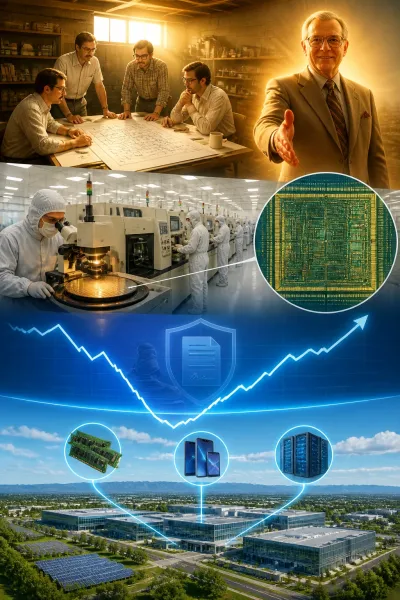
Micron Technology's journey began in 1978 when four former Mostek engineers founded a semiconductor design consultancy in a Boise, Idaho dental office basement. With crucial early investment from local potato magnate J.R. Simplot, the company transitioned to manufacturing, opening "Fab 1" in 1981 to produce 64K DRAM chips. Despite its unconventional location, Micron quickly distinguished itself through engineering excellence, producing the world's smallest DRAM designs. The 1980s proved turbulent, marked by a brutal 1985 market crash and fierce competition from Japanese manufacturers. Micron survived by aggressively shrinking die sizes to lower costs and by leading a landmark anti-dumping trade case that resulted in the 1986 U.S.-Japan Semiconductor Trade Agreement, securing its position as a rare surviving U.S. DRAM maker.
The 1990s and 2000s saw Micron navigate the PC revolution and the dot-com bust through strategic diversification and consolidation. The company expanded globally, establishing a major manufacturing footprint in Asia (Taiwan, Japan, Singapore) while maintaining R&D leadership in Boise. It entered the NAND flash market via the IM Flash Technologies joint venture with Intel (2006), a pivotal move that reduced reliance on volatile DRAM cycles. The dot-com crash forced painful restructuring but also created acquisition opportunities; Micron purchased Toshiba's DRAM assets (2001) and later Elpida Memory (2013), consolidating the industry and solidifying its status as a top-three global DRAM supplier. Leadership transitions from founders to Steve Appleton, Mark Durcan, and Sanjay Mehrotra maintained a consistent culture of innovation, manufacturing discipline, and strategic risk-taking.
As the mobile revolution exploded, Micron capitalized on its NAND and low-power DRAM (LPDDR) expertise, becoming a critical supplier for smartphones and solid-state drives. The company further expanded into enterprise SSDs, graphics memory (GDDR), and high-bandwidth memory (HBM), moving up the value chain into higher-margin, specialized solutions for data centers and AI accelerators. Navigating the 2010s and 2020s required managing immense geopolitical complexity, including IP litigation in China, supply chain disruptions from the COVID-19 pandemic, and the strategic imperatives of the U.S. CHIPS Act. Throughout, Micron maintained a commitment to R&D, pushing 3D NAND layer counts and DRAM process nodes (1-alpha and beyond) while investing in emerging architectures like compute-in-memory and persistent memory.
Today, as an S&P 500 company, Micron stands as a linchpin of the global digital infrastructure, its memory and storage powering everything from consumer devices and automotive systems to hyperscale clouds and artificial intelligence. Its legacy is defined by a unique culture forged in Idaho—combining engineering resilience, collaborative problem-solving, and a willingness to endure cyclical downturns to fund the next breakthrough. From potato fields to the forefront of the AI era, Micron’s history reflects the trajectory of the semiconductor industry itself: a relentless pursuit of density, speed, and efficiency that has fundamentally shaped the modern interconnected world.
What You'll Find Inside:
- The improbable founding story of Micron Technology in Boise, Idaho—transforming potato fields into a semiconductor powerhouse through pioneering DRAM innovations that challenged industry giants.
- How Micron navigated the brutal boom-and-bust cycles of the semiconductor industry, including the 1980s trade wars with Japan, the dot-com crash, and strategic consolidation through acquisitions like Elpida Memory.
- The pivotal diversification into NAND flash memory via the IM Flash Technologies joint venture with Intel, which positioned Micron to dominate the mobile revolution and enterprise storage markets.
- Leadership transitions across four decades—from founders to Steve Appleton, Mark Durcan, and Sanjay Mehrotra—that maintained a culture of innovation, collaboration, and resilience while evolving corporate strategy.
- Micron's critical role in enabling modern computing paradigms—from PCs and smartphones to AI, cloud data centers, autonomous vehicles, and IoT—and its push into next-generation memory like HBM, persistent memory, and compute-in-memory architectures.
Who's It For:
This book is ideal for semiconductor industry professionals, technology investors, and business strategists seeking a detailed case study of how a company survives and thrives in a brutally cyclical, capital-intensive industry. It will also appeal to students of innovation management and American corporate history, as well as general readers interested in the hidden infrastructure powering the digital age—from PCs and smartphones to AI and autonomous vehicles.
Introduction
In the annals of American enterprise, few companies embody the relentless spirit of innovation and the dramatic shifts of technological progress quite like Micron Technology. From its humble beginnings amidst Idaho's potato fields to its current standing as a global semiconductor giant and a venerable member of the S&P 500, Micron's journey is a compelling saga of vision, perseverance, and strategic acumen. This book, "A History of Micron Technology: The Story of an S&P 500 Company," chronicles this remarkable trajectory, offering an in-depth exploration of the forces that shaped a company integral to the digital age.
Micron's story is, in many ways, a microcosm of the semiconductor industry itself—an arena characterized by dizzying innovation, intense competition, and cycles of boom and bust. Born from an audacious idea to build memory chips in a landscape far removed from Silicon Valley, Micron rapidly ascended to become a critical player in the global technology ecosystem. Its pioneering work in DRAM (Dynamic Random-Access Memory) and subsequent diversification into NAND flash memory and other advanced storage solutions have underpinned revolutions from the personal computer to the smartphone, and now, the burgeoning fields of artificial intelligence and the Internet of Things.
Enjoying it? The full book includes every chapter.
Table of Contents:
- Introduction Free
- Chapter 1: The Genesis of Micron: From Potato Fields to Semiconductors Free
- Chapter 2: Early Innovations and the Quest for DRAM
- Chapter 3: Navigating the Volatile Semiconductor Landscape of the 1980s
- Chapter 4: Global Expansion and the Rise of a Memory Giant
- Chapter 5: Diversification and the Challenge of New Technologies
- Chapter 6: Micron's Role in the PC Revolution
- Chapter 7: Surviving the Dot-Com Bust and Industry Consolidation
- Chapter 8: Strategic Acquisitions and Expanding Market Share
- Chapter 9: The Mobile Revolution and New Memory Demands
- Chapter 10: Research and Development: Pushing the Boundaries of Memory
- Chapter 11: Manufacturing Excellence and Global Operations
- Chapter 12: Leadership Transitions and Evolving Corporate Strategy
- Chapter 13: Micron and the Enterprise: Powering Data Centers and Cloud Computing
- Chapter 14: The Internet of Things (IoT) and Edge Computing Opportunities
- Chapter 15: Overcoming Economic Downturns and Market Fluctuations
- Chapter 16: Intellectual Property and the Competitive Landscape
- Chapter 17: Micron's Impact on Boise and the Local Community
- Chapter 18: Corporate Social Responsibility and Sustainability Initiatives
- Chapter 19: The Evolution of Memory: From DRAM to NAND and Beyond
- Chapter 20: Emerging Technologies: AI, Machine Learning, and Automotive
- Chapter 21: Navigating Geopolitical Challenges and Supply Chain Complexities
- Chapter 22: Financial Performance and Shareholder Value
- Chapter 23: Micron's Culture: Innovation, Collaboration, and Resilience
- Chapter 24: Looking to the Future: The Next Generation of Memory and Storage
- Chapter 25: Micron Technology: A Legacy of Innovation and an S&P 500 Journey
Included when you buy the full book.
Author:
Published By:
Date Published:
October 15, 2026
Type:
Nonfiction
Language:
English
Word Count:
37,154 words
Reading Time:
2 hours 36 minutes
Sample:
Order:
Buy the A History of Micron Technology ebook on MixCache.com:
Buy NowIncludes every chapter. Not sure yet? Read the opening free.
Full ebook will be available immediately
- read online or download as a PDF file.
$5 account credit for all new MixCache.com accounts, usable toward any ebook purchase!*
MixCache.com Total Access
Get unlimited access to this book + all books published by MixCache.com for $11.99/month
Subscribe to MTA





Ratings & Reviews
Ask Questions About This Book
Have a question about the content? Ask our AI assistant!
Start by asking a question about "A History of Micron Technology"
Example: "Does this book mention William Shakespeare?"
Thinking...