
Browse by Category
Fiction
- Action & Adventure
- African American
- Anthologies
- Children's Fiction
- Classics
- Comics & Graphic Novels
- Coming of Age
- Contemporary
- Cultural & Regional
- Drama
- Erotica
- Fantasy
- General
- Historical Fiction
- Horror
- Humor & Satire
- Literary Fiction
- Mystery, Thriller & Suspense
- Poetry
- Religious & Inspirational
- Romance
- Science Fiction
- Short Stories
- War & Military
- Westerns
- Women's Fiction
- Young Adult
Non-Fiction
- Antiques & Collectibles
- Arts & Photography
- Biographies & Memoirs
- Business & Money
- Children's Non-Fiction
-
Computers & Technology
- Artificial Intelligence
- Computer Science
- Cybersecurity & Cryptography
- Data Science & Analytics
- Databases & Big Data
- Game Development & Design
- General
- Hardware & DIY
- Mobile App Development
- Networking & Cloud Computing
- Operating Systems
- Programming
- Robotics
- Software
- Software Engineering
- User Experience (UX) & Design
- Web Development & Design
- Cooking, Food & Wine
- Crafts, Hobbies & Home
- Education & Teaching
- Engineering
- General
- Health, Fitness & Dieting
-
History
- African History
- African History - North Africa
- African History - Sub-Saharan Africa
- American History
- American History - 20th Century
- American History - Civil War
- American History - Colonial Period
- Ancient History
- Asian History
- Asian History - China
- Asian History - India
- Asian History - Japan
- Asian History - Southeast Asia
- European History
- European History - Ancient Greece
- European History - Ancient Rome
- European History - Medieval
- European History - Modern
- European History - Renaissance
- General
- Middle Eastern History
- Military History
- Military History - Aviation
- Military History - Naval
- Social & Cultural History
- World History
- Humor & Entertainment
- Industrial Technology
- Language Learning
- Law
- LGBTQ+ Non-Fiction
- Literary Criticism
- Medical Books
- Parenting & Relationships
- Philosophy
- Politics & Social Sciences
- Reference
- Religion & Spirituality
-
Science & Math
- Agricultural Sciences
- Astronomy & Space Science
- Behavioral Sciences
- Biological Sciences
- Botany & Plant Science
- Chemistry
- Earth Sciences
- Engineering - Chemical
- Engineering - Civil
- Engineering - Electrical
- Engineering - Mechanical
- Environment
- General
- Geology
- Mathematics
- Nature & Ecology
- Oceanography
- Paleontology
- Physics
- Statistics
- Self-Help
- Sports & Outdoors
- Study Aids
- Sustainability & Green Living
- Textbooks
- Transportation
- Travel
- True Crime
- Urban Planning & Development
- Veterinary Medicine
- Writing & Publishing
Jump to Section
MixCache.com Total Access
Unlimited reading and audiobooks for every book published by MixCache.com.
Included titles carry the MTA badge.
Learn more →
A History of Linde plc
MTA
The Story of an S&P 500 Company
About this book:
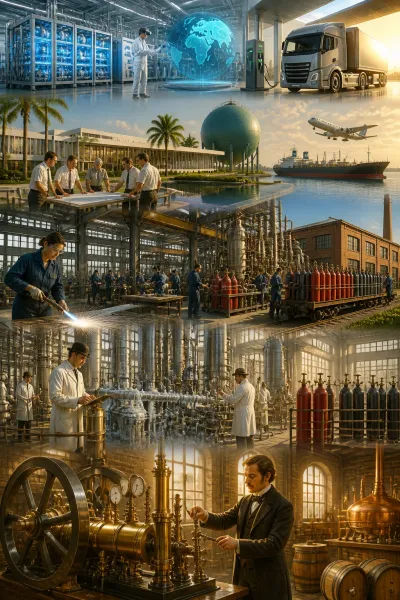
Carl von Linde’s invention of the first reliable ammonia refrigeration machine in 1876 revolutionized the brewing and food industries, leading to the founding of Gesellschaft für Linde's Eismaschinen in 1879. The company rapidly expanded across Europe, but a pivotal shift occurred when Linde turned his scientific focus to cryogenics, achieving the industrial-scale liquefaction and separation of air in 1895 and 1902. This breakthrough established industrial gases—oxygen, nitrogen, and later rare gases—as the company’s core business. Two World Wars accelerated this transition, as demand for oxygen in metalworking and nitrogen for explosives cemented Linde’s role as a strategic industrial supplier. Despite the devastation of WWII, the company rebuilt, diversifying into materials handling and engineering while expanding its global footprint through strategic acquisitions and partnerships in North America, Asia, and Latin America.
The late 20th and early 21st centuries were defined by technological specialization and digital transformation. Linde became indispensable to the semiconductor industry by mastering ultra-high-purity gas production and delivery systems, while simultaneously advancing medical gas applications and safety standards. The company navigated energy crises, economic downturns, and rising environmental awareness by driving efficiency and pioneering early environmental solutions. This trajectory culminated in the transformative 2018 merger with U.S. rival Praxair, creating Linde plc—the world’s largest industrial gas company. The merger secured a balanced global presence, delivered significant synergies, and facilitated the company’s entry into the S&P 500, marking its arrival as a premier global financial and industrial entity.
In its current era, Linde plc has strategically pivoted toward sustainability as a primary growth engine, leveraging its core gas separation and cryogenic competencies to lead the clean energy transition. The company is investing heavily in green and blue hydrogen production, carbon capture and utilization (CCUS), and eco-efficient industrial applications to decarbonize hard-to-abate sectors like steel and cement. Simultaneously, Linde is deepening its digital capabilities—deploying AI, digital twins, and predictive analytics—to optimize its vast global supply chain and offer data-driven value to customers. Guided by a culture rooted in engineering excellence, operational rigor, and safety, Linde continues to navigate geopolitical complexities and market volatility, positioning itself not merely as a gas supplier but as an architect of the sustainable industrial infrastructure of the future.
What You'll Find Inside:
- The evolution of Linde from a 19th-century refrigeration pioneer founded by Carl von Linde into the world's leading industrial gases and engineering company through continuous technological innovation in cryogenics and air separation.
- The transformative 2018 merger with Praxair that created Linde plc, the world's largest industrial gas company by revenue and market capitalization, and secured its place in the S&P 500.
- Linde's critical enabling role in strategically vital industries including semiconductor manufacturing (ultra-high purity gases), healthcare (medical gases), and the emerging clean hydrogen economy.
- A century-plus legacy of research and development driving advancements in gas production efficiency, digital transformation of operations, and the evolution of world-class safety standards across global operations.
- The company's strategic pivot toward sustainability as a core growth driver, positioning Linde as a foundational leader in green hydrogen production, carbon capture technologies, and industrial decarbonization solutions.
Who's It For:
This book is ideal for business leaders, corporate strategists, and investors seeking insights into how a technology-driven industrial company achieves sustained global dominance through innovation, strategic M&A, and adaptation to megatrends like decarbonization. It will also appeal to historians of technology and industry, engineers in the gases sector, and students of corporate evolution who want a detailed case study of resilience across wars, energy crises, and digital disruption.
Table of Contents:
- Introduction
- Chapter 1 The Dawn of an Industrial Giant: Founding and Early Years
- Chapter 2 Pioneering Refrigeration: Linde's Early Technological Innovations
- Chapter 3 Expansion Across Europe: Establishing a Continental Presence
- Chapter 4 World Wars and Industrial Shifts: Navigating Tumultuous Times
- Chapter 5 Post-War Reconstruction and Diversification
- Chapter 6 The Rise of Industrial Gases: A New Core Business
- Chapter 7 Global Ambitions: Entering New Markets
- Chapter 8 Mergers and Acquisitions: Shaping the Modern Linde
- Chapter 9 Technological Advancements in Gas Production and Application
- Chapter 10 The Energy Crisis and Adaptation Strategies
- Chapter 11 Environmental Stewardship: Early Initiatives and Challenges
- Chapter 12 Digital Transformation: Embracing Automation and Data
- Chapter 13 Navigating Economic Downturns and Resurgence
- Chapter 14 Innovation in Healthcare and Medical Gases
- Chapter 15 Linde's Role in the Semiconductor Industry
- Chapter 16 The Evolution of Safety Standards and Practices
- Chapter 17 From European Powerhouse to Global Leader
- Chapter 18 The Praxair Merger: A Defining Moment
- Chapter 19 Becoming an S&P 500 Company: Milestones and Impact
- Chapter 20 Sustainable Solutions: Driving Green Technologies
- Chapter 21 Challenges and Opportunities in the 21st Century
- Chapter 22 Leadership and Corporate Culture: The People Behind Linde
- Chapter 23 Research and Development: Fueling Future Growth
- Chapter 24 Linde in a Changing World: Geopolitical and Economic Influences
- Chapter 25 The Future of Linde: Innovation, Sustainability, and Continued Growth
Author:
Published By:
Date Published:
October 11, 2026
Type:
Nonfiction
Language:
English
Word Count:
38,872 words
Reading Time:
2 hours 43 minutes
Sample:
MixCache.com Total Access
Get unlimited access to this book + all books published by MixCache.com for $11.99/month
Subscribe to MTAOr purchase this book individually below
Order:
Buy the A History of Linde plc ebook on MixCache.com:
Buy Now
Full ebook will be available immediately
- read online or download as a PDF file.
$5 account credit for all new MixCache.com accounts, usable toward any ebook purchase!*



Ratings & Reviews
Ask Questions About This Book
Have a question about the content? Ask our AI assistant!
Start by asking a question about "A History of Linde plc"
Example: "Does this book mention William Shakespeare?"
Thinking...