
Browse by Category
Fiction
- Action & Adventure
- African American
- Anthologies
- Children's Fiction
- Classics
- Comics & Graphic Novels
- Coming of Age
- Contemporary
- Cultural & Regional
- Drama
- Erotica
- Fantasy
- General
- Historical Fiction
- Horror
- Humor & Satire
- Literary Fiction
- Mystery, Thriller & Suspense
- Poetry
- Religious & Inspirational
- Romance
- Science Fiction
- Short Stories
- War & Military
- Westerns
- Women's Fiction
- Young Adult
Non-Fiction
- Antiques & Collectibles
- Arts & Photography
- Biographies & Memoirs
- Business & Money
- Children's Non-Fiction
-
Computers & Technology
- Artificial Intelligence
- Computer Science
- Cybersecurity & Cryptography
- Data Science & Analytics
- Databases & Big Data
- Game Development & Design
- General
- Hardware & DIY
- Mobile App Development
- Networking & Cloud Computing
- Operating Systems
- Programming
- Robotics
- Software
- Software Engineering
- User Experience (UX) & Design
- Web Development & Design
- Cooking, Food & Wine
- Crafts, Hobbies & Home
- Education & Teaching
- Engineering
- General
- Health, Fitness & Dieting
-
History
- African History
- African History - North Africa
- African History - Sub-Saharan Africa
- American History
- American History - 20th Century
- American History - Civil War
- American History - Colonial Period
- Ancient History
- Asian History
- Asian History - China
- Asian History - India
- Asian History - Japan
- Asian History - Southeast Asia
- European History
- European History - Ancient Greece
- European History - Ancient Rome
- European History - Medieval
- European History - Modern
- European History - Renaissance
- General
- Middle Eastern History
- Military History
- Military History - Aviation
- Military History - Naval
- Social & Cultural History
- World History
- Humor & Entertainment
- Industrial Technology
- Language Learning
- Law
- LGBTQ+ Non-Fiction
- Literary Criticism
- Medical Books
- Parenting & Relationships
- Philosophy
- Politics & Social Sciences
- Reference
- Religion & Spirituality
-
Science & Math
- Agricultural Sciences
- Astronomy & Space Science
- Behavioral Sciences
- Biological Sciences
- Botany & Plant Science
- Chemistry
- Earth Sciences
- Engineering - Chemical
- Engineering - Civil
- Engineering - Electrical
- Engineering - Mechanical
- Environment
- General
- Geology
- Mathematics
- Nature & Ecology
- Oceanography
- Paleontology
- Physics
- Statistics
- Self-Help
- Sports & Outdoors
- Study Aids
- Sustainability & Green Living
- Textbooks
- Transportation
- Travel
- True Crime
- Urban Planning & Development
- Veterinary Medicine
- Writing & Publishing
Jump to Section
MixCache.com Total Access
Unlimited reading and audiobooks for every book published by MixCache.com.
Included titles carry the MTA badge.
Learn more →
A History of Cummins
MTA
The Story of an S&P 500 Company
About this book:
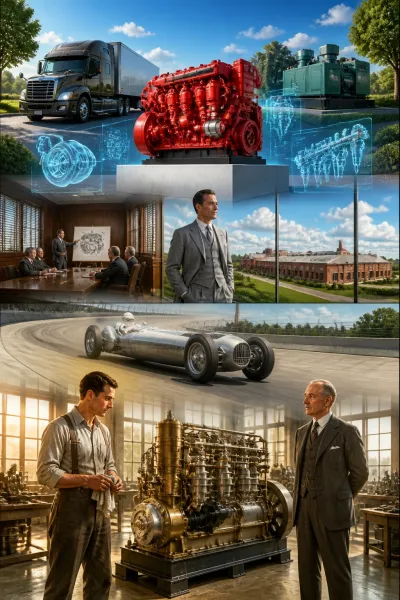
Founded in 1919 in Columbus, Indiana, by mechanic Clessie Cummins and banker William G. Irwin, Cummins Inc. began as a struggling venture licensing unproven diesel technology. Through Clessie’s engineering brilliance—epitomized by the Model F and the revolutionary P-T fuel system—and Irwin’s financial backing, the company survived the Great Depression by proving diesel’s superior fuel economy and durability in record-setting automotive stunts. Under the strategic leadership of J. Irwin Miller, who assumed the presidency in 1947, Cummins transitioned from wartime production into a post-war industrial powerhouse, expanding into heavy-duty trucking, construction, and power generation while establishing its first foreign manufacturing plant in Scotland in 1956 to launch a global footprint.
The latter half of the 20th century was defined by diversification and technological adaptation. Cummins acquired key component manufacturers like Holset Engineering to vertically integrate turbocharger production, expanded into mid-range engines with the successful B and C Series, and navigated intensifying competition from Detroit Diesel and Caterpillar. The company met the rising tide of environmental regulation by pioneering electronic engine controls and exhaust aftertreatment systems, including DPF and SCR technologies, transforming the diesel engine into a clean, electronically managed power source. This era also saw the formalization of the Cummins Production System (CPS), embedding lean manufacturing and continuous improvement into a global operations framework that ensured quality across continents.
Entering the 21st century, Cummins solidified its status as an S&P 500 company through financial discipline, robust corporate governance, and a brand synonymous with reliability and social responsibility—championed by Miller’s early advocacy for civil rights and community investment. The company weathered economic cycles, including the 2008 financial crisis, by leveraging a diversified portfolio, a resilient global supply chain, and a strong aftermarket service network. Strategic alliances and joint ventures, particularly in China and emerging technology sectors, accelerated market access and innovation capacity.
Today, Cummins operates in approximately 190 countries as a diversified "power solutions" leader. While maintaining dominance in advanced diesel and natural gas engines, the company is aggressively pivoting toward a zero-emission future through its "Destination Zero" strategy. This involves significant investments in battery-electric powertrains, hydrogen fuel cells, and hydrogen internal combustion engines, supported by digital connectivity, telematics, and advanced data analytics. Balancing its century-old heritage of mechanical ruggedness with cutting-edge electrification and alternative fuels, Cummins continues to evolve from an engine manufacturer into a comprehensive, sustainable power technology provider.
What You'll Find Inside:
- The founding partnership between mechanic Clessie Cummins and banker William G. Irwin, and how early diesel demonstrations (including the 1931 Indy 500 run) proved the technology's viability and saved the company during the Great Depression.
- Cummins' transformation through WWII military production into a global industrial leader, followed by post-war diversification into trucking, construction, agriculture, and power generation markets.
- Continuous technological innovation spanning the P-T fuel system, turbocharging, electronic engine controls, emissions aftertreatment (DPF/SCR), and the current pivot to electrification, hydrogen fuel cells, and alternative fuels.
- Strategic global expansion beginning with the 1956 Scotland plant, joint ventures in China and other markets, the Holset acquisition, and a decentralized management philosophy that enabled local responsiveness.
- J. Irwin Miller's visionary leadership establishing a culture of corporate responsibility, diversity, and ethical governance, alongside the Cummins Production System driving manufacturing excellence and the company's journey to S&P 500 inclusion.
Who's It For:
This book is ideal for business leaders, engineers, and students of industrial history who want a comprehensive case study in long-term corporate resilience and innovation. Investors and financial analysts will appreciate the detailed examination of how Cummins navigated economic cycles, strategic acquisitions, and technological disruption to achieve S&P 500 status. Readers interested in corporate culture and ethics will find the leadership of J. Irwin Miller—particularly his pioneering stance on civil rights and stakeholder capitalism—especially instructive for modern ESG-focused management.
Table of Contents:
- Introduction
- Chapter 1: The Early Days: Founding and First Innovations
- Chapter 2: Powering the World: Cummins' Entry into Diesel Engines
- Chapter 3: Wartime Production and Post-War Expansion
- Chapter 4: Innovation on the Horizon: Advancements in Engine Technology
- Chapter 5: Global Ambitions: Expanding Beyond American Shores
- Chapter 6: Facing the Competition: Navigating a Shifting Market
- Chapter 7: Diversification and Growth: New Ventures and Acquisitions
- Chapter 8: Environmental Challenges and Sustainable Solutions
- Chapter 9: Leadership and Legacy: Key Figures in Cummins' History
- Chapter 10: The Road Ahead: Adapting to New Technologies
- Chapter 11: Powering the S&P 500: A Journey to Market Recognition
- Chapter 12: Manufacturing Excellence: The Cummins Production System
- Chapter 13: Research and Development: Fueling Future Innovations
- Chapter 14: The Human Element: Culture and Workforce Development
- Chapter 15: Community and Responsibility: Cummins' Social Impact
- Chapter 16: Navigating Economic Downturns and Resurgence
- Chapter 17: Partnerships and Collaborations: Expanding Influence
- Chapter 18: The Digital Revolution: Integrating Technology in Operations
- Chapter 19: Global Supply Chains and Their Evolution
- Chapter 20: Engines for Every Need: From Heavy-Duty to Light Commercial
- Chapter 21: The Future of Power: Alternative Fuels and Electrification
- Chapter 22: Strategic Alliances and Joint Ventures
- Chapter 23: Brand Building and Market Perception
- Chapter 24: Financial Milestones and Corporate Governance
- Chapter 25: Cummins Today: A Global Power Leader
Author:
Published By:
Date Published:
October 8, 2026
Type:
Nonfiction
Language:
English
Word Count:
40,664 words
Reading Time:
2 hours 51 minutes
Sample:
MixCache.com Total Access
Get unlimited access to this book + all books published by MixCache.com for $11.99/month
Subscribe to MTAOr purchase this book individually below
Order:
Buy the A History of Cummins ebook on MixCache.com:
Buy Now
Full ebook will be available immediately
- read online or download as a PDF file.
$5 account credit for all new MixCache.com accounts, usable toward any ebook purchase!*





Ratings & Reviews
Ask Questions About This Book
Have a question about the content? Ask our AI assistant!
Start by asking a question about "A History of Cummins"
Example: "Does this book mention William Shakespeare?"
Thinking...