
Browse by Category
Fiction
- Action & Adventure
- African American
- Anthologies
- Children's Fiction
- Classics
- Comics & Graphic Novels
- Coming of Age
- Contemporary
- Cultural & Regional
- Drama
- Erotica
- Fantasy
- General
- Historical Fiction
- Horror
- Humor & Satire
- Literary Fiction
- Mystery, Thriller & Suspense
- Poetry
- Religious & Inspirational
- Romance
- Science Fiction
- Short Stories
- War & Military
- Westerns
- Women's Fiction
- Young Adult
Non-Fiction
- Antiques & Collectibles
- Arts & Photography
- Biographies & Memoirs
- Business & Money
- Children's Non-Fiction
-
Computers & Technology
- Artificial Intelligence
- Computer Science
- Cybersecurity & Cryptography
- Data Science & Analytics
- Databases & Big Data
- Game Development & Design
- General
- Hardware & DIY
- Mobile App Development
- Networking & Cloud Computing
- Operating Systems
- Programming
- Robotics
- Software
- Software Engineering
- User Experience (UX) & Design
- Web Development & Design
- Cooking, Food & Wine
- Crafts, Hobbies & Home
- Education & Teaching
- Engineering
- General
- Health, Fitness & Dieting
-
History
- African History
- African History - North Africa
- African History - Sub-Saharan Africa
- American History
- American History - 20th Century
- American History - Civil War
- American History - Colonial Period
- Ancient History
- Asian History
- Asian History - China
- Asian History - India
- Asian History - Japan
- Asian History - Southeast Asia
- European History
- European History - Ancient Greece
- European History - Ancient Rome
- European History - Medieval
- European History - Modern
- European History - Renaissance
- General
- Middle Eastern History
- Military History
- Military History - Aviation
- Military History - Naval
- Social & Cultural History
- World History
- Humor & Entertainment
- Industrial Technology
- Language Learning
- Law
- LGBTQ+ Non-Fiction
- Literary Criticism
- Medical Books
- Parenting & Relationships
- Philosophy
- Politics & Social Sciences
- Reference
- Religion & Spirituality
-
Science & Math
- Agricultural Sciences
- Astronomy & Space Science
- Behavioral Sciences
- Biological Sciences
- Botany & Plant Science
- Chemistry
- Earth Sciences
- Engineering - Chemical
- Engineering - Civil
- Engineering - Electrical
- Engineering - Mechanical
- Environment
- General
- Geology
- Mathematics
- Nature & Ecology
- Oceanography
- Paleontology
- Physics
- Statistics
- Self-Help
- Sports & Outdoors
- Study Aids
- Sustainability & Green Living
- Textbooks
- Transportation
- Travel
- True Crime
- Urban Planning & Development
- Veterinary Medicine
- Writing & Publishing
Jump to Section
MixCache.com Total Access
Unlimited reading and audiobooks for every book published by MixCache.com.
Included titles carry the MTA badge.
Learn more →
A History of Coca-Cola Company (The)
MTA
The Story of an S&P 500 Company
About this book:
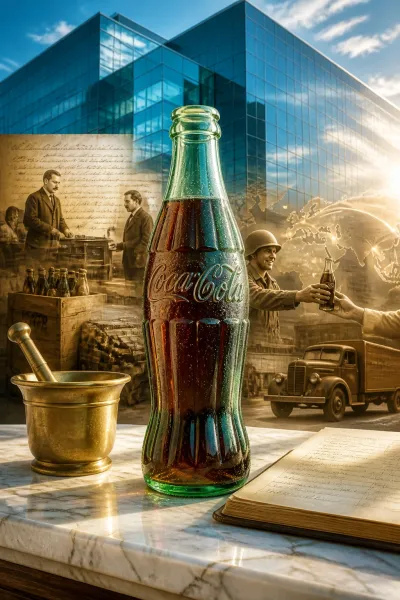
The Coca-Cola Company’s journey from an 1886 Atlanta pharmacy tonic to a global S&P 500 titan is defined by visionary leadership, a revolutionary franchised bottling system, and marketing genius. Pharmacist John Pemberton invented the drink, but Asa Candler acquired the fragmented rights and built a national brand through aggressive advertising, coupons, and the iconic Spencerian script. The pivotal 1899 decision to sell bottling rights for one dollar created a decentralized network of independent entrepreneurs who bore the capital risk and local execution, allowing Coca-Cola to scale rapidly without heavy corporate infrastructure. This "Coca-Cola System" proved adaptable globally, accelerated by Robert Woodruff’s WWII mandate to supply every serviceman a Coke for five cents, which established bottling plants worldwide and cemented the brand as a symbol of American comfort and modernity.
The mid-to-late 20th century brought fierce competition and internal crises. The "Pepsi Challenge" of the 1970s exposed taste preference vulnerabilities, culminating in the disastrous 1985 "New Coke" launch. The swift consumer revolt and return of "Coca-Cola Classic" paradoxically reinforced the brand’s emotional resonance and cultural sanctity. Post-crisis leadership under Roberto Goizueta and successors focused on financial discipline, international expansion into post-Cold War markets, and diversification beyond cola through acquisitions like Minute Maid, Odwalla, Costa Coffee, and a stake in Monster Beverage. This transformed the company into a "total beverage company" spanning water, juices, teas, coffee, and sports drinks, mitigating reliance on carbonated soft drinks as health trends shifted.
Entering the 21st century, the company navigated economic downturns, the Great Recession, and the COVID-19 pandemic by leveraging its resilient bottling network and expanding its portfolio toward zero-sugar and functional beverages. Leadership under Muhtar Kent and James Quincey accelerated refranchising bottling operations to lighten the balance sheet, pursued aggressive digital transformation and e-commerce strategies, and committed to ambitious sustainability goals like "World Without Waste" and water replenishment. Today, Coca-Cola’s enduring legacy rests on unparalleled brand equity—recognized by over 90% of the global population—a uniquely scalable operating model, and a diversified portfolio. Its future hinges on balancing heritage with agile innovation in health, digital personalization, and environmental stewardship to maintain relevance in a fragmenting, volatile marketplace.
What You'll Find Inside:
- The accidental invention of Coca-Cola in 1886 and Asa Candler's visionary marketing and franchising strategy that transformed a local tonic into a national brand.
- The revolutionary 1899 bottling contract (sold for $1) that created a decentralized, independent bottler network enabling rapid global expansion with minimal capital risk.
- Iconic advertising campaigns and brand assets (contour bottle, Santa Claus imagery, 'Hilltop', 'Share a Coke') that embedded Coca-Cola into global culture and consumer emotion.
- Strategic diversification from a single cola into a 'total beverage company' portfolio (water, juice, tea, coffee, sports drinks) driven by health trends and acquisitions like Minute Maid, Costa Coffee, and Bodyarmor.
- Resilience through global crises (Great Depression, World Wars, 2008 recession, COVID-19) and the New Coke debacle, demonstrating adaptive leadership and the enduring power of brand heritage.
Who's It For:
This book is ideal for business students, marketing professionals, and corporate strategists seeking a comprehensive case study in brand building, global franchising, and crisis management. History enthusiasts and general readers interested in the evolution of American capitalism and consumer culture will also appreciate the detailed narrative of how a simple beverage became a ubiquitous global icon. Investors and analysts tracking S&P 500 companies will find valuable insights into Coca-Cola's enduring financial resilience and strategic pivots.
Table of Contents:
- Introduction
- Chapter 1: The Genesis of a Global Icon
- Chapter 2: From Pemberton to Candler: Early Leadership and Vision
- Chapter 3: The Birth of the Bottle: Packaging a Phenomenon
- Chapter 4: Expanding Horizons: Early 20th Century Growth
- Chapter 5: The Secret Formula: Myth, Marketing, and Mystique
- Chapter 6: World Wars and Wartime Expansion
- Chapter 7: Post-War Boom and the Rise of International Markets
- Chapter 8: Diversification and New Ventures (1960s-1970s)
- Chapter 9: The Cola Wars: Pepsi Challenge and Market Battles
- Chapter 10: New Coke: A Risky Bet and a Swift Retreat
- Chapter 11: Reclaiming the Crown: Strategic Shifts and Brand Reinvention
- Chapter 12: Global Domination: Marketing to the World
- Chapter 13: The Innovation Imperative: New Products and Flavors
- Chapter 14: Health and Wellness Trends: Adapting to Changing Tastes
- Chapter 15: Bottling Partnerships and Supply Chain Mastery
- Chapter 16: Advertising and Brand Building: Iconic Campaigns
- Chapter 17: Sponsorships and Cultural Impact
- Chapter 18: Corporate Social Responsibility and Sustainability Efforts
- Chapter 19: Leadership Transitions and Strategic Evolution
- Chapter 20: Navigating Economic Downturns and Global Challenges
- Chapter 21: Acquisitions and Mergers: Expanding the Beverage Portfolio
- Chapter 22: Digital Transformation and E-commerce Strategies
- Chapter 23: The Coca-Cola System: A Global Network
- Chapter 24: The Enduring Legacy: Brand Power and Market Value
- Chapter 25: The Future of Refreshment: Challenges and Opportunities
Author:
Published By:
Date Published:
October 5, 2026
Type:
Nonfiction
Language:
English
Word Count:
39,791 words
Reading Time:
2 hours 47 minutes
Sample:
MixCache.com Total Access
Get unlimited access to this book + all books published by MixCache.com for $11.99/month
Subscribe to MTAOr purchase this book individually below
Order:
Buy the A History of Coca-Cola Company (The) ebook on MixCache.com:
Buy Now
Full ebook will be available immediately
- read online or download as a PDF file.
$5 account credit for all new MixCache.com accounts, usable toward any ebook purchase!*




Ratings & Reviews
Ask Questions About This Book
Have a question about the content? Ask our AI assistant!
Start by asking a question about "A History of Coca-Cola Company (The)"
Example: "Does this book mention William Shakespeare?"
Thinking...