
Browse by Category
Fiction
- Action & Adventure
- African American
- Anthologies
- Children's Fiction
- Classics
- Comics & Graphic Novels
- Coming of Age
- Contemporary
- Cultural & Regional
- Drama
- Erotica
- Fantasy
- General
- Historical Fiction
- Horror
- Humor & Satire
- Literary Fiction
- Mystery, Thriller & Suspense
- Poetry
- Religious & Inspirational
- Romance
- Science Fiction
- Short Stories
- War & Military
- Westerns
- Women's Fiction
- Young Adult
Non-Fiction
- Antiques & Collectibles
- Arts & Photography
- Biographies & Memoirs
- Business & Money
- Children's Non-Fiction
-
Computers & Technology
- Artificial Intelligence
- Computer Science
- Cybersecurity & Cryptography
- Data Science & Analytics
- Databases & Big Data
- Game Development & Design
- General
- Hardware & DIY
- Mobile App Development
- Networking & Cloud Computing
- Operating Systems
- Programming
- Robotics
- Software
- Software Engineering
- User Experience (UX) & Design
- Web Development & Design
- Cooking, Food & Wine
- Crafts, Hobbies & Home
- Education & Teaching
- Engineering
- General
- Health, Fitness & Dieting
-
History
- African History
- African History - North Africa
- African History - Sub-Saharan Africa
- American History
- American History - 20th Century
- American History - Civil War
- American History - Colonial Period
- Ancient History
- Asian History
- Asian History - China
- Asian History - India
- Asian History - Japan
- Asian History - Southeast Asia
- European History
- European History - Ancient Greece
- European History - Ancient Rome
- European History - Medieval
- European History - Modern
- European History - Renaissance
- General
- Middle Eastern History
- Military History
- Military History - Aviation
- Military History - Naval
- Social & Cultural History
- World History
- Humor & Entertainment
- Industrial Technology
- Language Learning
- Law
- LGBTQ+ Non-Fiction
- Literary Criticism
- Medical Books
- Parenting & Relationships
- Philosophy
- Politics & Social Sciences
- Reference
- Religion & Spirituality
-
Science & Math
- Agricultural Sciences
- Astronomy & Space Science
- Behavioral Sciences
- Biological Sciences
- Botany & Plant Science
- Chemistry
- Earth Sciences
- Engineering - Chemical
- Engineering - Civil
- Engineering - Electrical
- Engineering - Mechanical
- Environment
- General
- Geology
- Mathematics
- Nature & Ecology
- Oceanography
- Paleontology
- Physics
- Statistics
- Self-Help
- Sports & Outdoors
- Study Aids
- Sustainability & Green Living
- Textbooks
- Transportation
- Travel
- True Crime
- Urban Planning & Development
- Veterinary Medicine
- Writing & Publishing
Jump to Section

Want unlimited access to all books published by MixCache.com (plus their audiobooks)? Try MixCache.com Total Access. Look for the MTA badge on book covers to identify included titles.
Access to infinite ebooks: Don't see the book you want? Suggest it and we'll create it (free!) for you from scratch with our powerful AI book writer. Then read it with MTA - besides profiting from any sales it makes!
A History of Northrop Grumman
MTA
The Story of an S&P 500 Company
About this book:
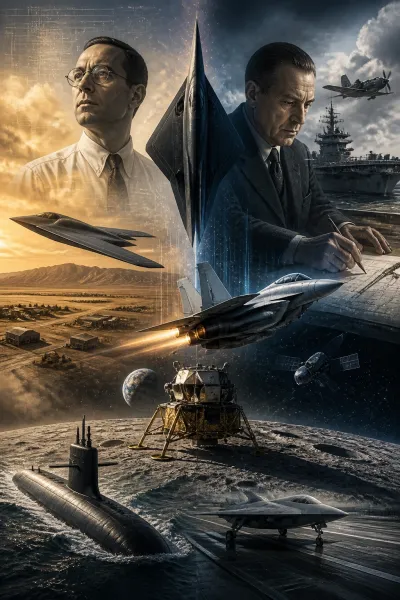
Northrop Grumman's history traces the convergence of two pioneering aviation enterprises—Jack Northrop's visionary flying wing experiments in California and Leroy Grumman's rugged naval "Iron Works" on Long Island—into a preeminent global aerospace and defense conglomerate. Forged through the crucibles of World War II and the Cold War, the legacy companies established distinct identities: Northrop pioneering stealth, advanced materials, and lightweight fighters like the F-5 and T-38, while Grumman dominated carrier aviation with icons such as the F-14 Tomcat, E-2 Hawkeye, and the Apollo Lunar Module. The post-Cold War era catalyzed a transformative merger in 1994, followed by strategic acquisitions of Westinghouse Electronic Systems, TRW, and shipbuilding assets, creating a diversified S&P 500 powerhouse spanning aeronautics, mission systems, space, and cybersecurity.
This integration enabled the company to deliver generation-defining programs, most notably the B-2 Spirit stealth bomber—realizing Jack Northrop’s decades-old flying wing dream—and the James Webb Space Telescope, a triumph of systems engineering unfolding a million miles from Earth. Simultaneously, Northrop Grumman pivoted to the information age, becoming a leader in electronic warfare (EA-6B Prowler, AESA radars), autonomous systems (RQ-4 Global Hawk, X-47B), and cyber operations, recognizing that modern warfare hinges on data dominance and networked "systems of systems" as much as airframes. The company navigated shifting geopolitical landscapes—from counter-terrorism to great power competition—by divesting non-core shipbuilding to focus on high-margin, technology-intensive sectors like the B-21 Raider bomber and hypersonics.
Underpinning this technological trajectory is a culture of human capital investment, ethical governance, and environmental responsibility, evolving from founder-driven engineering cultures into a unified workforce tackling AI, quantum computing, and multi-domain integration. Leadership across decades—from Kent Kresa’s consolidation to Kathy Warden’s digital transformation—has balanced shareholder value with a stated mission of national security. Today, Northrop Grumman stands at the frontier of space security, directed energy, and resilient communications, leveraging its legacy of "impossible" engineering to define the next era of aerospace and defense.
What You'll Find Inside:
- The parallel founding stories of Jack Northrop's visionary flying wing concepts and Leroy Grumman's rugged naval aircraft, and how their distinct legacies converged through strategic mergers to form an S&P 500 defense giant.
- In-depth coverage of iconic aircraft and space programs including the B-2 Spirit stealth bomber, F-14 Tomcat, E-2 Hawkeye, Lunar Module, and the James Webb Space Telescope, detailing their engineering breakthroughs and operational impact.
- The company's pivotal role in pioneering stealth technology, electronic warfare, airborne radar (AESA), and unmanned systems like the Global Hawk and X-47B, tracing the evolution from analog avionics to AI-driven autonomous platforms.
- Analysis of the post-Cold War consolidation wave — including the acquisitions of Grumman, Westinghouse Electronic Systems, TRW, and Ingalls Shipbuilding — and how financial discipline and portfolio diversification secured S&P 500 inclusion.
- Exploration of modern strategic frontiers: hypersonics, directed energy, quantum-resistant cybersecurity, multi-domain integration, and digital engineering, alongside the corporate culture, leadership philosophies, and human capital strategies that sustained innovation across decades.
Who's It For:
This book is ideal for aerospace and defense professionals, business historians, and investors seeking a comprehensive case study in corporate strategy and technological evolution. It will also appeal to engineering enthusiasts and students of innovation management who want to understand how mergers, R&D investment, and visionary leadership built a resilient S&P 500 enterprise at the intersection of national security and cutting-edge science.
Author:
Published By:
Date Published:
September 28, 2026
Type:
Nonfiction
Language:
English
Word Count:
37,718 words
Reading Time:
2 hours 38 minutes
Sample:
MixCache.com Total Access
Get unlimited access to this book + all books published by MixCache.com for $11.99/month
Subscribe to MTAOr purchase this book individually below
Order:
Buy the A History of Northrop Grumman ebook on MixCache.com:
Buy Now
Full ebook will be available immediately
- read online or download as a PDF file.
$5 account credit for all new MixCache.com accounts, usable toward any ebook purchase!*






Ratings & Reviews
Ask Questions About This Book
Have a question about the content? Ask our AI assistant!
Start by asking a question about "A History of Northrop Grumman"
Example: "Does this book mention William Shakespeare?"
Thinking...