
Browse by Category
Fiction
- Action & Adventure
- African American
- Anthologies
- Children's Fiction
- Classics
- Comics & Graphic Novels
- Coming of Age
- Contemporary
- Cultural & Regional
- Drama
- Erotica
- Fantasy
- General
- Historical Fiction
- Horror
- Humor & Satire
- Literary Fiction
- Mystery, Thriller & Suspense
- Poetry
- Religious & Inspirational
- Romance
- Science Fiction
- Short Stories
- War & Military
- Westerns
- Women's Fiction
- Young Adult
Non-Fiction
- Antiques & Collectibles
- Arts & Photography
- Biographies & Memoirs
- Business & Money
- Children's Non-Fiction
-
Computers & Technology
- Artificial Intelligence
- Computer Science
- Cybersecurity & Cryptography
- Data Science & Analytics
- Databases & Big Data
- Game Development & Design
- General
- Hardware & DIY
- Mobile App Development
- Networking & Cloud Computing
- Operating Systems
- Programming
- Robotics
- Software
- Software Engineering
- User Experience (UX) & Design
- Web Development & Design
- Cooking, Food & Wine
- Crafts, Hobbies & Home
- Education & Teaching
- Engineering
- General
- Health, Fitness & Dieting
-
History
- African History
- African History - North Africa
- African History - Sub-Saharan Africa
- American History
- American History - 20th Century
- American History - Civil War
- American History - Colonial Period
- Ancient History
- Asian History
- Asian History - China
- Asian History - India
- Asian History - Japan
- Asian History - Southeast Asia
- European History
- European History - Ancient Greece
- European History - Ancient Rome
- European History - Medieval
- European History - Modern
- European History - Renaissance
- General
- Middle Eastern History
- Military History
- Military History - Aviation
- Military History - Naval
- Social & Cultural History
- World History
- Humor & Entertainment
- Industrial Technology
- Language Learning
- Law
- LGBTQ+ Non-Fiction
- Literary Criticism
- Medical Books
- Parenting & Relationships
- Philosophy
- Politics & Social Sciences
- Reference
- Religion & Spirituality
-
Science & Math
- Agricultural Sciences
- Astronomy & Space Science
- Behavioral Sciences
- Biological Sciences
- Botany & Plant Science
- Chemistry
- Earth Sciences
- Engineering - Chemical
- Engineering - Civil
- Engineering - Electrical
- Engineering - Mechanical
- Environment
- General
- Geology
- Mathematics
- Nature & Ecology
- Oceanography
- Paleontology
- Physics
- Statistics
- Self-Help
- Sports & Outdoors
- Study Aids
- Sustainability & Green Living
- Textbooks
- Transportation
- Travel
- True Crime
- Urban Planning & Development
- Veterinary Medicine
- Writing & Publishing
Jump to Section

Want unlimited access to all books published by MixCache.com (plus their audiobooks)? Try MixCache.com Total Access. Look for the MTA badge on book covers to identify included titles.
Access to infinite ebooks: Don't see the book you want? Suggest it and we'll create it (free!) for you from scratch with our powerful AI book writer. Then read it with MTA - besides profiting from any sales it makes!
A History of Nucor
MTA
The Story of an S&P 500 Company
About this book:
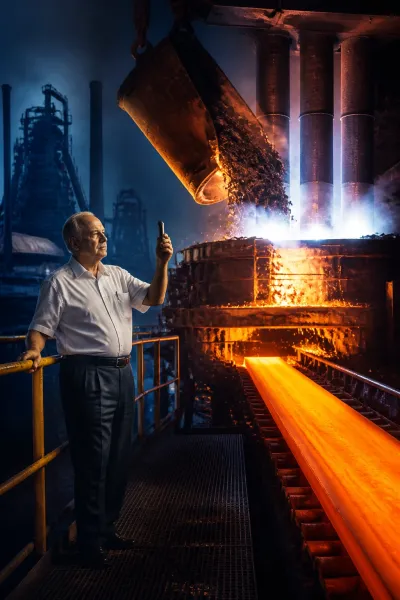
Nucor’s ascent from a diversified manufacturer to a dominant S&P 500 steel titan is rooted in a radical departure from industry tradition. Under visionary leader Kenneth Iverson, the company pioneered the minimill model, utilizing electric arc furnaces to melt scrap steel rather than relying on capital-intensive blast furnaces and virgin ore. This disruptive technology slashed startup costs, energy consumption, and environmental impact, while granting the operational agility to thrive during volatile economic cycles. Nucor systematically replicated this efficient model across the U.S., eventually mastering thin-slab casting to invade the flat-rolled market previously controlled by integrated giants, and diversifying into specialized alloys, stainless steel, and downstream fabrication to secure higher margins and stability.
The bedrock of this technological and strategic success was a revolutionary corporate culture built on extreme decentralization, radical transparency, and a performance-based pay system that aligned every employee’s incentives with plant profitability. By eliminating layers of management, empowering frontline workers to make decisions, and maintaining a strict no-layoff policy, Nucor fostered a loyal, non-unionized workforce that drove relentless continuous improvement and safety excellence. This human-centric philosophy, combined with Iverson’s legendary aversion to debt, created a resilient financial fortress that allowed the company to invest counter-cyclically, acquire distressed assets, and weather crises—from the 1980s recessions to the 2008 financial crisis and the COVID-19 pandemic—far better than its leveraged competitors.
Over subsequent decades, Nucor evolved from a low-cost commodity producer into a sophisticated provider of engineered steel solutions. Strategic investments in direct reduced iron (DRI) secured raw material independence for premium grades, while deep R&D collaborations with customers and equipment suppliers yielded advanced high-strength steels for automotive lightweighting and renewable energy infrastructure. The company leveraged digital transformation, automation, and predictive analytics to further optimize its "smart factories," extending its competitive edge. Throughout leadership transitions—from Iverson to Aycock, DiMicco, Ferriola, and Topalian—the core principles of lean operations, employee empowerment, and financial conservatism remained immutable, ensuring seamless succession and cultural continuity.
Today, Nucor stands as a model for modern industrial enterprise, proving that heavy manufacturing can be simultaneously high-tech, environmentally responsible, and profoundly human-centric. Its minimill revolution reshaped the global steel landscape, forcing legacy producers to adapt or exit, while its domestic footprint literally built the infrastructure of modern America. As the industry pivots toward a net-zero future, Nucor is leveraging its inherent circular economy advantages—recycled content and EAF flexibility—alongside explorations into green hydrogen and carbon capture to lead the decarbonization charge. Its enduring presence in the S&P 500 validates a unique formula: technological audacity, cultural integrity, and disciplined capital allocation forged an enterprise that not only survived the creative destruction of its sector but defined its future.
What You'll Find Inside:
- Nucor pioneered the minimill revolution, using electric arc furnaces and recycled scrap to disrupt the capital-intensive integrated steel mill model and become a low-cost, efficient producer.
- Kenneth Iverson's visionary leadership established a unique corporate culture of radical decentralization, performance-based incentives, and a no-layoff policy that empowered employees and drove exceptional productivity.
- The company continuously pushed technological boundaries, most notably perfecting thin-slab casting to enable minimills to produce high-quality flat-rolled steel, previously the exclusive domain of integrated mills.
- Nucor's conservative financial discipline—avoiding debt and maintaining a strong balance sheet—provided resilience during economic downturns and enabled counter-cyclical investments and strategic acquisitions.
- Nucor successfully diversified beyond commodity carbon steel into high-value specialized products (stainless, engineered bars, advanced high-strength steels) and downstream fabrication, while leading the industry in environmental stewardship and circular economy practices.
Who's It For:
This book is ideal for business leaders, investors, and students of industrial history seeking a deep case study in disruptive innovation and sustainable corporate culture. It will particularly benefit executives and managers interested in lean manufacturing, employee empowerment models, and strategic navigation of cyclical industries. Professionals in the metals, manufacturing, and supply chain sectors will find valuable insights into technological adaptation and competitive strategy.
Author:
Published By:
Date Published:
September 25, 2026
Type:
Nonfiction
Language:
English
Word Count:
41,196 words
Reading Time:
2 hours 53 minutes
Sample:
MixCache.com Total Access
Get unlimited access to this book + all books published by MixCache.com for $11.99/month
Subscribe to MTAOr purchase this book individually below
Order:
Buy the A History of Nucor ebook on MixCache.com:
Buy Now
Full ebook will be available immediately
- read online or download as a PDF file.
$5 account credit for all new MixCache.com accounts, usable toward any ebook purchase!*


Ratings & Reviews
Ask Questions About This Book
Have a question about the content? Ask our AI assistant!
Start by asking a question about "A History of Nucor"
Example: "Does this book mention William Shakespeare?"
Thinking...