
Browse by Category
Fiction
- Action & Adventure
- African American
- Anthologies
- Children's Fiction
- Classics
- Comics & Graphic Novels
- Coming of Age
- Contemporary
- Cultural & Regional
- Drama
- Erotica
- Fantasy
- General
- Historical Fiction
- Horror
- Humor & Satire
- Literary Fiction
- Mystery, Thriller & Suspense
- Poetry
- Religious & Inspirational
- Romance
- Science Fiction
- Short Stories
- War & Military
- Westerns
- Women's Fiction
- Young Adult
Non-Fiction
- Antiques & Collectibles
- Arts & Photography
- Biographies & Memoirs
- Business & Money
- Children's Non-Fiction
-
Computers & Technology
- Artificial Intelligence
- Computer Science
- Cybersecurity & Cryptography
- Data Science & Analytics
- Databases & Big Data
- Game Development & Design
- General
- Hardware & DIY
- Mobile App Development
- Networking & Cloud Computing
- Operating Systems
- Programming
- Robotics
- Software
- Software Engineering
- User Experience (UX) & Design
- Web Development & Design
- Cooking, Food & Wine
- Crafts, Hobbies & Home
- Education & Teaching
- Engineering
- General
- Health, Fitness & Dieting
-
History
- African History
- African History - North Africa
- African History - Sub-Saharan Africa
- American History
- American History - 20th Century
- American History - Civil War
- American History - Colonial Period
- Ancient History
- Asian History
- Asian History - China
- Asian History - India
- Asian History - Japan
- Asian History - Southeast Asia
- European History
- European History - Ancient Greece
- European History - Ancient Rome
- European History - Medieval
- European History - Modern
- European History - Renaissance
- General
- Middle Eastern History
- Military History
- Military History - Aviation
- Military History - Naval
- Social & Cultural History
- World History
- Humor & Entertainment
- Industrial Technology
- Language Learning
- Law
- LGBTQ+ Non-Fiction
- Literary Criticism
- Medical Books
- Parenting & Relationships
- Philosophy
- Politics & Social Sciences
- Reference
- Religion & Spirituality
-
Science & Math
- Agricultural Sciences
- Astronomy & Space Science
- Behavioral Sciences
- Biological Sciences
- Botany & Plant Science
- Chemistry
- Earth Sciences
- Engineering - Chemical
- Engineering - Civil
- Engineering - Electrical
- Engineering - Mechanical
- Environment
- General
- Geology
- Mathematics
- Nature & Ecology
- Oceanography
- Paleontology
- Physics
- Statistics
- Self-Help
- Sports & Outdoors
- Study Aids
- Sustainability & Green Living
- Textbooks
- Transportation
- Travel
- True Crime
- Urban Planning & Development
- Veterinary Medicine
- Writing & Publishing
Jump to Section

Want unlimited access to all books published by MixCache.com (plus their audiobooks)? Try MixCache.com Total Access. Look for the MTA badge on book covers to identify included titles.
Access to infinite ebooks: Don't see the book you want? Suggest it and we'll create it (free!) for you from scratch with our powerful AI book writer. Then read it with MTA - besides profiting from any sales it makes!
A History of Marvell Technology
MTA
The Story of an S&P 500 Company
About this book:
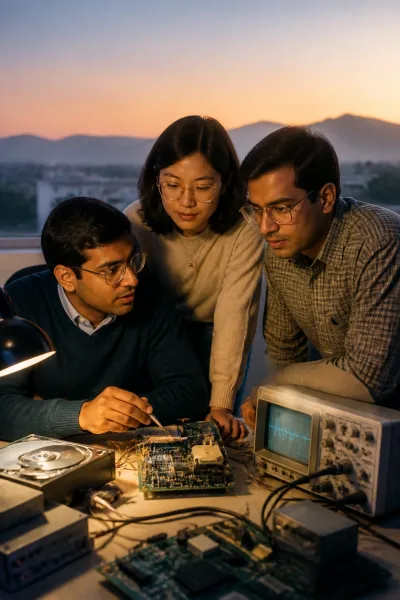
Marvell Technology was founded in 1995 by Sehat Sutardja, Weili Dai, and Pantas Sutardja in Santa Clara, California, initially targeting high‑performance mixed‑signal controllers for hard‑disk drives. Early success in HDD read‑channel chips quickly expanded into Ethernet PHYs, where the company’s Fast and Gigabit Ethernet solutions earned a reputation for speed and power efficiency. Throughout the late 1990s Marvell diversified into embedded processors, Wi‑Fi, and storage controllers, leveraging its engineering depth to build a broad portfolio that withstood the dot‑com bust through prudent finances, a lean operation, and market‑segment diversification.
The 2000s saw Marvell broaden its horizons further: the 2006 acquisition of Intel’s XScale ARM processor business gave it a foothold in mobile computing, while continued investment in storage yielded industry‑leading SATA, SAS, RAID, and SSD controllers. As networking evolved, Marvell pushed Ethernet to 10 GbE and beyond, added carrier‑grade and optical capabilities, and deepened its enterprise and data‑center focus. Strategic acquisitions—most notably Cavium (2018) for server processors and network security, Avera Semiconductor (2019) for custom ASIC design, and Inphi (2021) for high‑speed optical interconnects—reshaped the company into a data‑infrastructure specialist. Leadership transitioned in 2016 from the founder trio to Matt Murphy, who streamlined the portfolio, emphasized high‑growth, high‑margin markets, and guided Marvell to consistent revenue and profit growth, culminating in its inclusion in the S&P 500 index in 2021 as a validation of its sustained market leadership and financial maturity.
Today Marvell concentrates on enabling cloud, AI, and 5G infrastructures, providing end‑to‑end silicon—from compute and storage to high‑speed Ethernet, optical interconnects, and custom SoCs—while maintaining a relentless focus on power efficiency, security, and performance‑per‑watt. The company continues to invest heavily in R&D, protects its innovations with over 10,000 patents, cultivates a global engineering talent pool (including major R&D centers in India), and pursues sustainability and responsible supply‑chain practices. Looking ahead, Marvell aims to drive next‑generation data movement through silicon photonics, advanced packaging, AI‑optimized infrastructure, and evolving wireless standards, positioning itself as an indispensable partner to the world’s leading technology innovators as the digital transformation accelerates.
What You'll Find Inside:
- The founding story of Marvell Technology in 1995 by Sehat Sutardja, Weili Dai, and Pantas Sutardja, and their early breakthroughs in hard disk drive read-channel controllers that established the company's engineering-first culture.
- How Marvell navigated the dot-com bust through prudent financial management and strategic diversification into Ethernet networking, maintaining R&D investment while competitors retreated.
- The strategic acquisition roadmap that transformed Marvell — including Intel's XScale (2006), Cavium (2018), Avera Semiconductor (2019), and Inphi (2021) — building an end-to-end data infrastructure portfolio.
- Marvell's pivotal role in enabling cloud computing, 5G infrastructure, and AI workloads through innovations in high-speed Ethernet, optical interconnects, NVMe SSD controllers, and custom ASIC design capabilities.
- The company's evolution from a broad semiconductor player to a focused S&P 500 infrastructure leader, including leadership transitions, financial discipline, and the strategic divestiture of its automotive business to concentrate on cloud and AI markets.
Who's It For:
This book is ideal for semiconductor industry professionals, technology investors, and business strategists seeking to understand how a fabless chip company achieved S&P 500 status through strategic pivots and acquisitions. Engineering leaders and R&D managers will appreciate the deep dive into Marvell's culture of technical excellence and IP strategy. Students of corporate history and innovation management will find a compelling case study in navigating market cycles, from the dot-com bust to the AI infrastructure boom. Anyone interested in the invisible silicon infrastructure powering modern cloud, 5G, and AI ecosystems will value this comprehensive chronicle.
Author:
Published By:
Date Published:
September 24, 2026
Type:
Nonfiction
Language:
English
Word Count:
35,390 words
Reading Time:
2 hours 29 minutes
Sample:
Order:
Order A History of Marvell Technology (Paperback) on MixCache.com:
Buy NowPrint copy is made to order and ships worldwide. Includes the ebook free, ready to read instantly.
$5 account credit for all new MixCache.com accounts, usable toward any ebook purchase!*


