Browse by Category
Fiction
- Action & Adventure
- African American
- Anthologies
- Children's Fiction
- Classics
- Comics & Graphic Novels
- Coming of Age
- Contemporary
- Cultural & Regional
- Drama
- Erotica
- Fantasy
- General
- Historical Fiction
- Horror
- Humor & Satire
- Literary Fiction
- Mystery, Thriller & Suspense
- Poetry
- Religious & Inspirational
- Romance
- Science Fiction
- Short Stories
- War & Military
- Westerns
- Women's Fiction
- Young Adult
Non-Fiction
- Antiques & Collectibles
- Arts & Photography
- Biographies & Memoirs
- Business & Money
- Children's Non-Fiction
-
Computers & Technology
- Artificial Intelligence
- Computer Science
- Cybersecurity & Cryptography
- Data Science & Analytics
- Databases & Big Data
- Game Development & Design
- General
- Hardware & DIY
- Mobile App Development
- Networking & Cloud Computing
- Operating Systems
- Programming
- Robotics
- Software
- Software Engineering
- User Experience (UX) & Design
- Web Development & Design
- Cooking, Food & Wine
- Crafts, Hobbies & Home
- Education & Teaching
- Engineering
- General
- Health, Fitness & Dieting
-
History
- African History
- African History - North Africa
- African History - Sub-Saharan Africa
- American History
- American History - 20th Century
- American History - Civil War
- American History - Colonial Period
- Ancient History
- Asian History
- Asian History - China
- Asian History - India
- Asian History - Japan
- Asian History - Southeast Asia
- European History
- European History - Ancient Greece
- European History - Ancient Rome
- European History - Medieval
- European History - Modern
- European History - Renaissance
- General
- Middle Eastern History
- Military History
- Military History - Aviation
- Military History - Naval
- Social & Cultural History
- World History
- Humor & Entertainment
- Industrial Technology
- Language Learning
- Law
- LGBTQ+ Non-Fiction
- Literary Criticism
- Medical Books
- Parenting & Relationships
- Philosophy
- Politics & Social Sciences
- Reference
- Religion & Spirituality
-
Science & Math
- Agricultural Sciences
- Astronomy & Space Science
- Behavioral Sciences
- Biological Sciences
- Botany & Plant Science
- Chemistry
- Earth Sciences
- Engineering - Chemical
- Engineering - Civil
- Engineering - Electrical
- Engineering - Mechanical
- Environment
- General
- Geology
- Mathematics
- Nature & Ecology
- Oceanography
- Paleontology
- Physics
- Statistics
- Self-Help
- Sports & Outdoors
- Study Aids
- Sustainability & Green Living
- Textbooks
- Transportation
- Travel
- True Crime
- Urban Planning & Development
- Veterinary Medicine
- Writing & Publishing
Jump to Section

Want unlimited access to all books published by MixCache.com (plus their audiobooks)? Try MixCache.com Total Access. Look for the MTA badge on book covers to identify included titles.
Access to infinite ebooks: Don't see the book you want? Suggest it and we'll create it (free!) for you from scratch with our powerful AI book writer. Then read it with MTA - besides profiting from any sales it makes!
A History of Kraft Heinz
MTA
The Story of an S&P 500 Company
About this book:
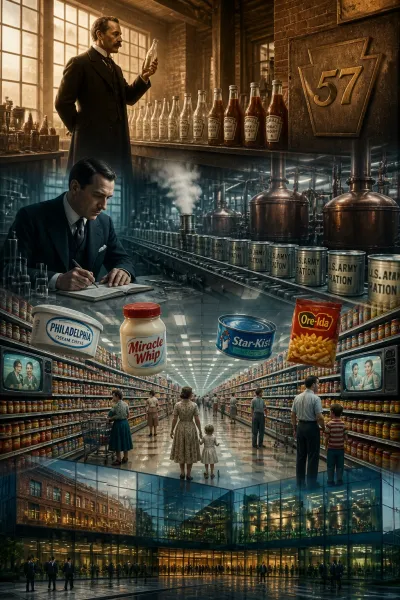
The history of Kraft Heinz traces the parallel origins and eventual convergence of two iconic American food empires. James L. Kraft revolutionized the dairy industry in 1916 by inventing pasteurized processed cheese, creating a shelf-stable product that became a staple for soldiers in World War I and, later, American households. Simultaneously, H.J. Heinz built a condiment empire starting with horseradish in 1869, establishing a global brand synonymous with quality and transparency—most famously through his tomato ketchup and the "57 Varieties" slogan. Both companies thrived through the 20th century by mastering industrial scale, mass marketing via radio and television, and strategic acquisitions, with Kraft expanding into brands like Philadelphia Cream Cheese and Miracle Whip, while Heinz acquired Star-Kist Tuna and Ore-Ida.
The late 20th century brought turbulence and consolidation. Kraft merged with Dart Industries, then became the target of a hostile takeover before being acquired by tobacco giant Philip Morris in 1988. Philip Morris merged Kraft with General Foods and later Nabisco, creating a food behemoth that eventually spun off as an independent Kraft Foods in 2007, later splitting its North American grocery business from its global snacks division (Mondelēz) in 2012. Meanwhile, Heinz was acquired in 2013 by 3G Capital and Warren Buffett’s Berkshire Hathaway, who installed a ruthless culture of zero-based budgeting and aggressive cost-cutting that dramatically improved margins.
The two giants united in 2015 when 3G and Berkshire orchestrated the merger of Kraft Foods Group and H.J. Heinz Company, forming The Kraft Heinz Company—the fifth-largest food company globally. The merger promised $1.5 billion in synergies through supply chain consolidation, workforce reductions, and zero-based budgeting across the combined portfolio. However, the singular focus on efficiency eventually clashed with shifting consumer preferences toward fresh, natural, and healthier foods. This tension culminated in a 2019 crisis: a $15.4 billion write-down of flagship brands like Kraft and Oscar Mayer, an SEC investigation into accounting practices, a dividend cut, and the departure of CEO Bernardo Hees.
Under new CEO Miguel Patricio, the company pivoted toward a balanced strategy of financial discipline and brand revitalization. Kraft Heinz divested non-core assets—including its natural cheese, nuts (Planters), and several international businesses—to reduce debt and fund innovation in growth areas like plant-based proteins and cleaner labels. The company navigated the COVID-19 pandemic with a temporary sales surge but faced persistent supply chain inflation. Today, Kraft Heinz remains an S&P 500 constituent focused on leveraging its immense brand equity and global scale while adapting to a digital, sustainability-conscious marketplace, striving to prove that operational rigor and organic growth can coexist in the modern food landscape.
What You'll Find Inside:
- The parallel entrepreneurial origins of Kraft (processed cheese innovation) and Heinz (ketchup purity standards) and their evolution into 20th-century food powerhouses through strategic acquisitions like General Foods, Nabisco, and Cadbury.
- The transformative impact of 3G Capital and Warren Buffett's partnership, introducing zero-based budgeting and aggressive cost-cutting that reshaped Heinz before the 2015 mega-merger created the fifth-largest food company globally.
- The profound integration challenges and cultural clashes following the merger, where 3G's efficiency-driven playbook achieved $1.5B in synergies but also triggered a $15.4B brand write-down in 2019, exposing the limits of cost-cutting without brand investment.
- The company's strategic pivot under CEO Miguel Patricio (2019 onward) balancing financial discipline with renewed focus on innovation, marketing, portfolio optimization (divesting Planters, natural cheese), and adapting to health/wellness and sustainability trends.
- A comprehensive view of modern food industry dynamics: digital transformation, supply chain resilience, ESG commitments, navigating the S&P 500's shifting expectations, and the ongoing challenge of evolving legacy brands for 21st-century consumers.
Who's It For:
This book is ideal for business professionals, investors, and students of corporate strategy seeking a detailed case study on mega-mergers, private equity operational playbooks, and brand portfolio management in the consumer packaged goods sector. Food industry executives and supply chain leaders will value its insights into global scaling, digital adaptation, and sustainability integration. Anyone interested in the intersection of iconic American brands, financial engineering, and evolving consumer trends will find this comprehensive history both instructive and engaging.
Author:
Published By:
Date Published:
September 17, 2026
Type:
Nonfiction
Language:
English
Word Count:
35,814 words
Reading Time:
2 hours 30 minutes
Sample:
Order:
Order A History of Kraft Heinz (Hardcover) on MixCache.com:
Buy NowPrint copy is made to order and ships worldwide. Includes the ebook free, ready to read instantly.
$5 account credit for all new MixCache.com accounts, usable toward any ebook purchase!*