
Browse by Category
Fiction
- Action & Adventure
- African American
- Anthologies
- Children's Fiction
- Classics
- Comics & Graphic Novels
- Coming of Age
- Contemporary
- Cultural & Regional
- Drama
- Erotica
- Fantasy
- General
- Historical Fiction
- Horror
- Humor & Satire
- Literary Fiction
- Mystery, Thriller & Suspense
- Poetry
- Religious & Inspirational
- Romance
- Science Fiction
- Short Stories
- War & Military
- Westerns
- Women's Fiction
- Young Adult
Non-Fiction
- Antiques & Collectibles
- Arts & Photography
- Biographies & Memoirs
- Business & Money
- Children's Non-Fiction
-
Computers & Technology
- Artificial Intelligence
- Computer Science
- Cybersecurity & Cryptography
- Data Science & Analytics
- Databases & Big Data
- Game Development & Design
- General
- Hardware & DIY
- Mobile App Development
- Networking & Cloud Computing
- Operating Systems
- Programming
- Robotics
- Software
- Software Engineering
- User Experience (UX) & Design
- Web Development & Design
- Cooking, Food & Wine
- Crafts, Hobbies & Home
- Education & Teaching
- Engineering
- General
- Health, Fitness & Dieting
-
History
- African History
- African History - North Africa
- African History - Sub-Saharan Africa
- American History
- American History - 20th Century
- American History - Civil War
- American History - Colonial Period
- Ancient History
- Asian History
- Asian History - China
- Asian History - India
- Asian History - Japan
- Asian History - Southeast Asia
- European History
- European History - Ancient Greece
- European History - Ancient Rome
- European History - Medieval
- European History - Modern
- European History - Renaissance
- General
- Middle Eastern History
- Military History
- Military History - Aviation
- Military History - Naval
- Social & Cultural History
- World History
- Humor & Entertainment
- Industrial Technology
- Language Learning
- Law
- LGBTQ+ Non-Fiction
- Literary Criticism
- Medical Books
- Parenting & Relationships
- Philosophy
- Politics & Social Sciences
- Reference
- Religion & Spirituality
-
Science & Math
- Agricultural Sciences
- Astronomy & Space Science
- Behavioral Sciences
- Biological Sciences
- Botany & Plant Science
- Chemistry
- Earth Sciences
- Engineering - Chemical
- Engineering - Civil
- Engineering - Electrical
- Engineering - Mechanical
- Environment
- General
- Geology
- Mathematics
- Nature & Ecology
- Oceanography
- Paleontology
- Physics
- Statistics
- Self-Help
- Sports & Outdoors
- Study Aids
- Sustainability & Green Living
- Textbooks
- Transportation
- Travel
- True Crime
- Urban Planning & Development
- Veterinary Medicine
- Writing & Publishing
Jump to Section

Want unlimited access to all books published by MixCache.com (plus their audiobooks)? Try MixCache.com Total Access. Look for the MTA badge on book covers to identify included titles.
Access to infinite ebooks: Don't see the book you want? Suggest it and we'll create it (free!) for you from scratch with our powerful AI book writer. Then read it with MTA - besides profiting from any sales it makes!
A History of AT&T
MTA
The Story of an S&P 500 Company
About this book:
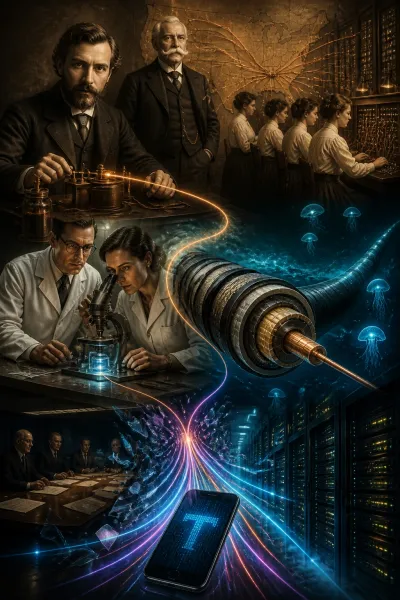
From its origins in Alexander Graham Bell’s 1876 telephone patent and the subsequent formation of the Bell Telephone Company, AT&T evolved into a vertically integrated monopoly known as the Bell System. Under the visionary leadership of Theodore Vail, the company embraced the doctrine of "One System, One Policy, Universal Service," aggressively expanding its national network while navigating early antitrust challenges through the 1913 Kingsbury Commitment. The post-World War II era marked a "Golden Age" of technological dominance, highlighted by Bell Labs' invention of the transistor in 1947—a breakthrough that birthed the information age—and the deployment of transcontinental and transatlantic cables. However, mounting regulatory pressure and competition in equipment and long-distance markets culminated in the 1984 divestiture, which shattered the Bell System into seven regional "Baby Bells" and a slimmed-down AT&T Corp.
The post-divestiture decades were defined by relentless restructuring and strategic pivots. AT&T Corp. re-entered wireless via the 1994 McCaw Cellular acquisition, spun off its manufacturing arm (Lucent Technologies) in 1996, and made a debt-laden, ultimately unsuccessful foray into cable television. Meanwhile, the Baby Bells consolidated; Southwestern Bell (SBC) acquired Pacific Telesis and Ameritech before executing a historic reversal by purchasing its former parent, AT&T Corp., in 2005. The combined entity, rebranded as AT&T Inc., solidified its wireless dominance by acquiring BellSouth—and with it, full control of Cingular Wireless—in 2006. This new AT&T became a wireless-first giant, securing the exclusive U.S. launch of the iPhone in 2007 and investing heavily in 4G LTE infrastructure.
Facing the convergence of voice, data, and video, AT&T pursued a "triple play" strategy, launching the fiber-based U-verse TV service and later acquiring DirecTV and Time Warner in a bid to become a media and entertainment powerhouse. This vertical integration strategy faltered under immense debt and cultural clashes, prompting a sharp strategic reversal under CEO John Stankey in the early 2020s. The company spun off WarnerMedia in 2022 to de-leverage and refocus exclusively on its core connectivity assets: 5G wireless and fiber-to-the-home broadband. Today, AT&T positions itself as a pure-play connectivity leader, deploying mid-band (C-band) and millimeter-wave 5G alongside aggressive fiber expansion, aiming to provide the foundational infrastructure for the Internet of Things, enterprise digital transformation, and the next generation of digital experiences.
What You'll Find Inside:
- The evolution of AT&T from Alexander Graham Bell's 1876 telephone invention into a vertically integrated national monopoly under Theodore Vail's 'One System, One Policy, Universal Service' philosophy.
- The pivotal role of Bell Telephone Laboratories in generating foundational innovations including the transistor, UNIX operating system, C programming language, fiber optics, and cellular technology that shaped the digital age.
- The 1984 antitrust divestiture that broke up the Bell System into seven 'Baby Bells' and a competitive AT&T Corp., fundamentally reshaping the U.S. telecommunications landscape and introducing market competition.
- The strategic cycle of fragmentation and reintegration through mega-mergers—including SBC Communications acquiring its former parent AT&T Corp. and BellSouth—to rebuild a wireless-centric telecommunications giant.
- AT&T's current strategic pivot away from media acquisitions (DirecTV, Time Warner) back to core connectivity, prioritizing 5G wireless leadership and fiber-to-the-home broadband deployment as the foundation for future growth.
Who's It For:
This book is ideal for business historians, telecommunications professionals, and investors seeking a comprehensive narrative of AT&T's 150-year journey as an S&P 500 benchmark. It will particularly benefit readers interested in corporate strategy, antitrust regulation, and technological innovation cycles, offering lessons on how a monopoly adapts to disruptive competition and regulatory upheaval. Students of American industrial history and technology management will find its detailed account of leadership decisions and infrastructure evolution especially valuable.
Author:
Published By:
Date Published:
September 16, 2026
Type:
Nonfiction
Language:
English
Word Count:
42,089 words
Reading Time:
2 hours 57 minutes
Sample:
MixCache.com Total Access
Get unlimited access to this book + all books published by MixCache.com for $11.99/month
Subscribe to MTAOr purchase this book individually below
Order:
Buy the A History of AT&T ebook on MixCache.com:
Buy Now
Full ebook will be available immediately
- read online or download as a PDF file.
$5 account credit for all new MixCache.com accounts, usable toward any ebook purchase!*





Ratings & Reviews
Ask Questions About This Book
Have a question about the content? Ask our AI assistant!
Start by asking a question about "A History of AT&T"
Example: "Does this book mention William Shakespeare?"
Thinking...