Browse by Category
Fiction
- Action & Adventure
- African American
- Anthologies
- Children's Fiction
- Classics
- Comics & Graphic Novels
- Coming of Age
- Contemporary
- Cultural & Regional
- Drama
- Erotica
- Fantasy
- General
- Historical Fiction
- Horror
- Humor & Satire
- Literary Fiction
- Mystery, Thriller & Suspense
- Poetry
- Religious & Inspirational
- Romance
- Science Fiction
- Short Stories
- War & Military
- Westerns
- Women's Fiction
- Young Adult
Non-Fiction
- Antiques & Collectibles
- Arts & Photography
- Biographies & Memoirs
- Business & Money
- Children's Non-Fiction
-
Computers & Technology
- Artificial Intelligence
- Computer Science
- Cybersecurity & Cryptography
- Data Science & Analytics
- Databases & Big Data
- Game Development & Design
- General
- Hardware & DIY
- Mobile App Development
- Networking & Cloud Computing
- Operating Systems
- Programming
- Robotics
- Software
- Software Engineering
- User Experience (UX) & Design
- Web Development & Design
- Cooking, Food & Wine
- Crafts, Hobbies & Home
- Education & Teaching
- Engineering
- General
- Health, Fitness & Dieting
-
History
- African History
- African History - North Africa
- African History - Sub-Saharan Africa
- American History
- American History - 20th Century
- American History - Civil War
- American History - Colonial Period
- Ancient History
- Asian History
- Asian History - China
- Asian History - India
- Asian History - Japan
- Asian History - Southeast Asia
- European History
- European History - Ancient Greece
- European History - Ancient Rome
- European History - Medieval
- European History - Modern
- European History - Renaissance
- General
- Middle Eastern History
- Military History
- Military History - Aviation
- Military History - Naval
- Social & Cultural History
- World History
- Humor & Entertainment
- Industrial Technology
- Language Learning
- Law
- LGBTQ+ Non-Fiction
- Literary Criticism
- Medical Books
- Parenting & Relationships
- Philosophy
- Politics & Social Sciences
- Reference
- Religion & Spirituality
-
Science & Math
- Agricultural Sciences
- Astronomy & Space Science
- Behavioral Sciences
- Biological Sciences
- Botany & Plant Science
- Chemistry
- Earth Sciences
- Engineering - Chemical
- Engineering - Civil
- Engineering - Electrical
- Engineering - Mechanical
- Environment
- General
- Geology
- Mathematics
- Nature & Ecology
- Oceanography
- Paleontology
- Physics
- Statistics
- Self-Help
- Sports & Outdoors
- Study Aids
- Sustainability & Green Living
- Textbooks
- Transportation
- Travel
- True Crime
- Urban Planning & Development
- Veterinary Medicine
- Writing & Publishing
Jump to Section

Want unlimited access to all books published by MixCache.com (plus their audiobooks)? Try MixCache.com Total Access. Look for the MTA badge on book covers to identify included titles.
Access to infinite ebooks: Don't see the book you want? Suggest it and we'll create it (free!) for you from scratch with our powerful AI book writer. Then read it with MTA - besides profiting from any sales it makes!
A History of Dollar General
MTA
The Story of an S&P 500 Company
About this book:
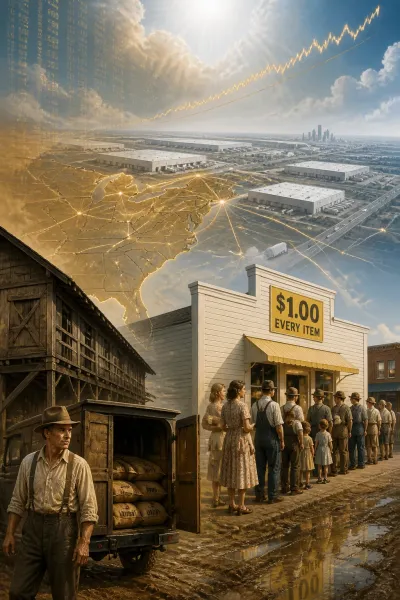
From its humble origins as J.L. Turner’s wholesale dry goods business in Depression-era Kentucky, Dollar General evolved into a retail empire through a simple yet revolutionary concept: the permanent "dollar store." Launched in 1955 by Cal Turner Sr., the fixed-price model democratized discount shopping for rural and underserved communities, fueling rapid expansion across the South. The company’s 1968 IPO provided capital to professionalize operations, build a sophisticated supply chain, and withstand economic cycles by doubling down on its core value proposition of convenience and affordability. Throughout the late 20th century, leadership transitions and strategic discipline allowed the chain to carve out a distinct niche, avoiding direct competition with big-box giants by dominating the small-town market with a lean, leased real estate model and a focused assortment of essential consumables.
The turn of the century brought transformative strategic shifts, most notably the aggressive development of private label brands like Clover Valley and DG Home, which enhanced margins and fostered brand loyalty. Operational resilience was further cemented by the DG Fresh initiative, a massive vertical integration of the cold supply chain that enabled the proliferation of fresh and frozen foods, effectively turning stores into vital grocery destinations in food deserts. Concurrently, the company embraced digital tools—not to replace its physical footprint, but to enhance it—deploying a robust mobile app, digital coupons, and buy-online-pickup-in-store capabilities that bridged the gap between its traditional customer base and modern omnichannel expectations. These innovations, paired with new store formats like DG Market and DGX, allowed Dollar General to deepen market penetration and capture a larger share of wallet while maintaining its low-cost operator status.
Navigating the unprecedented challenges of the COVID-19 pandemic underscored the company's designation as an essential retailer, validating its community-embedded real estate strategy and supply chain agility. In the aftermath, leadership has accelerated its focus on Environmental, Social, and Governance (ESG) priorities, from energy efficiency and sustainable sourcing to the enduring impact of the Dollar General Literacy Foundation. Modern governance under a professional executive team and independent board now steers the S&P 500 component, balancing shareholder returns through dividends and buybacks with heavy reinvestment in automation, AI-driven logistics, and workforce development. As it looks ahead, Dollar General remains committed to its founding ethos—serving the value-conscious consumer—while strategically evolving its format, technology, and assortment to secure its relevance in a dynamic retail landscape.
What You'll Find Inside:
- The entrepreneurial journey of J.L. Turner and Cal Turner Sr. from a Depression-era wholesale business to the innovative 'dollar store' concept that democratized discount retail.
- How Dollar General's strategic real estate focus on underserved rural and suburban communities created a durable competitive moat against big-box rivals like Walmart and Kmart.
- The transformation of supply chain operations through the DG Fresh initiative, bringing cold-chain logistics in-house to boost margins and expand fresh food access in food deserts.
- The evolution from a family-run enterprise to an S&P 500 company, including the 1968 IPO, a 2007 private equity buyout, 2009 relisting, and modern governance structures.
- Dollar General's adaptive resilience through economic cycles, the COVID-19 pandemic, and digital disruption via omnichannel integration, private label growth, and new store formats like DG Market and DGX.
Who's It For:
This book is ideal for business leaders, retail professionals, and entrepreneurs seeking lessons in scaling a value-driven enterprise across economic cycles. Investors and analysts will gain deep insight into Dollar General's financial discipline, capital allocation, and S&P 500 trajectory. Students of American business history and corporate strategy will appreciate the detailed case study of a company that built enduring competitive advantage through operational simplicity, community embeddedness, and pragmatic innovation.
Author:
Published By:
Date Published:
September 15, 2026
Type:
Nonfiction
Language:
English
Word Count:
35,571 words
Reading Time:
2 hours 29 minutes
Sample:
Order:
Order A History of Dollar General (Hardcover) on MixCache.com:
Buy NowPrint copy is made to order and ships worldwide. Includes the ebook free, ready to read instantly.
$5 account credit for all new MixCache.com accounts, usable toward any ebook purchase!*