
Browse by Category
Fiction
- Action & Adventure
- African American
- Anthologies
- Children's Fiction
- Classics
- Comics & Graphic Novels
- Coming of Age
- Contemporary
- Cultural & Regional
- Drama
- Erotica
- Fantasy
- General
- Historical Fiction
- Horror
- Humor & Satire
- Literary Fiction
- Mystery, Thriller & Suspense
- Poetry
- Religious & Inspirational
- Romance
- Science Fiction
- Short Stories
- War & Military
- Westerns
- Women's Fiction
- Young Adult
Non-Fiction
- Antiques & Collectibles
- Arts & Photography
- Biographies & Memoirs
- Business & Money
- Children's Non-Fiction
-
Computers & Technology
- Artificial Intelligence
- Computer Science
- Cybersecurity & Cryptography
- Data Science & Analytics
- Databases & Big Data
- Game Development & Design
- General
- Hardware & DIY
- Mobile App Development
- Networking & Cloud Computing
- Operating Systems
- Programming
- Robotics
- Software
- Software Engineering
- User Experience (UX) & Design
- Web Development & Design
- Cooking, Food & Wine
- Crafts, Hobbies & Home
- Education & Teaching
- Engineering
- General
- Health, Fitness & Dieting
-
History
- African History
- African History - North Africa
- African History - Sub-Saharan Africa
- American History
- American History - 20th Century
- American History - Civil War
- American History - Colonial Period
- Ancient History
- Asian History
- Asian History - China
- Asian History - India
- Asian History - Japan
- Asian History - Southeast Asia
- European History
- European History - Ancient Greece
- European History - Ancient Rome
- European History - Medieval
- European History - Modern
- European History - Renaissance
- General
- Middle Eastern History
- Military History
- Military History - Aviation
- Military History - Naval
- Social & Cultural History
- World History
- Humor & Entertainment
- Industrial Technology
- Language Learning
- Law
- LGBTQ+ Non-Fiction
- Literary Criticism
- Medical Books
- Parenting & Relationships
- Philosophy
- Politics & Social Sciences
- Reference
- Religion & Spirituality
-
Science & Math
- Agricultural Sciences
- Astronomy & Space Science
- Behavioral Sciences
- Biological Sciences
- Botany & Plant Science
- Chemistry
- Earth Sciences
- Engineering - Chemical
- Engineering - Civil
- Engineering - Electrical
- Engineering - Mechanical
- Environment
- General
- Geology
- Mathematics
- Nature & Ecology
- Oceanography
- Paleontology
- Physics
- Statistics
- Self-Help
- Sports & Outdoors
- Study Aids
- Sustainability & Green Living
- Textbooks
- Transportation
- Travel
- True Crime
- Urban Planning & Development
- Veterinary Medicine
- Writing & Publishing
Jump to Section

Want unlimited access to all books published by MixCache.com (plus their audiobooks)? Try MixCache.com Total Access. Look for the MTA badge on book covers to identify included titles.
Access to infinite ebooks: Don't see the book you want? Suggest it and we'll create it (free!) for you from scratch with our powerful AI book writer. Then read it with MTA - besides profiting from any sales it makes!
A History of Chevron Corporation
MTA
The Story of an S&P 500 Company
About this book:
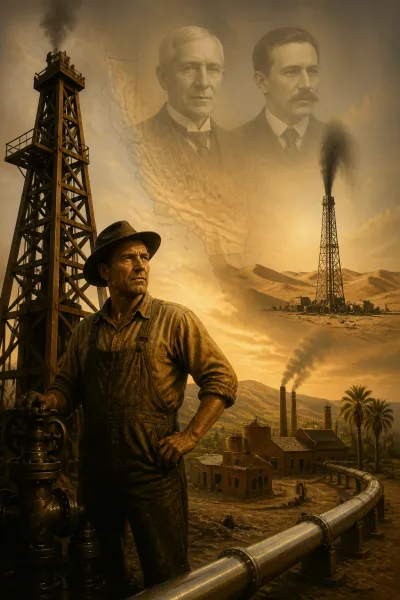
Chevron Corporation traces its roots to the mid‑19th‑century oil discoveries in Pennsylvania and California, where the Pacific Coast Oil Company—founded by Demetrius G. Scofield in 1876—drilled the state’s first commercially successful well at Pico Canyon and built California’s first modern refinery and pipeline network. The company’s fortunes became intertwined with John D. Rockefeller’s Standard Oil Trust, which acquired Pacific Coast Oil in 1900; after the 1911 Supreme Court breakup of Standard Oil, the West Coast operations emerged as the independent Standard Oil Company of California (Socal). Socal secured its own crude sources, expanded refining and marketing across California, and, during the interwar period, pursued international growth through the Caltex joint venture with Texaco and a bold concession in Saudi Arabia that led to the 1938 discovery at Dammam No. 7 and the eventual formation of Aramco.
World War II heightened demand for aviation fuel and other petroleum products, and Socal’s wartime contributions reinforced its strategic importance. In the postwar boom, Socal’s access to low‑cost Saudi Arabian crude through Aramco, the expansion of Caltex across Asia and Africa, and the rise of the “Seven Sisters” positioned it as a global energy leader. The 1970s energy crisis, OPEC price shocks, and the gradual nationalization of Aramco forced Socal to diversify its upstream portfolio, reduce reliance on Middle Eastern equity crude, and focus on operational efficiency. The pivotal 1984 acquisition of Gulf Oil for $13.2 billion—followed by rebranding as Chevron Corporation—added vast reserves, refining capacity, and a global retail network, while subsequent acquisitions such as Texaco in 2001 further integrated downstream assets and solidified Chevron’s status as a fully integrated, multinational energy giant.
From the late 20th century into the 21st, Chevron expanded into Africa’s prolific offshore basins (notably Angola’s Cabinda concession) and deepened its Asian presence through Caltex, liquefied natural‑gas projects in Australia, and unconventional plays in the Permian Basin. Leadership transitions guided the company through environmental regulation, technological leaps in 3‑D seismic, horizontal drilling, deepwater production, and digital transformation, while confronting climate change, public scrutiny, and the carbon transition through investments in methane reduction, carbon capture and storage, hydrogen, renewables, and lower‑carbon fuels. Chevron’s financial discipline, consistent dividend policy, and enduring place in the S&P 500 reflect its role as a major driver of global economic activity, energy security, and technological innovation, with a future strategy centered on decarbonizing existing operations, scaling new‑energy solutions, and maintaining innovation and sustainability as core pillars.
What You'll Find Inside:
- The complete evolution of Chevron from its 1876 origins as Pacific Coast Oil Company through the Standard Oil antitrust breakup to its emergence as a global integrated energy leader.
- Strategic growth through landmark mergers and acquisitions—including Gulf Oil (1984) and Texaco (2001)—and pivotal international ventures like Aramco in Saudi Arabia that reshaped global energy markets.
- Technological innovation across the value chain: from pioneering 3D seismic imaging and deepwater drilling to digital transformation with AI, IoT, and predictive analytics in modern operations.
- Navigation of geopolitical upheavals, environmental regulations, the 1970s energy crises, and the 21st-century carbon transition while maintaining financial discipline and shareholder returns.
- The company's dual strategy for the future: decarbonizing core oil and gas operations through CCUS, methane reduction, and efficiency while scaling lower-carbon solutions in hydrogen, renewables, and biofuels.
Who's It For:
This book is ideal for energy industry professionals, business strategists, investors, and students of corporate history who want a comprehensive case study of how a major multinational navigates technological disruption, geopolitical volatility, regulatory evolution, and the global energy transition. It offers valuable insights for anyone analyzing long-term corporate resilience, M&A integration, or the transformation of legacy industrial giants in a decarbonizing world.
Author:
Published By:
Date Published:
September 9, 2026
Type:
Nonfiction
Language:
English
Word Count:
41,889 words
Reading Time:
2 hours 56 minutes
Sample:
MixCache.com Total Access
Get unlimited access to this book + all books published by MixCache.com for $11.99/month
Subscribe to MTAOr purchase this book individually below
Order:
Buy the A History of Chevron Corporation ebook on MixCache.com:
Buy Now
Full ebook will be available immediately
- read online or download as a PDF file.
$5 account credit for all new MixCache.com accounts, usable toward any ebook purchase!*



Ratings & Reviews
Ask Questions About This Book
Have a question about the content? Ask our AI assistant!
Start by asking a question about "A History of Chevron Corporation"
Example: "Does this book mention William Shakespeare?"
Thinking...