Browse by Category
Fiction
- Action & Adventure
- African American
- Anthologies
- Children's Fiction
- Classics
- Comics & Graphic Novels
- Coming of Age
- Contemporary
- Cultural & Regional
- Drama
- Erotica
- Fantasy
- General
- Historical Fiction
- Horror
- Humor & Satire
- Literary Fiction
- Mystery, Thriller & Suspense
- Poetry
- Religious & Inspirational
- Romance
- Science Fiction
- Short Stories
- War & Military
- Westerns
- Women's Fiction
- Young Adult
Non-Fiction
- Antiques & Collectibles
- Arts & Photography
- Biographies & Memoirs
- Business & Money
- Children's Non-Fiction
-
Computers & Technology
- Artificial Intelligence
- Computer Science
- Cybersecurity & Cryptography
- Data Science & Analytics
- Databases & Big Data
- Game Development & Design
- General
- Hardware & DIY
- Mobile App Development
- Networking & Cloud Computing
- Operating Systems
- Programming
- Robotics
- Software
- Software Engineering
- User Experience (UX) & Design
- Web Development & Design
- Cooking, Food & Wine
- Crafts, Hobbies & Home
- Education & Teaching
- Engineering
- General
- Health, Fitness & Dieting
-
History
- African History
- African History - North Africa
- African History - Sub-Saharan Africa
- American History
- American History - 20th Century
- American History - Civil War
- American History - Colonial Period
- Ancient History
- Asian History
- Asian History - China
- Asian History - India
- Asian History - Japan
- Asian History - Southeast Asia
- European History
- European History - Ancient Greece
- European History - Ancient Rome
- European History - Medieval
- European History - Modern
- European History - Renaissance
- General
- Middle Eastern History
- Military History
- Military History - Aviation
- Military History - Naval
- Social & Cultural History
- World History
- Humor & Entertainment
- Industrial Technology
- Language Learning
- Law
- LGBTQ+ Non-Fiction
- Literary Criticism
- Medical Books
- Parenting & Relationships
- Philosophy
- Politics & Social Sciences
- Reference
- Religion & Spirituality
-
Science & Math
- Agricultural Sciences
- Astronomy & Space Science
- Behavioral Sciences
- Biological Sciences
- Botany & Plant Science
- Chemistry
- Earth Sciences
- Engineering - Chemical
- Engineering - Civil
- Engineering - Electrical
- Engineering - Mechanical
- Environment
- General
- Geology
- Mathematics
- Nature & Ecology
- Oceanography
- Paleontology
- Physics
- Statistics
- Self-Help
- Sports & Outdoors
- Study Aids
- Sustainability & Green Living
- Textbooks
- Transportation
- Travel
- True Crime
- Urban Planning & Development
- Veterinary Medicine
- Writing & Publishing
Jump to Section
MixCache.com Total Access
Unlimited reading and audiobooks for every book published by MixCache.com.
Included titles carry the MTA badge.
Learn more →
A History of IBM
MTA
The Story of an S&P 500 Company
About this book:
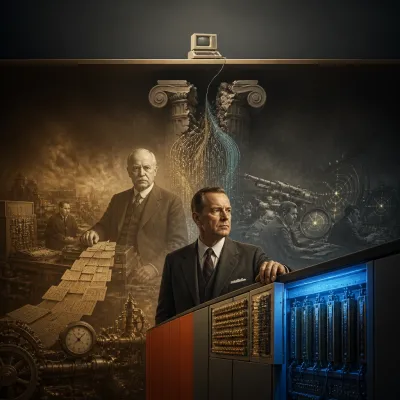
International Business Machines (IBM) began as a 1911 merger of tabulating, scale, and time-recording companies orchestrated by Charles Flint, but its identity was forged under Thomas J. Watson Sr., who instilled a culture of "THINK," aggressive salesmanship, and a leasing model that stabilized revenue through the Great Depression. The company dominated early data processing with punched card technology, proved indispensable during World War II, and successfully pivoted to electronic computing with the 650 and 700 series mainframes. Watson Jr.'s audacious $5 billion gamble on the System/360 in 1964 unified incompatible product lines into a single architecture, cementing IBM's mainframe monopoly but attracting a 13-year antitrust lawsuit that forced the unbundling of software and services. Despite this victory, the rise of minicomputers and the personal computer revolution—entered hastily via the 1981 IBM PC using off-the-shelf parts from Intel and Microsoft—eroded margins and exposed internal bureaucratic inertia, leading to near-collapse in the early 1990s.
Louis Gerstner’s 1993 arrival as an outsider CEO sparked a historic turnaround; he rejected calls to break up the company, slashed costs, dismantled silos, and pivoted IBM toward integrated solutions, services, and the emerging "e-business" internet opportunity. This era saw the mainframe repositioned as a secure web server, the acquisition of Lotus, and a strategic embrace of Linux and open source that rebuilt credibility with developers. The 2000s featured further portfolio refinement: divesting commoditized PC and x86 server businesses to Lenovo while acquiring software and cloud capabilities like SoftLayer and, crucially, Red Hat in 2019 for $34 billion to anchor a hybrid cloud strategy. Simultaneously, IBM invested heavily in fundamental research, yielding Nobel Prizes and breakthroughs in relational databases, nanotechnology, and artificial intelligence—most publicly demonstrated by Watson’s 2011 Jeopardy! victory and subsequent commercialization as enterprise AI.
Throughout its history, IBM maintained a unique global footprint and a research-driven culture that balanced paternalistic employee loyalty with periodic, painful restructurings. Its leadership lineage—from the Watsons through Gerstner, Palmisano, Rometty, to Krishna—reflects a pattern of radical reinvention driven by existential threats. Today, as a constant S&P 500 constituent, IBM focuses on a triad of hybrid cloud (via Red Hat OpenShift), trustworthy enterprise AI, and quantum computing, accessible via the cloud to foster an open ecosystem. Having shed legacy infrastructure services via the Kyndryl spin-off, the company aims to orchestrate complex multi-cloud environments for enterprises, betting that its century-long expertise in security, reliability, and systems integration will remain essential infrastructure for the cognitive and quantum eras.
What You'll Find Inside:
- IBM's transformation from tabulating machines to mainframe leadership, highlighted by the System/360's unified architecture that redefined computing compatibility.
- The Watson family's leadership established IBM's global reach, innovative culture, and enduring focus on research and customer-centric solutions.
- Strategic pivots from hardware to software/services, open source (Linux), cloud computing (Red Hat), and AI (Watson) kept IBM relevant across technological eras.
- IBM navigated antitrust battles, financial crises, and market commoditization by divesting low-margin businesses and acquiring high-growth assets like Lotus, SoftLayer, and Red Hat.
- The company's current strategy centers on hybrid cloud, artificial intelligence, and quantum computing as interconnected pillars for future enterprise transformation.
Who's It For:
This book is ideal for business leaders, technology professionals, students of history or computer science, and investors who want to understand how IBM's century-long journey of innovation, adaptation, and leadership has shaped the modern technology landscape and its ongoing influence on global markets.
Table of Contents:
- Introduction
- Chapter 1: The Dawn of Computing: From Tabulators to ThinkPads
- Chapter 2: The Watson Era: Forging a Corporate Giant
- Chapter 3: punched Cards and the Rise of Data Processing
- Chapter 4: World War II and the Evolution of IBM's Role
- Chapter 5: The Mainframe Marvel: Dominating the Computing Landscape
- Chapter 6: The System/360 Revolution: A Bold Bet Pays Off
- Chapter 7: Facing the Giants: Antitrust Battles and Shifting Tides
- Chapter 8: Personal Computing Arrives: A New Frontier for IBM
- Chapter 9: Software and Services: Expanding Beyond Hardware
- Chapter 10: The Internet Boom and IBM's Strategic Pivots
- Chapter 11: Reinventing IBM: Lou Gerstner and the Turnaround Story
- Chapter 12: E-Business and the Connected World
- Chapter 13: Open Source and Linux: Embracing Collaboration
- Chapter 14: Watson Takes On the World: AI and Cognitive Computing
- Chapter 15: Cloud Computing: A New Infrastructure Paradigm
- Chapter 16: Quantum Computing: Exploring the Next Frontier
- Chapter 17: Global Reach: IBM's International Footprint
- Chapter 18: Research and Innovation: Shaping the Future of Technology
- Chapter 19: Corporate Culture and Employee Legacy
- Chapter 20: Acquisitions and Divestitures: Strategic Transformations
- Chapter 21: IBM and the S&P 500: A Constant Presence
- Chapter 22: Challenges and Adaptations in a Dynamic Market
- Chapter 23: Leadership and Vision: Guiding IBM Through the Ages
- Chapter 24: Social Responsibility and Ethical Computing
- Chapter 25: The Future of IBM: Innovation in the 21st Century
Author:
Published By:
Date Published:
August 22, 2026
Type:
Nonfiction
Language:
English
Word Count:
40,595 words
Reading Time:
2 hours 51 minutes
Sample:
Order:
Order A History of IBM (Paperback) on MixCache.com:
Buy NowPrint copy is made to order and ships worldwide. Includes the ebook free, ready to read instantly.
$5 account credit for all new MixCache.com accounts, usable toward any ebook purchase!*