
Browse by Category
Fiction
- Action & Adventure
- African American
- Anthologies
- Children's Fiction
- Classics
- Comics & Graphic Novels
- Coming of Age
- Contemporary
- Cultural & Regional
- Drama
- Erotica
- Fantasy
- General
- Historical Fiction
- Horror
- Humor & Satire
- Literary Fiction
- Mystery, Thriller & Suspense
- Poetry
- Religious & Inspirational
- Romance
- Science Fiction
- Short Stories
- War & Military
- Westerns
- Women's Fiction
- Young Adult
Non-Fiction
- Antiques & Collectibles
- Arts & Photography
- Biographies & Memoirs
- Business & Money
- Children's Non-Fiction
-
Computers & Technology
- Artificial Intelligence
- Computer Science
- Cybersecurity & Cryptography
- Data Science & Analytics
- Databases & Big Data
- Game Development & Design
- General
- Hardware & DIY
- Mobile App Development
- Networking & Cloud Computing
- Operating Systems
- Programming
- Robotics
- Software
- Software Engineering
- User Experience (UX) & Design
- Web Development & Design
- Cooking, Food & Wine
- Crafts, Hobbies & Home
- Education & Teaching
- Engineering
- General
- Health, Fitness & Dieting
-
History
- African History
- African History - North Africa
- African History - Sub-Saharan Africa
- American History
- American History - 20th Century
- American History - Civil War
- American History - Colonial Period
- Ancient History
- Asian History
- Asian History - China
- Asian History - India
- Asian History - Japan
- Asian History - Southeast Asia
- European History
- European History - Ancient Greece
- European History - Ancient Rome
- European History - Medieval
- European History - Modern
- European History - Renaissance
- General
- Middle Eastern History
- Military History
- Military History - Aviation
- Military History - Naval
- Social & Cultural History
- World History
- Humor & Entertainment
- Industrial Technology
- Language Learning
- Law
- LGBTQ+ Non-Fiction
- Literary Criticism
- Medical Books
- Parenting & Relationships
- Philosophy
- Politics & Social Sciences
- Reference
- Religion & Spirituality
-
Science & Math
- Agricultural Sciences
- Astronomy & Space Science
- Behavioral Sciences
- Biological Sciences
- Botany & Plant Science
- Chemistry
- Earth Sciences
- Engineering - Chemical
- Engineering - Civil
- Engineering - Electrical
- Engineering - Mechanical
- Environment
- General
- Geology
- Mathematics
- Nature & Ecology
- Oceanography
- Paleontology
- Physics
- Statistics
- Self-Help
- Sports & Outdoors
- Study Aids
- Sustainability & Green Living
- Textbooks
- Transportation
- Travel
- True Crime
- Urban Planning & Development
- Veterinary Medicine
- Writing & Publishing
Jump to Section
MixCache.com Total Access
Unlimited reading and audiobooks for every book published by MixCache.com.
Included titles carry the MTA badge.
Learn more →
The Silk Road: Trade Routes That Shaped Empires
MTA
How Ancient Commerce Connected East and West
About this book:
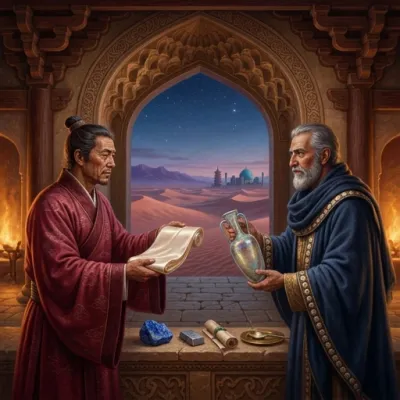
The Silk Road emerged not as a single path but as a vast, evolving network of arteries connecting East and West, born from early antiquity's trade in necessities like obsidian, salt, and metals. The genesis of sericulture in China created a unique, high-value commodity—silk—that became the network's namesake and primary driver, compelling the Han Dynasty to secure the Hexi Corridor westward and the Roman Empire to drain its coffers eastward. Between these titans, intermediary powers like the Parthian and Sasanian Empires mastered the role of middlemen, controlling flow and pricing while fostering the cosmopolitan oasis cities—Samarkand, Bukhara, Dunhuang—that became vibrant melting pots of language, faith, and culture. This exchange transcended merchandise; it facilitated the profound transmission of Buddhism, Christianity, Islam, and technologies like papermaking, gunpowder, and the compass, fundamentally altering the trajectory of civilizations across Eurasia.
The network reached its zenith under the Tang Dynasty and the subsequent Mongol Imperium. The Tang capital Chang'an became a global metropolis, while the *Pax Mongolica* unified the route under a single political umbrella, guaranteeing unprecedented security and enabling figures like Marco Polo to traverse the continent. However, the 14th-century Black Death traveled these same arteries, decimating populations and destabilizing the Mongol khanates, while the rise of maritime trade—spearheaded by European voyages around Africa—offered cheaper, higher-volume alternatives to the perilous overland journey. Consequently, the great caravans dwindled, the oasis cities declined, and the center of global economic gravity shifted irreversibly from the Eurasian heartland to the Atlantic seaboard.
Yet the Silk Road's legacy proved indelible, woven into the fabric of the modern world through the global diffusion of crops, culinary traditions, artistic motifs, and scientific knowledge like the decimal system and paper. Its historical narrative of connectivity driven by mutual benefit, despite political rivalry, offers a powerful template for the present. Today, China's Belt and Road Initiative explicitly invokes this ancient heritage, seeking to revive transcontinental linkages through modern infrastructure—railways, pipelines, and digital corridors—demonstrating that the fundamental human impulse to bridge distances, exchange innovations, and forge shared prosperity remains the timeless engine of history.
What You'll Find Inside:
- The Silk Road was history's first global superhighway, facilitating not just trade in silk and spices but the profound exchange of ideas, technologies (papermaking, gunpowder, compass), religions (Buddhism, Islam, Christianity), and artistic styles across Eurasia.
- Successive empires—Han, Parthian, Sasanian, Tang, Mongol, and Islamic Caliphates—actively shaped, protected, and profited from these routes, with the Pax Mongolica creating an unprecedented era of transcontinental security and integration.
- The vibrant oasis cities (Samarkand, Bukhara, Dunhuang, Kashgar) served as multicultural hubs where merchants, missionaries, and scholars converged, creating unique cultural syntheses visible in art, architecture, cuisine, and language.
- The Black Death's devastating spread along these same arteries and the rise of European maritime routes (spearheaded by Portuguese and Spanish explorers inspired by Marco Polo) led to the gradual decline of overland caravan trade.
- China's modern Belt and Road Initiative consciously revives the Silk Road's legacy, seeking to recreate transcontinental connectivity through massive infrastructure investment, digital networks, and geopolitical strategy across Eurasia and Africa.
Who's It For:
This book is ideal for history enthusiasts, students of world history and international relations, and professionals in global trade or geopolitics who seek a comprehensive narrative of how ancient commerce forged the first globalized world. Readers interested in cultural diffusion, the rise and fall of empires, and the historical roots of modern Eurasian connectivity will find it particularly rewarding.
Table of Contents:
- Introduction: The Threads of Connection
- Chapter 1: The Dawn of Desert Paths: Early Trade in Antiquity
- Chapter 2: The Genesis of Silk: Sericulture's Secrets and Early Expansion
- Chapter 3: Empires in the East: Han Dynasty's Reach Westward
- Chapter 4: Parthian Bridges: Connecting Rome and China
- Chapter 5: Roman Luxuries: The Western Demand for Silk and Spices
- Chapter 6: Beyond Merchandise: The Exchange of Ideas and Innovations
- Chapter 7: Buddhism's Journey: A Spiritual Flow Along the Routes
- Chapter 8: The Rise of Nomad Empires: Guardians and Disruptors of Trade
- Chapter 9: Crossroads of Faith: The Spread of Religions and Philosophies
- Chapter 10: Sasanian Splendor: Persian Influence on Silk Road Commerce
- Chapter 11: Tang Dynasty's Golden Age: Zenith of East-West Exchange
- Chapter 12: The Arab Ascendancy: Islamic Civilization and New Trade Horizons
- Chapter 13: Cities of Sands: Oases as Hubs of Culture and Commerce
- Chapter 14: The Venetian Ventures: European Merchants Look East
- Chapter 15: Marco Polo's Legacy: Charting New Paths and Inspiring Exploration
- Chapter 16: The Mongol Imperium: Unifying the Routes, Forging New Connections
- Chapter 17: Black Death's Shadow: Disruptions and Transformations
- Chapter 18: Maritime vs. Overland: The Shifting Tides of Global Trade
- Chapter 19: The Decline of Caravans: New Routes and Changing Fortunes
- Chapter 20: Echoes of the Past: The Enduring Legacy of the Silk Road
- Chapter 21: Modern Revivals: Contemporary Connections and the "New Silk Road"
- Chapter 22: Cultural Confluence: Gastronomy, Art, and Fashion's Ancient Roots
- Chapter 23: Technological Transfers: From Papermaking to Gunpowder
- Chapter 24: The Geopolitics of Connectivity: Past Lessons for Present Ambitions
- Chapter 25: The Indomitable Spirit of Exchange: A Timeless Human Endeavor
Author:
Published By:
Date Published:
August 18, 2026
Type:
Nonfiction
Language:
English
Word Count:
42,723 words
Reading Time:
3 hours
Sample:
MixCache.com Total Access
Get unlimited access to this book + all books published by MixCache.com for $11.99/month
Subscribe to MTAOr purchase this book individually below
Order:
Buy the The Silk Road: Trade Routes That Shaped Empires ebook on MixCache.com:
Buy Now
Full ebook will be available immediately
- read online or download as a PDF file.
$5 account credit for all new MixCache.com accounts, usable toward any ebook purchase!*




Ratings & Reviews
Ask Questions About This Book
Have a question about the content? Ask our AI assistant!
Start by asking a question about "The Silk Road: Trade Routes That Shaped Empires"
Example: "Does this book mention William Shakespeare?"
Thinking...