
Browse by Category
Fiction
- Action & Adventure
- African American
- Anthologies
- Children's Fiction
- Classics
- Comics & Graphic Novels
- Coming of Age
- Contemporary
- Cultural & Regional
- Drama
- Erotica
- Fantasy
- General
- Historical Fiction
- Horror
- Humor & Satire
- Literary Fiction
- Mystery, Thriller & Suspense
- Poetry
- Religious & Inspirational
- Romance
- Science Fiction
- Short Stories
- War & Military
- Westerns
- Women's Fiction
- Young Adult
Non-Fiction
- Antiques & Collectibles
- Arts & Photography
- Biographies & Memoirs
- Business & Money
- Children's Non-Fiction
-
Computers & Technology
- Artificial Intelligence
- Computer Science
- Cybersecurity & Cryptography
- Data Science & Analytics
- Databases & Big Data
- Game Development & Design
- General
- Hardware & DIY
- Mobile App Development
- Networking & Cloud Computing
- Operating Systems
- Programming
- Robotics
- Software
- Software Engineering
- User Experience (UX) & Design
- Web Development & Design
- Cooking, Food & Wine
- Crafts, Hobbies & Home
- Education & Teaching
- Engineering
- General
- Health, Fitness & Dieting
-
History
- African History
- African History - North Africa
- African History - Sub-Saharan Africa
- American History
- American History - 20th Century
- American History - Civil War
- American History - Colonial Period
- Ancient History
- Asian History
- Asian History - China
- Asian History - India
- Asian History - Japan
- Asian History - Southeast Asia
- European History
- European History - Ancient Greece
- European History - Ancient Rome
- European History - Medieval
- European History - Modern
- European History - Renaissance
- General
- Middle Eastern History
- Military History
- Military History - Aviation
- Military History - Naval
- Social & Cultural History
- World History
- Humor & Entertainment
- Industrial Technology
- Language Learning
- Law
- LGBTQ+ Non-Fiction
- Literary Criticism
- Medical Books
- Parenting & Relationships
- Philosophy
- Politics & Social Sciences
- Reference
- Religion & Spirituality
-
Science & Math
- Agricultural Sciences
- Astronomy & Space Science
- Behavioral Sciences
- Biological Sciences
- Botany & Plant Science
- Chemistry
- Earth Sciences
- Engineering - Chemical
- Engineering - Civil
- Engineering - Electrical
- Engineering - Mechanical
- Environment
- General
- Geology
- Mathematics
- Nature & Ecology
- Oceanography
- Paleontology
- Physics
- Statistics
- Self-Help
- Sports & Outdoors
- Study Aids
- Sustainability & Green Living
- Textbooks
- Transportation
- Travel
- True Crime
- Urban Planning & Development
- Veterinary Medicine
- Writing & Publishing
Jump to Section
MixCache.com Total Access
Unlimited reading and audiobooks for every book published by MixCache.com.
Included titles carry the MTA badge.
Learn more →
The Rise and Fall of the Silk Road Caravans
MTA
How Trade Shaped Empires Across Continents
About this book:
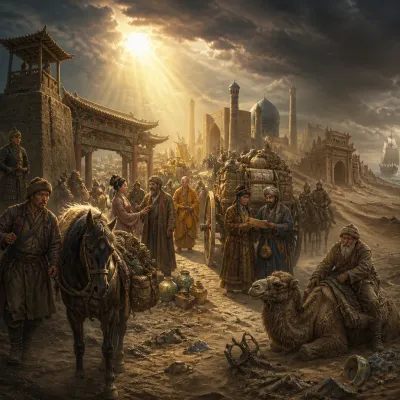
The Silk Road emerged organically from prehistoric exchange networks across Eurasia, evolving from nomadic trails and oasis settlements into a structured transcontinental system under the Han Dynasty’s westward expansion. China’s monopoly on silk and desire for "heavenly horses" catalyzed formal diplomatic and commercial ties with Central Asia, while the Xiongnu and later Sogdian merchants became indispensable intermediaries bridging East and West. This network facilitated not only the flow of luxury goods like silk, spices, and jade but also the profound transmission of Buddhism, technologies such as paper and gunpowder, artistic styles, and agricultural crops, creating a vibrant cosmopolitan culture in oasis cities like Dunhuang, Samarkand, and Kashgar.
The route flourished under the Tang Dynasty and later the *Pax Mongolica*, when Mongol unification of the steppe provided unprecedented security and infrastructure, enabling figures like Marco Polo to traverse the continent and accelerating the diffusion of innovations that would later fuel the European Renaissance. However, the network’s connectivity also facilitated the catastrophic spread of the Black Death in the 14th century, which decimated populations and destabilized the Mongol Empire. Concurrently, the fragmentation of political authority and the rise of the Ottoman Empire in the west increased the costs and dangers of overland travel, prompting a decisive shift toward maritime routes pioneered by Portuguese and Spanish explorers seeking direct access to Asian markets.
By the early modern period, the overland Silk Road had largely ceded its primacy to oceanic highways, though regional caravan trade persisted in Persia under the Safavids and India under the Mughals. The legacy of the Silk Road endures far beyond its commercial decline; it fundamentally reshaped the modern world through the global dissemination of paper, printing, gunpowder, the compass, and countless crops and culinary traditions. Its history established the template for globalization, demonstrating the dual-edged nature of interconnectedness—driving cultural synthesis and technological progress while also transmitting disease and geopolitical conflict—echoes of which continue to inform contemporary initiatives like China’s Belt and Road.
What You'll Find Inside:
- The evolution of the Silk Road from sporadic prehistoric exchanges to a sophisticated transcontinental network shaped by empires like the Han, Tang, and Mongols.
- The pivotal role of nomadic peoples and merchant communities—especially the Sogdians—in bridging East and West as cultural brokers, linguists, and trade masters.
- How the Silk Road served as a superhighway for revolutionary technologies (paper, printing, gunpowder) and religions (Buddhism, Islam, Christianity) that transformed civilizations.
- The devastating impact of the Black Death, which traveled along these very routes, accelerating the fragmentation of the Mongol Empire and the decline of overland trade.
- The dramatic shift from camel caravans to maritime dominance during the Age of Exploration, and the Silk Road's enduring legacy in modern initiatives like China's Belt and Road.
Who's It For:
This book is ideal for history enthusiasts and general readers fascinated by the origins of globalization, offering an accessible narrative of how trade connected continents. Students of world history, Eurasian studies, and economic history will appreciate its comprehensive scope from ancient exchange to modern geopolitical echoes. Anyone curious about the cross-cultural forces that shaped art, religion, technology, and cuisine across Asia, the Middle East, and Europe will find this journey through the Silk Road's rise and fall both enlightening and engaging.
Table of Contents:
- Introduction: Threads of Destiny: The Silk Road's Enduring Legacy
- Chapter 1: The Dawn of Desert Paths: Origins of Ancient Exchange
- Chapter 2: Weaving the Web: Early Trade Networks and Nomadic Peoples
- Chapter 3: The First Silken Threads: China's Quest for the West
- Chapter 4: Beyond the Wall: The Xiongnu and the Northern Routes
- Chapter 5: Empires Embrace the Road: Han Dynasty Expansion
- Chapter 6: Parthian Intermediaries: Bridging East and West
- Chapter 7: Rome's Lure: The Thirst for Silk and Spice
- Chapter 8: The Oasis Cities: Hubs of Trade and Culture
- Chapter 9: The Sogdian Merchants: Masters of the Trade Routes
- Chapter 10: Faiths on the Frontier: Buddhism's Journey Westward
- Chapter 11: The Golden Age of Caravans: Tang Dynasty Flourishing
- Chapter 12: The Arab Conquests: Reshaping the Southern Silk Road
- Chapter 13: Paper, Print, and Powder: Innovations East and West
- Chapter 14: The Mongol Yoke: Unifying the Eurasian Steppe
- Chapter 15: Pax Mongolica: A Brief Resurgence of Trade
- Chapter 16: Black Death on the Road: The Plague's Devastating Impact
- Chapter 17: The Decline of Overland Routes: Rise of Maritime Trade
- Chapter 18: The Age of Exploration: New Routes, New Worlds
- Chapter 19: The Ottoman Shadow: Shifting Power in the West
- Chapter 20: The Safavid Empire: Persia's Role in a Changing World
- Chapter 21: The Mughal Legacy: India's Enduring Connections
- Chapter 22: Echoes in the Desert: The Enduring Spirit of the Caravans
- Chapter 23: Rediscovering the Road: Modern Perspectives on Ancient Paths
- Chapter 24: The Silk Road's Cultural Echoes: Art, Cuisine, and Language
- Chapter 25: A Global Tapestry: The Silk Road's Lasting Impact on the World
Author:
Published By:
Date Published:
August 17, 2026
Type:
Nonfiction
Language:
English
Word Count:
46,884 words
Reading Time:
3 hours 17 minutes
Sample:
MixCache.com Total Access
Get unlimited access to this book + all books published by MixCache.com for $11.99/month
Subscribe to MTAOr purchase this book individually below
Order:
Buy the The Rise and Fall of the Silk Road Caravans ebook on MixCache.com:
Buy Now
Full ebook will be available immediately
- read online or download as a PDF file.
$5 account credit for all new MixCache.com accounts, usable toward any ebook purchase!*


Ratings & Reviews
Ask Questions About This Book
Have a question about the content? Ask our AI assistant!
Start by asking a question about "The Rise and Fall of the Silk Road Caravans"
Example: "Does this book mention William Shakespeare?"
Thinking...