
Browse by Category
Fiction
- Action & Adventure
- African American
- Anthologies
- Children's Fiction
- Classics
- Comics & Graphic Novels
- Coming of Age
- Contemporary
- Cultural & Regional
- Drama
- Erotica
- Fantasy
- General
- Historical Fiction
- Horror
- Humor & Satire
- Literary Fiction
- Mystery, Thriller & Suspense
- Poetry
- Religious & Inspirational
- Romance
- Science Fiction
- Short Stories
- War & Military
- Westerns
- Women's Fiction
- Young Adult
Non-Fiction
- Antiques & Collectibles
- Arts & Photography
- Biographies & Memoirs
- Business & Money
- Children's Non-Fiction
-
Computers & Technology
- Artificial Intelligence
- Computer Science
- Cybersecurity & Cryptography
- Data Science & Analytics
- Databases & Big Data
- Game Development & Design
- General
- Hardware & DIY
- Mobile App Development
- Networking & Cloud Computing
- Operating Systems
- Programming
- Robotics
- Software
- Software Engineering
- User Experience (UX) & Design
- Web Development & Design
- Cooking, Food & Wine
- Crafts, Hobbies & Home
- Education & Teaching
- Engineering
- General
- Health, Fitness & Dieting
-
History
- African History
- African History - North Africa
- African History - Sub-Saharan Africa
- American History
- American History - 20th Century
- American History - Civil War
- American History - Colonial Period
- Ancient History
- Asian History
- Asian History - China
- Asian History - India
- Asian History - Japan
- Asian History - Southeast Asia
- European History
- European History - Ancient Greece
- European History - Ancient Rome
- European History - Medieval
- European History - Modern
- European History - Renaissance
- General
- Middle Eastern History
- Military History
- Military History - Aviation
- Military History - Naval
- Social & Cultural History
- World History
- Humor & Entertainment
- Industrial Technology
- Language Learning
- Law
- LGBTQ+ Non-Fiction
- Literary Criticism
- Medical Books
- Parenting & Relationships
- Philosophy
- Politics & Social Sciences
- Reference
- Religion & Spirituality
-
Science & Math
- Agricultural Sciences
- Astronomy & Space Science
- Behavioral Sciences
- Biological Sciences
- Botany & Plant Science
- Chemistry
- Earth Sciences
- Engineering - Chemical
- Engineering - Civil
- Engineering - Electrical
- Engineering - Mechanical
- Environment
- General
- Geology
- Mathematics
- Nature & Ecology
- Oceanography
- Paleontology
- Physics
- Statistics
- Self-Help
- Sports & Outdoors
- Study Aids
- Sustainability & Green Living
- Textbooks
- Transportation
- Travel
- True Crime
- Urban Planning & Development
- Veterinary Medicine
- Writing & Publishing
Jump to Section
MixCache.com Total Access
Unlimited reading and audiobooks for every book published by MixCache.com.
Included titles carry the MTA badge.
Learn more →
The Forgotten Engineers of the Roman Aqueducts
MTA
How Ancient Water Systems Shaped an Empire
About this book:
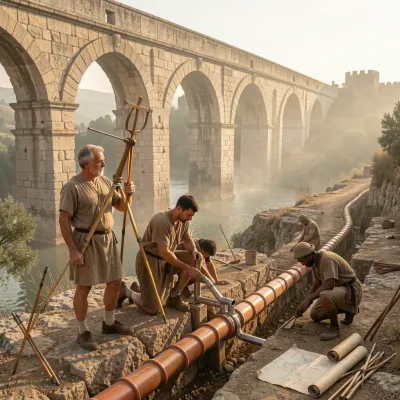
The Forgotten Engineers of the Roman Aqueducts traces how Roman mastery of water management transformed the empire from a modest settlement into a hydraulic civilization whose aqueducts supplied cities, farms, forts, and industries across three continents. Beginning with early water‑management traditions of the Minoans, Mesopotamians, Egyptians, Persians, and Greeks, the book shows how Roman engineers inherited and refined these ideas, launching their first projects—the Aqua Appia (312 BCE) and the Anio Vetus (272 BCE)—to bring reliable, gravity‑fed water to a growing Rome. Surveyors known as agrimensores used tools like the groma and chorobates to lay out routes with astonishingly gentle gradients; master builders then turned stone, Roman concrete (opus caementicium) made with pozzolana, waterproof opus signinum linings, lead pipes, and terracotta conduits into enduring channels, arches, tunnels, and siphons that stretched for dozens, sometimes over a hundred, kilometers.
The book emphasizes the human dimension of these works: a workforce of slaves, legionary soldiers, and skilled free laborers quarried, hauled, cut, and assembled the materials under the direction of engineers whose names rarely survived. Once built, the aqueducts required ceaseless vigilance—the familia aquaria cleared sinter deposits, repaired leaks, maintained lead pipes, and managed distribution through castellum tanks that hierarchy‑allocated water to public fountains, baths, and private connections. This system delivered abundant clean water that fueled Rome’s legendary public baths, fountains, and domestic luxuries, while also irrigating hinterlands, powering mills and fulleries, flushing the Cloaca Maxima, and supporting military garrisons and frontier settlements, thereby strengthening public health, economic productivity, and imperial control.
Beyond Italy, provincial aqueducts such as the Pont du Gard in Gaul, the Aqueduct of Segovia in Hispania, and the Zaghouan aqueduct supplying Carthage adapted Roman principles to local topography and climate, spreading Romanization and economic vitality. The book details how the aqueducts’ decline mirrored the Western Empire’s collapse—loss of funding, maintenance crews, administrative authority, and eventual repurposing of materials—while Eastern Roman (Byzantine) systems endured. Finally, it highlights the lasting legacy of Roman hydraulic engineering: the rediscovery of arches, concrete, gravity flow, and public water administration that inspired medieval, Renaissance, and modern engineers, proving that the forgotten engineers’ anonymous ingenuity laid the foundations for urban water systems that still shape civilization today.
What You'll Find Inside:
- Roman aqueducts were gravity‑fed engineering feats that transported water across vast distances using precise surveying and gentle gradients.
- The builders employed innovative materials such as Roman concrete (pozzolana‑lime mix), opus signinum waterproof lining, and lead pipes to ensure durability and pressure management.
- A diverse workforce of slaves, legionary soldiers, and skilled free laborers executed the massive construction and ongoing maintenance of the aqueduct network.
- Beyond urban supply, aqueducts enabled agricultural irrigation, military logistics, public baths and fountains, and significantly improved public health and hygiene in Roman cities.
- The legacy of these forgotten engineers influenced later civilizations, from Byzantine and Islamic hydraulic practices to Renaissance and modern civil engineering.
Who's It For:
This book is ideal for history enthusiasts, civil engineering students, and anyone fascinated by ancient infrastructure who wants to understand how Roman water systems powered an empire and influenced modern engineering. It will also appeal to readers interested in the intersection of technology, public health, and societal development in the classical world.
Table of Contents:
- Introduction: The Invisible Architects of Rome's Grandeur
- Chapter 1: Water in the Ancient World: Beyond Survival
- Chapter 2: The Cradle of Innovation: Early Hydraulic Ingenuity Before Rome
- Chapter 3: The Birth of a Vision: Rome's First Forays into Water Management
- Chapter 4: The Surveyors and Their Tools: Mapping the Untamed Landscape
- Chapter 5: The Master Builders: From Quarry to Keystone
- Chapter 6: Gravity's Architects: Understanding the Principles of Flow
- Chapter 7: Bridging the Gaps: The Art and Science of Aqueduct Arches
- Chapter 8: Tunnels Through Time: Subterranean Engineering Marvels
- Chapter 9: The Mortar, Lead, and Clay: Materials of Endurance
- Chapter 10: Purity and Pressure: Managing Water Quality and Distribution
- Chapter 11: The Workforce: Slaves, Soldiers, and Skilled Laborers
- Chapter 12: Maintaining the Lifeline: Repairs, Renovations, and Vigilance
- Chapter 13: The Urban Impact: Water for Baths, Fountains, and Homes
- Chapter 14: Agricultural Transformation: Irrigating an Empire
- Chapter 15: Military Might: Aqueducts as Strategic Assets
- Chapter 16: The Economics of Water: Funding, Labor, and Resources
- Chapter 17: Public Health and Hygiene: A Revolution in Roman Life
- Chapter 18: Beyond Rome: Aqueduct Networks Across the Provinces
- Chapter 19: The Engineering Legacies: Influence on Subsequent Civilizations
- Chapter 20: Whispers in the Archives: Piecing Together Their Stories
- Chapter 21: The Unsung Heroes: Identifying Key Innovators
- Chapter 22: Failure and Resilience: Learning from Collapses and Repairs
- Chapter 23: The Spiritual Dimension: Water, Gods, and Rituals
- Chapter 24: The Decline and Fall: What Happened to Rome's Water Systems?
- Chapter 25: Echoes in Stone: The Enduring Legacy of the Forgotten Engineers
Author:
Published By:
Date Published:
August 15, 2026
Type:
Nonfiction
Language:
English
Word Count:
36,804 words
Reading Time:
2 hours 35 minutes
Sample:
MixCache.com Total Access
Get unlimited access to this book + all books published by MixCache.com for $11.99/month
Subscribe to MTAOr purchase this book individually below
Order:
Buy the The Forgotten Engineers of the Roman Aqueducts ebook on MixCache.com:
Buy Now
Full ebook will be available immediately
- read online or download as a PDF file.
$5 account credit for all new MixCache.com accounts, usable toward any ebook purchase!*





Ratings & Reviews
Ask Questions About This Book
Have a question about the content? Ask our AI assistant!
Start by asking a question about "The Forgotten Engineers of the Roman Aqueducts"
Example: "Does this book mention William Shakespeare?"
Thinking...