Browse by Category
Fiction
- Action & Adventure
- African American
- Anthologies
- Children's Fiction
- Classics
- Comics & Graphic Novels
- Coming of Age
- Contemporary
- Cultural & Regional
- Drama
- Erotica
- Fantasy
- General
- Historical Fiction
- Horror
- Humor & Satire
- Literary Fiction
- Mystery, Thriller & Suspense
- Poetry
- Religious & Inspirational
- Romance
- Science Fiction
- Short Stories
- War & Military
- Westerns
- Women's Fiction
- Young Adult
Non-Fiction
- Antiques & Collectibles
- Arts & Photography
- Biographies & Memoirs
- Business & Money
- Children's Non-Fiction
-
Computers & Technology
- Artificial Intelligence
- Computer Science
- Cybersecurity & Cryptography
- Data Science & Analytics
- Databases & Big Data
- Game Development & Design
- General
- Hardware & DIY
- Mobile App Development
- Networking & Cloud Computing
- Operating Systems
- Programming
- Robotics
- Software
- Software Engineering
- User Experience (UX) & Design
- Web Development & Design
- Cooking, Food & Wine
- Crafts, Hobbies & Home
- Education & Teaching
- Engineering
- General
- Health, Fitness & Dieting
-
History
- African History
- African History - North Africa
- African History - Sub-Saharan Africa
- American History
- American History - 20th Century
- American History - Civil War
- American History - Colonial Period
- Ancient History
- Asian History
- Asian History - China
- Asian History - India
- Asian History - Japan
- Asian History - Southeast Asia
- European History
- European History - Ancient Greece
- European History - Ancient Rome
- European History - Medieval
- European History - Modern
- European History - Renaissance
- General
- Middle Eastern History
- Military History
- Military History - Aviation
- Military History - Naval
- Social & Cultural History
- World History
- Humor & Entertainment
- Industrial Technology
- Language Learning
- Law
- LGBTQ+ Non-Fiction
- Literary Criticism
- Medical Books
- Parenting & Relationships
- Philosophy
- Politics & Social Sciences
- Reference
- Religion & Spirituality
-
Science & Math
- Agricultural Sciences
- Astronomy & Space Science
- Behavioral Sciences
- Biological Sciences
- Botany & Plant Science
- Chemistry
- Earth Sciences
- Engineering - Chemical
- Engineering - Civil
- Engineering - Electrical
- Engineering - Mechanical
- Environment
- General
- Geology
- Mathematics
- Nature & Ecology
- Oceanography
- Paleontology
- Physics
- Statistics
- Self-Help
- Sports & Outdoors
- Study Aids
- Sustainability & Green Living
- Textbooks
- Transportation
- Travel
- True Crime
- Urban Planning & Development
- Veterinary Medicine
- Writing & Publishing
Jump to Section
MixCache.com Total Access
Unlimited reading and audiobooks for every book published by MixCache.com.
Included titles carry the MTA badge.
Learn more →
The Lost Craft of Japanese Bamboo Basketry
MTA
Techniques, History, and Modern Revival
About this book:
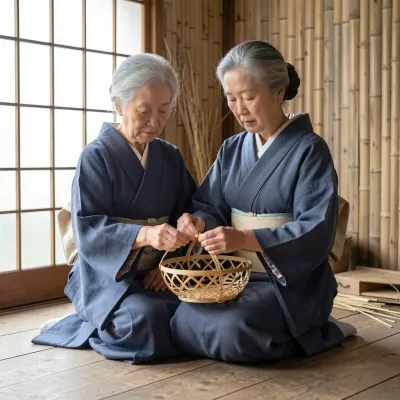
Japanese bamboo basketry, or *takekago*, is portrayed as a deeply rooted cultural practice that intertwines the material’s natural resilience with centuries‑old aesthetic philosophies such as *wabi‑sabi*. The book traces the craft from its Jomon origins through the Nara, Heian, Kamakura, Muromachi, Edo, Meiji, Taisho, and Showa periods, showing how bamboo evolved from utilitarian containers to objects of artistic merit, influenced by tea ceremony, flower arrangement, and regional artistic centers. Central to this evolution is the embrace of imperfection, transience, and humility—principles that shape everything from material selection to finished form.
Technical mastery is detailed through the sacred ritual of harvesting and curing bamboo, the precise splitting and refining of strips, and the essential toolkit of hatchets, knives, planes, and awls. Foundational weaves like *hira‑ami* (plain weave) and *asa‑no‑ha* (hemp leaf pattern) lay the groundwork for advanced patterns such as *mutsume‑ami* (hexagonal weave) and *yotsume‑ami* (four‑eye weave), which enable both structural strength and intricate aesthetic expression. Shaping techniques transform flat mats into three‑dimensional vessels through controlled bending, temporary molds, and refined rim and handle treatments, while an understanding of bamboo species—*Madake*, *Moso*, *Hachiku*, and others—guides choices based on strength, flexibility, and visual qualities.
The work further explores regional styles ranging from the robust utility of Beppu and the delicate *sensuji* work of Suruga to the refined elegance of Kyoto and the rugged traditions of Sado Island, revealing how local resources and cultural needs diversify the craft. Symbolism embedded in geometric patterns, animal and plant motifs, and forms such as flower baskets and tea‑ceremony containers conveys virtues of longevity, protection, and harmony. The legacies of master weavers—from early Edo pioneers like Hayakawa Shōkosai I to Living National Treasures such as Iizuka Shōkansai—are highlighted, alongside the mid‑20th‑century decline caused by industrialization, plastic competition, and shifting aesthetics, and the subsequent revival driven by cultural institutions, apprenticeship programs, and global appreciation. Contemporary artists push bamboo into monumental sculpture and interdisciplinary design while maintaining sustainability through ethical sourcing, natural finishes, and waste‑reducing practices. The book concludes by framing the craft’s future as a balance of tradition and innovation, where bamboo’s ecological benefits, global market interest, and enduring philosophical depth continue to inspire new generations of artisans and enthusiasts.
What You'll Find Inside:
- Comprehensive historical journey tracing Japanese bamboo basketry from ancient Jomon period utilitarian objects to its contemporary status as internationally recognized fine art
- In-depth exploration of wabi-sabi philosophy and how it fundamentally shapes the aesthetic principles, material choices, and artistic approach in traditional and contemporary bamboo basketry
- Detailed technical guidance covering bamboo species selection, traditional preparation methods, essential tools, and step-by-step instruction for weaving techniques from basic hira-ami to advanced patterns like mutsume-ami and yotsume-ami
- Regional style variations across Japan, examining how local resources, cultural needs, and artistic traditions created distinctive approaches in Beppu, Suruga, Kyoto, Sado Island, and other regions
- Analysis of the craft's decline, revival, and future prospects including contemporary innovations, sustainability practices, ethical sourcing, and global market expansion
Who's It For:
This book is ideal for aspiring and experienced bamboo weavers seeking technical mastery, collectors and enthusiasts of Japanese art and craft traditions, cultural historians interested in traditional material practices, and designers looking for sustainable inspiration. It will particularly benefit those who appreciate the intersection of technical skill, philosophical depth, and artistic expression in handcrafted works, whether they aim to practice the craft, build a collection, or simply deepen their understanding of this remarkable art form.
Table of Contents:
- Introduction
- Chapter 1: The Enduring Legacy of Bamboo in Japanese Culture
- Chapter 2: A Brief History of Japanese Basketry
- Chapter 3: The Philosophy of Wabi-Sabi and Its Influence on Craft
- Chapter 4: Selecting and Preparing Bamboo: A Sacred Ritual
- Chapter 5: Essential Tools and Their Traditional Uses
- Chapter 6: Basic Weaving Techniques: Hira-ami and Asa-no-ha
- Chapter 7: Advanced Patterns: Mutsume-ami and Yotsume-ami
- Chapter 8: Shaping and Forming: From Flat Mats to Three-Dimensional Art
- Chapter 9: Understanding Different Bamboo Species and Their Properties
- Chapter 10: Regional Variations in Basketry Styles
- Chapter 11: The Art of the Handle: Integration and Aesthetics
- Chapter 12: Natural Dyes and Finishes: Enhancing Bamboo's Beauty
- Chapter 13: Symbolism and Meaning in Traditional Designs
- Chapter 14: Master Weavers of the Past: Their Lives and Legacies
- Chapter 15: The Decline of Traditional Basketry and Its Causes
- Chapter 16: The Role of Cultural Institutions in Preservation
- Chapter 17: Contemporary Artists and Their Innovative Approaches
- Chapter 18: Bridging Tradition and Modernity: New Forms and Functions
- Chapter 19: Sustainability and Ethical Sourcing of Bamboo
- Chapter 20: The Global Appeal of Japanese Bamboo Art
- Chapter 21: From Craft to Fine Art: Exhibitions and Recognition
- Chapter 22: Learning the Craft: Workshops and Apprenticeships
- Chapter 23: Collecting Japanese Bamboo Baskets: A Guide for Enthusiasts
- Chapter 24: The Future of Japanese Bamboo Basketry
- Chapter 25: A Personal Journey: Reflections on the Craft
Author:
Published By:
Date Published:
August 15, 2026
Type:
Nonfiction
Language:
English
Word Count:
41,357 words
Reading Time:
2 hours 54 minutes
Sample:
Order:
Order The Lost Craft of Japanese Bamboo Basketry (Paperback) on MixCache.com:
Buy NowPrint copy is made to order and ships worldwide. Includes the ebook free, ready to read instantly.
$5 account credit for all new MixCache.com accounts, usable toward any ebook purchase!*