
Browse by Category
Fiction
- Action & Adventure
- African American
- Anthologies
- Children's Fiction
- Classics
- Comics & Graphic Novels
- Coming of Age
- Contemporary
- Cultural & Regional
- Drama
- Erotica
- Fantasy
- General
- Historical Fiction
- Horror
- Humor & Satire
- Literary Fiction
- Mystery, Thriller & Suspense
- Poetry
- Religious & Inspirational
- Romance
- Science Fiction
- Short Stories
- War & Military
- Westerns
- Women's Fiction
- Young Adult
Non-Fiction
- Antiques & Collectibles
- Arts & Photography
- Biographies & Memoirs
- Business & Money
- Children's Non-Fiction
-
Computers & Technology
- Artificial Intelligence
- Computer Science
- Cybersecurity & Cryptography
- Data Science & Analytics
- Databases & Big Data
- Game Development & Design
- General
- Hardware & DIY
- Mobile App Development
- Networking & Cloud Computing
- Operating Systems
- Programming
- Robotics
- Software
- Software Engineering
- User Experience (UX) & Design
- Web Development & Design
- Cooking, Food & Wine
- Crafts, Hobbies & Home
- Education & Teaching
- Engineering
- General
- Health, Fitness & Dieting
-
History
- African History
- African History - North Africa
- African History - Sub-Saharan Africa
- American History
- American History - 20th Century
- American History - Civil War
- American History - Colonial Period
- Ancient History
- Asian History
- Asian History - China
- Asian History - India
- Asian History - Japan
- Asian History - Southeast Asia
- European History
- European History - Ancient Greece
- European History - Ancient Rome
- European History - Medieval
- European History - Modern
- European History - Renaissance
- General
- Middle Eastern History
- Military History
- Military History - Aviation
- Military History - Naval
- Social & Cultural History
- World History
- Humor & Entertainment
- Industrial Technology
- Language Learning
- Law
- LGBTQ+ Non-Fiction
- Literary Criticism
- Medical Books
- Parenting & Relationships
- Philosophy
- Politics & Social Sciences
- Reference
- Religion & Spirituality
-
Science & Math
- Agricultural Sciences
- Astronomy & Space Science
- Behavioral Sciences
- Biological Sciences
- Botany & Plant Science
- Chemistry
- Earth Sciences
- Engineering - Chemical
- Engineering - Civil
- Engineering - Electrical
- Engineering - Mechanical
- Environment
- General
- Geology
- Mathematics
- Nature & Ecology
- Oceanography
- Paleontology
- Physics
- Statistics
- Self-Help
- Sports & Outdoors
- Study Aids
- Sustainability & Green Living
- Textbooks
- Transportation
- Travel
- True Crime
- Urban Planning & Development
- Veterinary Medicine
- Writing & Publishing
Jump to Section
MixCache.com Total Access
Unlimited reading and audiobooks for every book published by MixCache.com.
Included titles carry the MTA badge.
Learn more →
The Rise of Floating Farms
MTA
How Aquaponics is Reshaping City Food Systems
About this book:
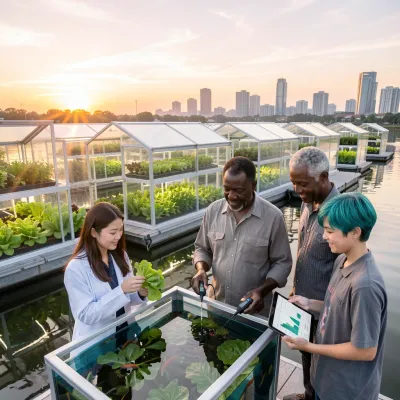
The Rise of Floating Farms explores aquaponics—integrating fish farming and soilless plant cultivation—as a transformative solution to 21st-century urban food challenges. It argues that traditional agriculture, strained by land scarcity, water-intensive practices, pollution, and long supply chains, is inadequate for feeding growing urban populations. Floating farms, by utilizing underutilized waterways for aquaponic systems, offer a paradigm shift: producing fresh food directly within cities while radically conserving resources. The book details how aquaponics creates a closed-loop ecosystem where fish waste nourishes plants, and plants purify water for fish, enabling up to 90% less water use than conventional farming and eliminating synthetic fertilizers.
Technically, the text covers system designs ranging from simple raft-based ponds to advanced pontoon-mounted greenhouses, emphasizing principles like stability, water circulation, nutrient balancing, and renewable energy integration. It explains crop selection (prioritizing leafy greens, herbs, and fruiting vegetables) and fish species (tilapia, trout, catfish) suited to symbiotic systems, alongside pest management through biological controls and energy efficiency via solar/wind power and passive cooling. Economic analysis reveals dual revenue streams from plants and fish, significant savings on water and fertilizer, reduced food miles, and viability through community engagement, educational programs, and integration with urban infrastructure like energy grids and waste streams.
Socially, floating farms enhance food security in underserved areas, create green jobs, serve as educational hubs, and foster community resilience, particularly in disaster scenarios where their water-based operation provides flood-resistant food production. The book highlights global case studies—from Rotterdam’s multi-functional dairy and produce farm to Singapore’s high-tech initiatives—and outlines how supportive policies, technological advancements (AI, IoT for monitoring), and investment pathways are scaling the sector. Ultimately, it envisions floating farms as integral nodes in a diverse, localized urban food ecosystem—complementing vertical farms and community gardens—to build resilient, sustainable cities where waterways become productive landscapes, reconnecting residents with food sources while advancing ecological and economic equity.
What You'll Find Inside:
- Aquaponics fundamentals: How fish waste nourishes plants in a closed-loop, symbiotic system that eliminates need for synthetic fertilizers
- Environmental advantages: Floating farms conserve up to 90% more water than traditional agriculture while utilizing underutilized urban waterways
- System designs: From DIY rafts to commercial pontoon platforms, covering stability, water flow, and climate control principles
- Economic analysis: Dual revenue streams from plants and fish, reduced operational costs, and investment opportunities in urban aquaponics
- Community impact: Enhancing food security, creating green jobs, providing educational platforms, and strengthening urban resilience
Who's It For:
This book is essential reading for urban planners developing food security strategies, entrepreneurs exploring agricultural innovations, environmental advocates focused on sustainable solutions, and citizens interested in local food production. It provides valuable insights for anyone seeking to understand how floating farms can transform urban food systems through sustainable aquaponics.
Table of Contents:
- Introduction: Cultivating the Urban Blue Revolution
- Chapter 1: The Global Food Challenge in the 21st Century
- Chapter 2: A Brief History of Hydroponics and Aquaculture
- Chapter 3: Understanding Aquaponics: The Symbiotic System
- Chapter 4: The Environmental Imperative: Why Floating Farms?
- Chapter 5: Design Principles for Floating Aquaponic Systems
- Chapter 6: From Ponds to Pontoons: A Spectrum of Floating Farm Models
- Chapter 7: Water Management and Nutrient Cycling in Aquaponics
- Chapter 8: Choosing the Right Crops for Floating Farms
- Chapter 9: Selecting Fish Species for Aquaponic Integration
- Chapter 10: Pest and Disease Management in Controlled Environments
- Chapter 11: Energy Efficiency and Renewable Solutions for Floating Farms
- Chapter 12: The Economic Viability of Urban Aquaponics
- Chapter 13: Case Studies: Pioneering Floating Farms Around the World
- Chapter 14: Community Engagement and Social Impact of Urban Farms
- Chapter 15: Policy and Regulation: Paving the Way for Floating Agriculture
- Chapter 16: Technological Advancements: AI, IoT, and Automation
- Chapter 17: Education and Training for the Next Generation of Aquaponic Farmers
- Chapter 18: Overcoming Challenges: Scaling and Sustainability
- Chapter 19: The Role of Floating Farms in Disaster Relief and Food Security
- Chapter 20: Integrating Floating Farms with Existing Urban Infrastructure
- Chapter 21: The Future of Urban Food Systems: A Holistic View
- Chapter 22: Investment Opportunities in the Aquaponics Sector
- Chapter 23: From Lab to Table: Ensuring Food Safety and Quality
- Chapter 24: Empowering Local Economies Through Aquaponics
- Chapter 25: A Vision for a Resilient and Food-Secure Urban Future
Author:
Published By:
Date Published:
August 14, 2026
Type:
Nonfiction
Language:
English
Word Count:
42,567 words
Reading Time:
2 hours 59 minutes
Sample:
Order:
Order The Rise of Floating Farms (Hardcover) on MixCache.com:
Buy NowPrint copy is made to order and ships worldwide. Includes the ebook free, ready to read instantly.
$5 account credit for all new MixCache.com accounts, usable toward any ebook purchase!*


