Browse by Category
Fiction
- Action & Adventure
- African American
- Anthologies
- Children's Fiction
- Classics
- Comics & Graphic Novels
- Coming of Age
- Contemporary
- Cultural & Regional
- Drama
- Erotica
- Fantasy
- General
- Historical Fiction
- Horror
- Humor & Satire
- Literary Fiction
- Mystery, Thriller & Suspense
- Poetry
- Religious & Inspirational
- Romance
- Science Fiction
- Short Stories
- War & Military
- Westerns
- Women's Fiction
- Young Adult
Non-Fiction
- Antiques & Collectibles
- Arts & Photography
- Biographies & Memoirs
- Business & Money
- Children's Non-Fiction
-
Computers & Technology
- Artificial Intelligence
- Computer Science
- Cybersecurity & Cryptography
- Data Science & Analytics
- Databases & Big Data
- Game Development & Design
- General
- Hardware & DIY
- Mobile App Development
- Networking & Cloud Computing
- Operating Systems
- Programming
- Robotics
- Software
- Software Engineering
- User Experience (UX) & Design
- Web Development & Design
- Cooking, Food & Wine
- Crafts, Hobbies & Home
- Education & Teaching
- Engineering
- General
- Health, Fitness & Dieting
-
History
- African History
- African History - North Africa
- African History - Sub-Saharan Africa
- American History
- American History - 20th Century
- American History - Civil War
- American History - Colonial Period
- Ancient History
- Asian History
- Asian History - China
- Asian History - India
- Asian History - Japan
- Asian History - Southeast Asia
- European History
- European History - Ancient Greece
- European History - Ancient Rome
- European History - Medieval
- European History - Modern
- European History - Renaissance
- General
- Middle Eastern History
- Military History
- Military History - Aviation
- Military History - Naval
- Social & Cultural History
- World History
- Humor & Entertainment
- Industrial Technology
- Language Learning
- Law
- LGBTQ+ Non-Fiction
- Literary Criticism
- Medical Books
- Parenting & Relationships
- Philosophy
- Politics & Social Sciences
- Reference
- Religion & Spirituality
-
Science & Math
- Agricultural Sciences
- Astronomy & Space Science
- Behavioral Sciences
- Biological Sciences
- Botany & Plant Science
- Chemistry
- Earth Sciences
- Engineering - Chemical
- Engineering - Civil
- Engineering - Electrical
- Engineering - Mechanical
- Environment
- General
- Geology
- Mathematics
- Nature & Ecology
- Oceanography
- Paleontology
- Physics
- Statistics
- Self-Help
- Sports & Outdoors
- Study Aids
- Sustainability & Green Living
- Textbooks
- Transportation
- Travel
- True Crime
- Urban Planning & Development
- Veterinary Medicine
- Writing & Publishing
Jump to Section
MixCache.com Total Access
Unlimited reading and audiobooks for every book published by MixCache.com.
Included titles carry the MTA badge.
Learn more →
The Forgotten Engineers of Roman Aqueducts
MTA
How Ancient Water Systems Shaped Civilization
About this book:
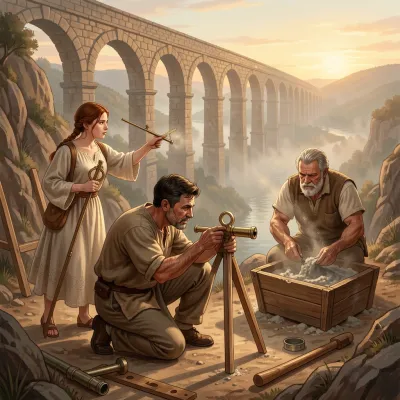
The book traces how Rome’s rapid urban growth outstripped local water sources, prompting the creation of an empire‑spanning aqueduct network that began with the underground Aqua Appia in 312 BCE and expanded over five centuries. While emperors and officials commissioned the works, the actual design and construction rested on a corps of forgotten engineers—surveyors (*libratores*), architects (*architecti*), and specialized craftsmen—who used tools like the *groma*, *chorobates*, and *dioptra* to lay precise gradients, developed Roman concrete with pozzolana, lined channels with waterproof *opus signinum*, and employed lead pipes for urban distribution. Their innovations included gravity‑fed tunnels, multi‑tiered arcades, inverted siphons, and sophisticated settling tanks, all built by a mixed workforce of soldiers, slaves, and free laborers organized under state and imperial financing.
Beyond moving water, the aqueducts reshaped Roman life: they fed public baths, fountains, and latrines, improving hygiene and public health despite later lead‑pipe concerns; they powered industrial mills at Barbegal and hydraulic mines in Spain; and their arched bridges and conduits became monumental symbols of imperial power, civic order, and technological mastery. Constant maintenance by the *familia aquaria*—cleaning mineral deposits, repairing linings, and inspecting channels—kept many systems functioning for centuries, while the hierarchical *castella* distributed water to fountains, baths, and private users, ensuring broad public access even during shortages.
The network’s decline mirrored Rome’s own, as barbarian invasions, economic collapse, and administrative decay led to abandonment, looting for building materials, and loss of engineering knowledge during the Dark Ages. Surviving texts by Vitruvius and Frontinus, along with standing ruins, sparked a Renaissance revival that informed later hydraulic practice. The book concludes that Roman aqueducts established enduring principles—gravity‑fed flow, durable materials, integrated water management, and public utility—that echo in modern pipelines and treatment plants, offering lessons in sustainable, long‑term infrastructure while reminding us of the human cost and ethical dimensions inherent in such monumental achievements.
What You'll Find Inside:
- The forgotten engineers behind Roman aqueducts: surveyors, architects, hydrologists, and skilled laborers who designed and built these systems
- Sophisticated surveying techniques and tools used to maintain precise gradients over dozens of kilometers across challenging terrain
- Innovative materials and construction methods including Roman concrete (opus caementicium), lead piping, and mastery of the arch
- The aqueducts' multifaceted impact on public health, hygiene, industrial applications, and as symbols of Roman imperial power
- The enduring legacy from ancient aqueducts to modern water systems and lessons for sustainable engineering today
Who's It For:
This book is ideal for history enthusiasts, engineering students, and anyone fascinated by ancient infrastructure and technological innovation. Readers interested in Roman history, civil engineering, or the evolution of urban water systems will find particular value in its detailed exploration of both the technical achievements and human stories behind these monumental works.
Table of Contents:
- Introduction
- Chapter 1: The Invisible Architects: Unearthing Their Legacy
- Chapter 2: Water Scarcity and the Birth of an Idea
- Chapter 3: Early Roman Engineering: Foundations of Innovation
- Chapter 4: The Surveyors: Mastering the Landscape
- Chapter 5: Tools and Techniques of the Ancient Engineer
- Chapter 6: Materials of Enduring Might: Stone, Mortar, and Lead
- Chapter 7: The Art of the Arch: Distributing Weight and Force
- Chapter 8: Siphons and Pressure Systems: Defying Gravity
- Chapter 9: Bridging the Gaps: Aqueduct Bridges and Their Construction
- Chapter 10: Tunnels Through Mountains: Subterranean Marvels
- Chapter 11: The Workforce: Slaves, Soldiers, and Skilled Laborers
- Chapter 12: Financing the Giants: State, Emperors, and Private Patrons
- Chapter 13: Maintenance and Repair: Sustaining the Flow
- Chapter 14: Water Distribution Within the City: Castella and Fountains
- Chapter 15: Public Health and Hygiene: A Revolutionary Impact
- Chapter 16: Industrial Applications: Mills, Mines, and Workshops
- Chapter 17: The Aqueduct as a Symbol of Roman Power
- Chapter 18: Failures and Lessons Learned: Engineering Challenges
- Chapter 19: The Decline and Fall: When the Water Stopped Flowing
- Chapter 20: Echoes in the Dark Ages: Preservation and Loss of Knowledge
- Chapter 21: Renaissance Revival: Rediscovering Ancient Wisdom
- Chapter 22: From Roman Arches to Modern Pipelines: A Continuous Thread
- Chapter 23: The Unsung Heroes: Reclaiming Their Names
- Chapter 24: Modern Lessons from Ancient Giants: Sustainable Engineering
- Chapter 25: The Enduring Legacy: How Aqueducts Shaped Our World
Author:
Published By:
Date Published:
August 13, 2026
Type:
Nonfiction
Language:
English
Word Count:
33,383 words
Reading Time:
2 hours 20 minutes
Sample:
Order:
Order The Forgotten Engineers of Roman Aqueducts (Paperback) on MixCache.com:
Buy NowPrint copy is made to order and ships worldwide. Includes the ebook free, ready to read instantly.
$5 account credit for all new MixCache.com accounts, usable toward any ebook purchase!*