
Browse by Category
Fiction
- Action & Adventure
- African American
- Anthologies
- Children's Fiction
- Classics
- Comics & Graphic Novels
- Coming of Age
- Contemporary
- Cultural & Regional
- Drama
- Erotica
- Fantasy
- General
- Historical Fiction
- Horror
- Humor & Satire
- Literary Fiction
- Mystery, Thriller & Suspense
- Poetry
- Religious & Inspirational
- Romance
- Science Fiction
- Short Stories
- War & Military
- Westerns
- Women's Fiction
- Young Adult
Non-Fiction
- Antiques & Collectibles
- Arts & Photography
- Biographies & Memoirs
- Business & Money
- Children's Non-Fiction
-
Computers & Technology
- Artificial Intelligence
- Computer Science
- Cybersecurity & Cryptography
- Data Science & Analytics
- Databases & Big Data
- Game Development & Design
- General
- Hardware & DIY
- Mobile App Development
- Networking & Cloud Computing
- Operating Systems
- Programming
- Robotics
- Software
- Software Engineering
- User Experience (UX) & Design
- Web Development & Design
- Cooking, Food & Wine
- Crafts, Hobbies & Home
- Education & Teaching
- Engineering
- General
- Health, Fitness & Dieting
-
History
- African History
- African History - North Africa
- African History - Sub-Saharan Africa
- American History
- American History - 20th Century
- American History - Civil War
- American History - Colonial Period
- Ancient History
- Asian History
- Asian History - China
- Asian History - India
- Asian History - Japan
- Asian History - Southeast Asia
- European History
- European History - Ancient Greece
- European History - Ancient Rome
- European History - Medieval
- European History - Modern
- European History - Renaissance
- General
- Middle Eastern History
- Military History
- Military History - Aviation
- Military History - Naval
- Social & Cultural History
- World History
- Humor & Entertainment
- Industrial Technology
- Language Learning
- Law
- LGBTQ+ Non-Fiction
- Literary Criticism
- Medical Books
- Parenting & Relationships
- Philosophy
- Politics & Social Sciences
- Reference
- Religion & Spirituality
-
Science & Math
- Agricultural Sciences
- Astronomy & Space Science
- Behavioral Sciences
- Biological Sciences
- Botany & Plant Science
- Chemistry
- Earth Sciences
- Engineering - Chemical
- Engineering - Civil
- Engineering - Electrical
- Engineering - Mechanical
- Environment
- General
- Geology
- Mathematics
- Nature & Ecology
- Oceanography
- Paleontology
- Physics
- Statistics
- Self-Help
- Sports & Outdoors
- Study Aids
- Sustainability & Green Living
- Textbooks
- Transportation
- Travel
- True Crime
- Urban Planning & Development
- Veterinary Medicine
- Writing & Publishing
Jump to Section
MixCache.com Total Access
Unlimited reading and audiobooks for every book published by MixCache.com.
Included titles carry the MTA badge.
Learn more →
Historical Criminology: Evolution of Crime Concepts from Antiquity to Modernity
MTA
From Code of Hammurabi to Cyber Laws
About this book:
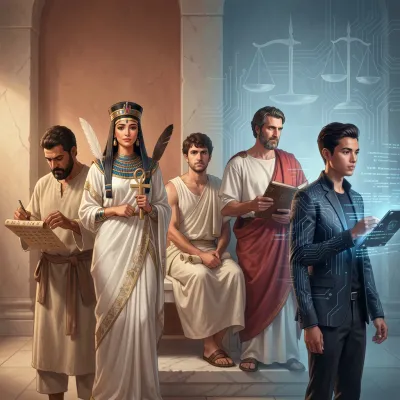
This book traces the evolution of crime concepts from ancient legal codes to contemporary digital challenges, demonstrating how definitions of criminality and justice are dynamic reflections of societal values, power structures, and historical contexts. Beginning with Mesopotamia's Code of Ur-Nammu and Hammurabi—where laws emphasized restitution and lex talionis but were stratified by social class—and ancient Egypt's justice system centered on maintaining cosmic order (Ma'at) under pharaonic authority, the narrative shows early legal systems blending divine sanction with emerging state control. Classical Greece introduced citizen participation in justice through Athens' democratic courts and distinctions between public and private wrongs, while Roman law systematized jurisprudence through concepts like mens rea, the ius civile/gentium divide, and the foundation for later civil law traditions via the Corpus Juris Civilis.
The work then explores how religion reshaped crime perceptions, from early Christianity's focus on sin and spiritual judgment—leading to ecclesiastical courts, canon law, and the criminalization of heresy—to the Middle Ages' Germanic wergild system and compurgation ordeals, followed by feudalism's manorial courts and the rise of royal justice in England that birthed common law. The Inquisition era intensified religious crime persecution through torture and execution for heresy and witchcraft, while the Enlightenment ushered in rational reforms: Beccaria and Bentham advocated for proportionality, deterrence, and human rights, challenging torture and excessive punishment, and inspiring revolutionary legal changes in America and France that emphasized due process and constitutional limits on state power, even as periods like the Reign of Terror revealed the fragility of these ideals.
Finally, the book analyzes modernity's transformations: the Industrial Revolution generated urban crime and anomie, spurring modern policing; Victorian criminology sought scientific explanations for deviance amid class biases; imperialism imposed racialized legal systems criminalizing resistance; World Wars and totalitarian regimes exposed state crime, catalyzing international justice via Nuremberg and the concept of crimes against humanity; the Cold War fueled ideological criminalization; civil rights movements challenged systemic injustices; globalization enabled transnational crime networks; and the digital revolution birthed cybercrime, with contemporary debates centering on inequality, mass incarceration, human rights, and emerging frontiers like the Metaverse. Throughout, the text argues that crime remains a fluid construct—shaped by technology, ideology, and social struggle—reflecting humanity's enduring quest to balance order, justice, and evolving conceptions of wrongdoing.
What You'll Find Inside:
- The book traces how definitions of crime and justice evolved from ancient legal codes like Hammurabi's to modern cyber laws, demonstrating crime is a fluid social construct shaped by historical context.
- It examines how religion, colonialism, industrialization, and technological revolutions fundamentally reshaped legal frameworks and punitive practices across different eras and societies.
- It explores the emergence of state crime during World Wars and totalitarian regimes, leading to the development of international criminal justice mechanisms like the Nuremberg Trials and ICC.
- It analyzes contemporary criminology debates including mass incarceration, racial disparities, sentencing reform, cybercrime challenges, and restorative justice approaches.
- It concludes with forward-looking considerations about crime in virtual environments like the Metaverse and emerging technologies such as AI, deepfakes, and biotechnology.
Who's It For:
This book is ideal for students and scholars of criminology, criminal justice, history, and law who seek a comprehensive historical perspective on how concepts of crime and punishment have evolved. It will also benefit criminal justice professionals, policymakers, and law enforcement officers wanting to understand the historical roots of contemporary legal challenges. General readers interested in the interplay between society, culture, and legal systems will find valuable insights into why certain behaviors are criminalized across different historical periods.
Table of Contents:
- Introduction: Tracing the Shifting Sands of Crime and Justice
- Chapter 1: The Dawn of Law - Crime and Punishment in Ancient Mesopotamia
- Chapter 2: Divine Justice and Mortal Wrongs - Crime in Ancient Egypt
- Chapter 3: Order and Ostracism - Crime and Law in Classical Greece
- Chapter 4: The Pax Romana and the Scales of Justice - Crime in Ancient Rome
- Chapter 5: Sin and Sanctuary - Early Christian Views on Crime and Deviance
- Chapter 6: Barbarians, Codes, and Compurgation - Germanic Law and the Early Middle Ages
- Chapter 7: Feudalism and Felony - Crime and Justice in the High Middle Ages
- Chapter 8: Heresy, Witchcraft, and Inquisition - Religious Crime and Persecution
- Chapter 9: The Birth of Common Law - Royal Justice and Local Customs
- Chapter 10: Renaissance and Reformation - Shifting Perceptions of Crime and Morality
- Chapter 11: The Age of Exploration and Colonial Crime - Justice in New Worlds
- Chapter 12: Absolute Monarchy and State Control - Crime and Punishment in the Early Modern Era
- Chapter 13: Enlightenment and Reform - Rationalizing Justice and Punishment
- Chapter 14: Revolution and Republics - Crime and Law in Times of Upheaval
- Chapter 15: The Industrial Revolution - New Crimes and Urban Anomie
- Chapter 16: Victorian Vice and the Rise of Criminology - Class, Poverty, and Deviance
- Chapter 17: Imperialism, Race, and Crime - Colonial Legacies and Legal Systems
- Chapter 18: World Wars and Totalitarianism - State Crime and International Justice
- Chapter 19: The Roaring Twenties and the Great Depression - Organized Crime and Social Dislocation
- Chapter 20: Post-War Society and the Cold War - New Fears and New Crimes
- Chapter 21: Civil Rights, Social Movements, and Legal Change - Justice in an Era of Protest
- Chapter 22: Globalization and Transnational Crime - Borderless Offenses
- Chapter 23: The Digital Revolution - The Emergence of Cybercrime
- Chapter 24: Contemporary Debates in Criminology - Justice, Inequality, and Human Rights
- Chapter 25: From Hammurabi to the Metaverse - The Enduring Evolution of Crime Concepts
Author:
Published By:
Date Published:
August 12, 2026
Type:
Nonfiction
Language:
English
Word Count:
41,940 words
Reading Time:
2 hours 56 minutes
Sample:
MixCache.com Total Access
Get unlimited access to this book + all books published by MixCache.com for $11.99/month
Subscribe to MTAOr purchase this book individually below
Order:
Buy the Historical Criminology: Evolution of Crime Concepts from Antiquity to Modernity ebook on MixCache.com:
Buy Now
Full ebook will be available immediately
- read online or download as a PDF file.
$5 account credit for all new MixCache.com accounts, usable toward any ebook purchase!*




Ratings & Reviews
Ask Questions About This Book
Have a question about the content? Ask our AI assistant!
Start by asking a question about "Historical Criminology: Evolution of Crime Concepts from Antiquity to Modernity"
Example: "Does this book mention William Shakespeare?"
Thinking...