Browse by Category
Fiction
- Action & Adventure
- African American
- Anthologies
- Children's Fiction
- Classics
- Comics & Graphic Novels
- Coming of Age
- Contemporary
- Cultural & Regional
- Drama
- Erotica
- Fantasy
- General
- Historical Fiction
- Horror
- Humor & Satire
- Literary Fiction
- Mystery, Thriller & Suspense
- Poetry
- Religious & Inspirational
- Romance
- Science Fiction
- Short Stories
- War & Military
- Westerns
- Women's Fiction
- Young Adult
Non-Fiction
- Antiques & Collectibles
- Arts & Photography
- Biographies & Memoirs
- Business & Money
- Children's Non-Fiction
-
Computers & Technology
- Artificial Intelligence
- Computer Science
- Cybersecurity & Cryptography
- Data Science & Analytics
- Databases & Big Data
- Game Development & Design
- General
- Hardware & DIY
- Mobile App Development
- Networking & Cloud Computing
- Operating Systems
- Programming
- Robotics
- Software
- Software Engineering
- User Experience (UX) & Design
- Web Development & Design
- Cooking, Food & Wine
- Crafts, Hobbies & Home
- Education & Teaching
- Engineering
- General
- Health, Fitness & Dieting
-
History
- African History
- African History - North Africa
- African History - Sub-Saharan Africa
- American History
- American History - 20th Century
- American History - Civil War
- American History - Colonial Period
- Ancient History
- Asian History
- Asian History - China
- Asian History - India
- Asian History - Japan
- Asian History - Southeast Asia
- European History
- European History - Ancient Greece
- European History - Ancient Rome
- European History - Medieval
- European History - Modern
- European History - Renaissance
- General
- Middle Eastern History
- Military History
- Military History - Aviation
- Military History - Naval
- Social & Cultural History
- World History
- Humor & Entertainment
- Industrial Technology
- Language Learning
- Law
- LGBTQ+ Non-Fiction
- Literary Criticism
- Medical Books
- Parenting & Relationships
- Philosophy
- Politics & Social Sciences
- Reference
- Religion & Spirituality
-
Science & Math
- Agricultural Sciences
- Astronomy & Space Science
- Behavioral Sciences
- Biological Sciences
- Botany & Plant Science
- Chemistry
- Earth Sciences
- Engineering - Chemical
- Engineering - Civil
- Engineering - Electrical
- Engineering - Mechanical
- Environment
- General
- Geology
- Mathematics
- Nature & Ecology
- Oceanography
- Paleontology
- Physics
- Statistics
- Self-Help
- Sports & Outdoors
- Study Aids
- Sustainability & Green Living
- Textbooks
- Transportation
- Travel
- True Crime
- Urban Planning & Development
- Veterinary Medicine
- Writing & Publishing
Jump to Section

Want unlimited access to all books published by MixCache.com (plus their audiobooks)? Try MixCache.com Total Access. Look for the MTA badge on book covers to identify included titles.
Access to infinite ebooks: Don't see the book you want? Suggest it and we'll create it (free!) for you from scratch with our powerful AI book writer. Then read it with MTA - besides profiting from any sales it makes!
Germany's Path to Unity
MTA
From Fragmented States to Federal Republic
About this book:
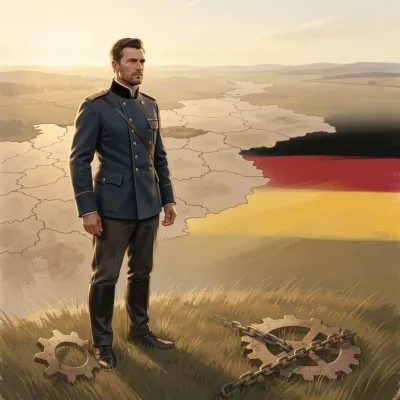
The book traces Germany's journey from a patchwork of fragmented states under the Holy Roman Empire to a unified federal republic. It begins with the Empire's decentralized structure, which fostered strong regional identities and hindered national unity for centuries. The rise of Prussia and Austria as competing powers set the stage for a struggle over Germany's future, intensified by the Napoleonic Wars that dissolved the Holy Roman Empire and sparked early nationalist sentiments. The Congress of Vienna created the loose German Confederation, but economic integration through the Zollverein customs union, driven by Prussian leadership, laid essential groundwork for unity by creating a shared market and fostering interstate cooperation, even as liberal and nationalist revolutions of 1848 ultimately failed to achieve political unification.
The narrative then turns to Otto von Bismarck, whose "blood and iron" realpolitik orchestrated unification through a series of wars: the Danish War (1864), the Austro-Prussian War (1866), and the Franco-Prussian War (1870-71). These conflicts excluded Austria, established Prussian dominance, and culminated in the proclamation of the German Empire in 1871. The imperial era saw rapid industrialization, social change, and a complex political structure balancing monarchical authority with limited popular representation, followed by the empire's collapse in World War I. The Weimar Republic's fragile democracy succumbed to economic crises and extremist movements, paving the way for Nazi rule, World War II, and Germany's subsequent division into East and West Allied occupation zones.
The final chapters detail the Cold War division, with West Germany embracing a social market economy and democratic integration with the West, while East Germany became a Soviet-style socialist state. Economic miracles in both societies highlighted stark contrasts, fueling dissent in the East that grew with Gorbachev's reforms. The fall of the Berlin Wall in 1989 triggered a peaceful revolution, leading to reunification in 1990 after complex negotiations codified in the Two Plus Four Treaty. The reunited Federal Republic faced immense challenges integrating divergent economic, social, and political systems but emerged as a sovereign, democratic nation committed to European integration, finally resolving the centuries-old German Question.
What You'll Find Inside:
- The book traces how the Holy Roman Empire's fragmented structure created centuries of political division that hindered German unity.
- It examines the Prussian-Austrian rivalry and how Otto von Bismarck used military strength and diplomacy to achieve unification through 'blood and iron' realpolitik.
- It details the economic foundations of unity through the Zollverein customs union that preceded political unification by creating interdependence among German states.
- It covers Germany's tumultuous 20th century including WWI, the Weimar Republic, Nazi era, WWII, and postwar division into East and West during the Cold War.
- It explains the peaceful revolution of 1989 and the diplomatic negotiations (Two Plus Four Treaty) that led to German reunification in 1990.
Who's It For:
This book is ideal for history students, scholars of European studies, and general readers seeking a comprehensive understanding of Germany's complex journey from medieval fragmentation to modern unity. It provides valuable insights for anyone interested in nation-building processes, the interplay of economics and politics in state formation, and the historical forces that shape national identity. Readers will particularly benefit from its detailed analysis of how economic cooperation, military conflict, and ideological struggles have defined Germany's path to becoming a federal republic.
Author:
Published By:
Date Published:
August 8, 2026
Type:
Nonfiction
Language:
English
Word Count:
45,954 words
Reading Time:
3 hours 13 minutes
Sample:
Order:
Order Germany's Path to Unity (Hardcover) on MixCache.com:
Buy NowPrint copy is made to order and ships worldwide. Includes the ebook free, ready to read instantly.
$5 account credit for all new MixCache.com accounts, usable toward any ebook purchase!*