
Browse by Category
Fiction
- Action & Adventure
- African American
- Anthologies
- Children's Fiction
- Classics
- Comics & Graphic Novels
- Coming of Age
- Contemporary
- Cultural & Regional
- Drama
- Erotica
- Fantasy
- General
- Historical Fiction
- Horror
- Humor & Satire
- Literary Fiction
- Mystery, Thriller & Suspense
- Poetry
- Religious & Inspirational
- Romance
- Science Fiction
- Short Stories
- War & Military
- Westerns
- Women's Fiction
- Young Adult
Non-Fiction
- Antiques & Collectibles
- Arts & Photography
- Biographies & Memoirs
- Business & Money
- Children's Non-Fiction
-
Computers & Technology
- Artificial Intelligence
- Computer Science
- Cybersecurity & Cryptography
- Data Science & Analytics
- Databases & Big Data
- Game Development & Design
- General
- Hardware & DIY
- Mobile App Development
- Networking & Cloud Computing
- Operating Systems
- Programming
- Robotics
- Software
- Software Engineering
- User Experience (UX) & Design
- Web Development & Design
- Cooking, Food & Wine
- Crafts, Hobbies & Home
- Education & Teaching
- Engineering
- General
- Health, Fitness & Dieting
-
History
- African History
- African History - North Africa
- African History - Sub-Saharan Africa
- American History
- American History - 20th Century
- American History - Civil War
- American History - Colonial Period
- Ancient History
- Asian History
- Asian History - China
- Asian History - India
- Asian History - Japan
- Asian History - Southeast Asia
- European History
- European History - Ancient Greece
- European History - Ancient Rome
- European History - Medieval
- European History - Modern
- European History - Renaissance
- General
- Middle Eastern History
- Military History
- Military History - Aviation
- Military History - Naval
- Social & Cultural History
- World History
- Humor & Entertainment
- Industrial Technology
- Language Learning
- Law
- LGBTQ+ Non-Fiction
- Literary Criticism
- Medical Books
- Parenting & Relationships
- Philosophy
- Politics & Social Sciences
- Reference
- Religion & Spirituality
-
Science & Math
- Agricultural Sciences
- Astronomy & Space Science
- Behavioral Sciences
- Biological Sciences
- Botany & Plant Science
- Chemistry
- Earth Sciences
- Engineering - Chemical
- Engineering - Civil
- Engineering - Electrical
- Engineering - Mechanical
- Environment
- General
- Geology
- Mathematics
- Nature & Ecology
- Oceanography
- Paleontology
- Physics
- Statistics
- Self-Help
- Sports & Outdoors
- Study Aids
- Sustainability & Green Living
- Textbooks
- Transportation
- Travel
- True Crime
- Urban Planning & Development
- Veterinary Medicine
- Writing & Publishing
Jump to Section
MixCache.com Total Access
Unlimited reading and audiobooks for every book published by MixCache.com.
Included titles carry the MTA badge.
Learn more →
Latvia's Path to Sovereignty
MTA
From German Rule to Baltic Independence
About this book:
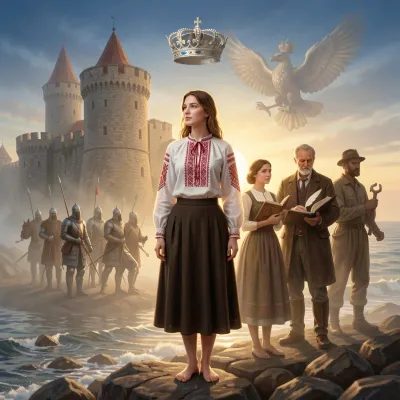
Latvia’s journey to sovereignty began with its early Baltic and Finno‑Ugric inhabitants and was profoundly shaped by successive waves of foreign domination. German crusaders established Riga and the Livonian Confederation in the early 13th century, imposing feudal serfdom that endured for centuries. Swedish rule in the 17th century brought limited reforms, while Russian control after the Great Northern War confirmed German elite privileges but later pursued Russification. Enlightenment ideas sparked the first Latvian national awakening in the 19th century, led by figures such as Krišjānis Valdemārs, Juris Alunāns, and Krišjānis Barons, who revived the language, collected folk songs, and fostered a nascent civic consciousness.
Industrialization and urbanization in the late 19th century created a Latvian working class and intensified social tensions, culminating in the 1905 Revolution, which combined demands for land reform, civil liberties, and national autonomy. World War I devastated Latvian lands but also produced the Latvian Riflemen, whose bravery fueled aspirations for statehood. Following the Russian Empire’s collapse, Latvia proclaimed independence on 18 November 1918, only to face immediate threats from Bolsheviks, German paramilitaries, and White Russians. The Latvian War of Independence (1918‑1920) ended with the defeat of Soviet and German forces and the signing of the Latvian‑Soviet Peace Treaty, securing de facto sovereignty.
The interwar republic (1920‑1940) undertook radical land redistribution, built democratic institutions, and experienced economic recovery and cultural flourishing, yet political instability led to Kārlis Ulmanis’s authoritarian turn in 1934. The Molotov‑Ribbentrop Pact of 1939 paved the way for Soviet occupation in 1940, marked by mass deportations, terror, and the dismantling of Latvian statehood. Nazi Germany’s invasion in 1941 brought the Holocaust and further devastation, after which the Soviets re‑occupied Latvia in 1944‑45, intensified Russification, collectivization, and deportations (notably Operation Priboi in 1949), while an armed resistance—the Forest Brothers—persisted underground until the mid‑1950s. Decades of Soviet rule suppressed Latvian language and culture, but a quiet resistance endured.
The liberalizing policies of Gorbachev’s glasnost and perestroika in the mid‑1980s reignited national sentiment. Environmental protests, historical reckoning, and the Latvian Popular Front galvanized mass non‑violent action—the Singing Revolution—culminating in the May 1990 Declaration on the Restoration of Independence. The failed August 1991 coup in Moscow gave Latvia the opportunity to declare full independence on 21 August 1991, which was rapidly recognized worldwide. The last Russian troops left in 1994. Since then, Latvia has joined NATO (2004) and the EU (2004), adopted the euro (2014), and revived its language, culture, and democratic institutions while navigating the legacy of a significant Russian‑speaking minority and the challenges of a globalized economy. This trajectory—from ancient tribes through centuries of foreign rule, two world wars, occupations, and a peaceful renaissance—has forged a resilient, sovereign Latvia firmly integrated into the Euro‑Atlantic community.
What You'll Find Inside:
- The book traces Latvia's centuries-long struggle against foreign domination, from German crusaders and Swedish rule to Russian, Nazi, and Soviet occupations.
- It highlights the cultural and linguistic national awakening that preserved Latvian identity despite repression and foreign control.
- It details the Latvian War of Independence (1918‑1920) and the subsequent interwar republic's nation‑building efforts.
- It examines Soviet-era terrors, mass deportations, and resistance movements such as the Forest Brothers and the Singing Revolution.
- It concludes with the restoration of independence in 1991 and Latvia's integration into the European Union and NATO.
Who's It For:
This book is ideal for students, scholars, and general readers interested in Eastern European history, Baltic studies, and nationalist movements. It will especially benefit those studying post‑Soviet state formation, the interplay of culture and politics under oppression, and Latvia's path to EU and NATO membership. Readers seeking a clear, narrative‑driven account of how a small nation reclaimed its sovereignty will find the work both informative and inspiring.
Table of Contents:
- Introduction
- Chapter 1 Ancient Lands and Early Inhabitants
- Chapter 2 The Arrival of the German Crusaders and the Livonian Confederation
- Chapter 3 Swedish Dominance and the Rise of Riga
- Chapter 4 Under the Russian Eagle: Initial Encounters
- Chapter 5 The Enlightenment and Early Stirrings of National Identity
- Chapter 6 Serfdom, Reforms, and the Growth of Latvian Peasantry
- Chapter 7 The First National Awakening: Cultural Revival and Language Preservation
- Chapter 8 Industrialization and Urbanization: Societal Shifts
- Chapter 9 The 1905 Revolution and its Impact on Latvian Aspirations
- Chapter 10 World War I: A Devastating Conflict on Latvian Soil
- Chapter 11 The Proclamation of Independence: November 18, 1918
- Chapter 12 The Latvian War of Independence: Fighting for Survival
- Chapter 13 Building a Nation: The Interwar Republic
- Chapter 14 Economic Development and Social Progress in Independent Latvia
- Chapter 15 Cultural Flourishing: Art, Literature, and Music between the Wars
- Chapter 16 The Molotov-Ribbentrop Pact and the End of Independence
- Chapter 17 Soviet Occupation and the Reign of Terror (1940-1941)
- Chapter 18 Nazi Occupation and the Holocaust in Latvia (1941-1945)
- Chapter 19 The Second Soviet Occupation: Consolidation of Power
- Chapter 20 Resistance Movements and the Forest Brothers
- Chapter 21 Russification and Sovietization: Transforming Latvian Society
- Chapter 22 The Singing Revolution: Gorbachev's Reforms and Latvian Awakening
- Chapter 23 The Path to Renewal: Popular Front and Democratic Movements
- Chapter 24 The August Coup and the Restoration of Independence (1991)
- Chapter 25 Latvia in the 21st Century: European Integration and National Identity
Author:
Published By:
Date Published:
August 7, 2026
Type:
Nonfiction
Language:
English
Word Count:
40,682 words
Reading Time:
2 hours 51 minutes
Sample:
Order:
Buy the Latvia's Path to Sovereignty ebook on MixCache.com:
Buy Now
Full ebook will be available immediately
- read online or download as a PDF file.
$5 account credit for all new MixCache.com accounts, usable toward any ebook purchase!*
MixCache.com Total Access
Get unlimited access to this book + all books published by MixCache.com for $11.99/month
Subscribe to MTA





Ratings & Reviews
Ask Questions About This Book
Have a question about the content? Ask our AI assistant!
Start by asking a question about "Latvia's Path to Sovereignty"
Example: "Does this book mention William Shakespeare?"
Thinking...